

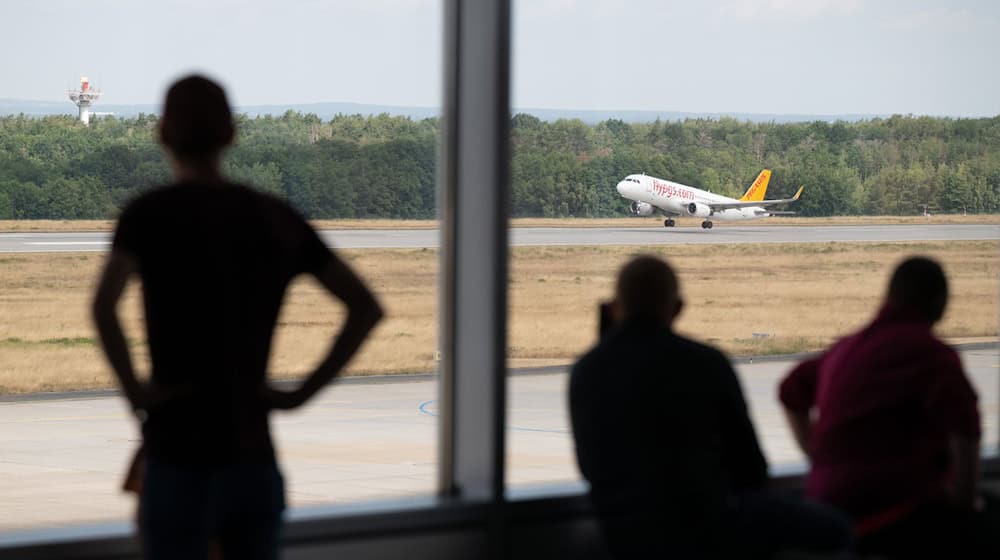
The course has been set: Saxony and Saxony-Anhalt want to phase out the subsidies for Leipzig/Halle and Dresden airports by 2030. However, the passenger business remains the major construction site. In Bavaria, the three international airports clearly exceeded the 50 million passenger mark again last year for the first time since coronavirus. Nuremberg reported an increase of 12 percent, Memmingen even 14.1 percent. The eastern German airports, on the other hand, are still below the pre-coronavirus level. Florian Linke, Acting Director of the Institute of Air Transport at the German Aerospace Center (DLR), explains why this is the case - and what other airports are doing differently. Last Tuesday, Saxony and Saxony-Anhalt announced their intention to gradually reduce their financial support for Mitteldeutsche Flughafen AG (MFAG). From 2030, no more compensation payments are to be made. At the same time, Dresden is taking a special path in future: Saxony-Anhalt no longer wants to participate in subsidies for the site from 2027. Saxony is therefore planning structural compensation and wants to support the airport with an additional nine million euros per year from 2027 until 2030. This puts double the pressure on the airports: they have to manage without permanent state aid - and at the same time attract more passengers again. According to aviation researchers, there are mainly structural reasons why this is much more difficult to achieve in the East than elsewhere. In the opinion of the DLR, the decisive factor is that air traffic has recovered very differently after the pandemic, depending on the business model: Large hubs and specialized low-cost locations in particular are benefiting - this is precisely where the differences to Dresden and Leipzig/Halle lie. The DLR assigns Leipzig/Halle and Dresden to a segment that has come under particular pressure after corona. "The recovery is weaker there because hub traffic in Germany - such as in Munich - and specialized low-cost locations - such as Memmingen - have recovered faster than classic decentralized scheduled traffic with a previously higher proportion of business travel," says Linke. Leipzig/Halle and Dresden served many domestic German routes before coronavirus - a segment that is only recovering slowly after the pandemic. It is precisely this segment that is under much greater pressure after coronavirus. Instead, airlines are more likely to use scarce capacities where higher capacity utilization and predictable yields are on the cards - for example in the tourism segment or at major hubs. According to Linke, the consequences are measurable in the "significantly reduced flight supply, the sharp decline in low-cost traffic and the lower number of destinations and frequencies". The slump is particularly severe in the low-cost flight segment. "The DLR evaluations show that the low-cost share in Dresden has fallen from over 40 percent before coronavirus to only around 6 percent in 2025, and in Leipzig from just under 18 percent to less than 10 percent," says Linke. Data from a recent DLR monitor also supports this picture. It is based on flight schedule data - comparing a reference week in July 2025 with the corresponding week in July 2019. Current passenger figures for the whole of 2025 are not yet available. Compared to 2019, the number of low-cost flights in Dresden is around 89 percent lower, in Leipzig 61 percent lower. One example of the decline in the low-cost flight segment is the withdrawal of Ryanair. The Irish airline has canceled all connections from Leipzig/Halle and has not flown to the airport since the winter flight schedule. This includes the recently popular route to London. Ryanair justified the move with what the company sees as excessively high taxes and charges in Germany. For Leipzig/Halle, this means a further significant reduction in the low-cost offering - and thus additional hurdles to attracting more passengers to the location again. According to Linke, Nuremberg benefits "from a catchment area with greater purchasing power and a more stable demand base" - and from a low-cost offering with a stronger focus on tourism. The DLR also points to differences in prosperity: GDP per inhabitant is around 49,100 euros in Central Franconia and around 36,200 euros in the Leipzig region. For Dresden and Leipzig/Halle, this makes the return to more passenger traffic even more difficult. In addition, there is competition from larger airports. Dresden in particular is within reach of the capital's BER airport and Prague Airport, which offer a much wider range of services. "Competition from larger airports such as BER and Prague is likely to be relevant in principle, especially for price and supply-oriented passengers," explains Linke. However, the data is too thin to derive hard outflow figures from this. In other words: the effect is suspected and plausible - but cannot be clearly quantified at present. In order to return to pre-corona levels, Linke sees cost conditions as a key lever. "In addition to an economic upturn that can hardly be influenced by transport policy, lower fees and costs for airlines would be a key lever from a supply perspective." The DLR Director also names a clear strategic direction: "A targeted recovery of low-cost and tourist traffic and stronger destination marketing would also be particularly effective." The findings are therefore also a response to the political debate: even if airports make savings - without a new offering and a coherent market profile, it could be difficult to raise the passenger base back to previous levels. Copyright 2026, dpa (www.dpa.de). All rights reservedLänder to phase out subsidies by 2030
"Hub traffic" and low-cost are recovering faster
Less supply, fewer destinations, fewer frequencies
Why the eastern German airports have a harder time
Competition from Berlin and Prague?
What would have to happen for the numbers to grow again?


