

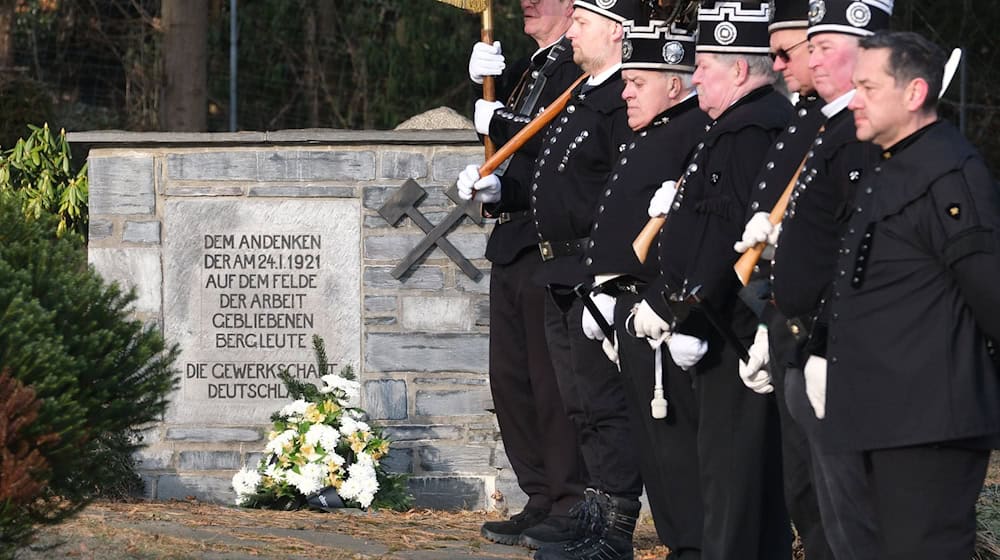
January 24, 1921 was one of the darkest hours of mining in Saxony. On that Monday, 200 miners arrived for the early shift at the Friedensschacht in Oelsnitz in the Ore Mountains. But many miners never saw the sun or their families again. On the 105th anniversary of the mining disaster, their victims were commemorated at the town's cemetery on Saturday. "When you consider how many of the victims had happily returned home from the trenches of the war or from long captivity, the disaster is all the more serious," explained Heino Neuber, chairman of the miners' association of the Lugau-Oelsnitz coalfield, the sponsoring association of the "Kohlewelt" museum. One of his ancestors also lost his life back then. 38 miners died directly as a result of the explosion, 19 others as a result of their serious injuries - a total of 57 fatalities. But how did it come about? On that winter morning, mine gas had ignited underground, triggering the explosion. Because of the escaping gas, fresh air had to be continuously supplied to the mines, explains Neuber. However, the fan was out of order at the start of the shift. As a result, a highly explosive mixture of methane and air had accumulated. Exactly how it ignited has never been fully explained. It is likely that a hewer tried to clean his gasoline safety lamp, opened it and caused the explosion, says Neuber. The rescuers were presented with a picture of horror in the light of their lamps. Witnesses reported at the time that injured people were wandering around in the darkness among a number of dead bodies; the paths underground were blocked by the blast wave and deformed tracks. The seriously injured screamed horribly as they tried to help them. Their burns caused excruciating pain. According to Neuber, safety regulations were tightened as a result of the mining accident. From then on, petrol safety lamps were reserved for certain specialists only, while the crews were equipped with electric lamps. "In addition, ventilators had to be kept running at all times in places where there was a tendency for mine gas to escape." In the history of mining in Saxony, there have always been underground accidents that have resulted in fatalities. For example, 101 people died in the Oelsnitz-Lugau mining district when a shaft collapsed in 1867. There was no second escape route, so many miners suffocated. Even more people died in an explosion in a coal mine in Zwickau in 1960: 123 miners. It is considered the most serious mining accident in the former GDR. There were also serious accidents in ore mining. For example, in 1955 in the uranium mine of Wismut. In a mine fire in Niederschlema, 33 people died and more than 100 were injured. In addition to ore mining, hard coal once also played an important role in Saxon mining - especially in the regions of Zwickau, Oelsnitz-Lugau and the Döhlen Basin near Freital. The coal was in demand as the "black diamond" in the factories, where it kept the machines running. This made local coal an important driver of industrialization in Saxony. Copyright 2026, dpa (www.dpa.de). All rights reservedThis is how the disaster took its course
Many fatalities in other underground accidents


