

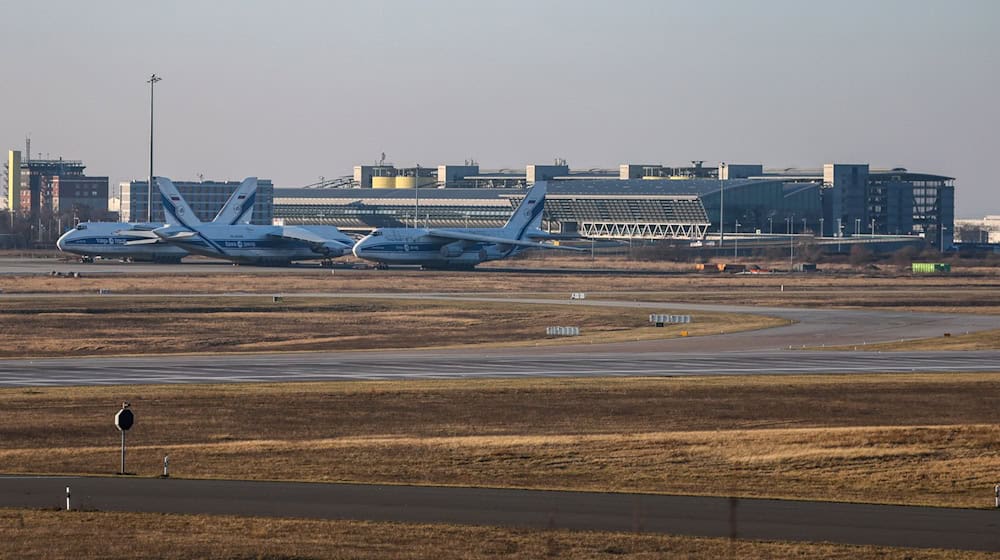
How many airports are needed in eastern Germany - and who will pay for them? This question has been debated for months, as the two airports Leipzig/Halle and Dresden cost money. Saxony and Saxony-Anhalt have had to step in financially to ensure their continued operation. However, this is set to end in 2030. And what happens now? The airports fulfill different functions. Leipzig/Halle is Germany's second-largest air freight location and also an airport for vacation traffic. Dresden is primarily a location for business and industrial connections. From the point of view of the state governments, Leipzig/Halle and Dresden airports are more than just transport infrastructure: they are seen as a location factor and economic driver for Saxony and Saxony-Anhalt. A study by the Institut der Deutschen Wirtschaft Köln Consult on behalf of Mitteldeutschen Flughafen AG (MFAG) quantifies the positive aspects as follows: According to the new agreement, the financial support from the federal states is to gradually decrease over the coming years: This makes the goal clear: from 2030, MFAG is to manage without these state compensation payments. The money is to be used for "expenses of a non-economic nature", such as costs for air traffic control or firefighting. The distribution between the countries is as follows: Saxony-Anhalt also insists on only providing financial support for tasks at Leipzig/Halle Airport. Independently of this, additional structural compensation is planned for Dresden Airport. From 2027 and initially until 2030, the airport is to receive nine million euros annually for costs of a non-economic nature. This sum will be provided exclusively by Saxony. Saxony-Anhalt no longer wants to participate in subsidies for Dresden Airport's losses from 2027. The Ministry of Finance in Magdeburg cites differing state interests as the reason for this. "While the Free State of Saxony has a direct state interest in both airport locations, the state of Saxony-Anhalt only has a direct regional economic interest in the Leipzig/Halle location due to its proximity to the state border," it said in Magdeburg. Funding from the two states was secured until 2026, but the future was unclear beyond that. With the new study, MFAG wants to show that airports are not only cost factors, but also economic drivers. The aim is to build a kind of bridge: support today, become independent tomorrow. The federal states are expressly linking their aid to a restructuring process. MFAG had already announced job cuts last year. Accordingly, 172 of a total of around 1,200 jobs have been cut - through natural fluctuation and social models. Airport boss Götz Ahmelmann did not want to rule out further cuts. The second driver should be further company relocations. Saxony's Finance Minister Christian Piwarz called on the federal government to reduce the location costs for German airports. "The air traffic tax and security fees must be reduced. Otherwise, German air traffic risks falling further in competition with European countries," he said. The study puts the gross value added of both airports at a total of 4.6 billion euros and the annual tax revenue at 875 million euros. This means that the tax revenue at state and municipal level exceeds the costs borne "more than sixfold". According to the calculations, every euro of value added at one of the airports generates a further 1.50 euros of value added in the economy as a whole. Each person directly employed leads to an average of around two additional jobs. Around two thirds of the overall effect remains in Saxony and Saxony-Anhalt. In Germany, this is relatively common. Berlin-Brandenburg Airport (BER), for example, was supported with 1.7 billion euros due to the effects of the coronavirus pandemic. Many federal states are wholly or partially involved in airports. In addition to Saxony and Saxony-Anhalt, these include Baden-Württemberg (Stuttgart), Bavaria (Munich), Hesse (Frankfurt), North Rhine-Westphalia (Cologne/Bonn), Lower Saxony (Hanover-Langenhagen), Bremen and Hamburg. In recent years, the state of Thuringia has also paid subsidies for Erfurt Airport. Copyright 2026, dpa (www.dpa.de). All rights reservedWhat role do Leipzig/Halle and Dresden airports play?
Why are Saxony and Saxony-Anhalt paying for the two airports at all?
What is the financing plan until 2030?
Who pays what - and for what exactly
Why is Dresden Airport receiving additional money?
Why is Dresden so controversial?
Why is the debate coming up now - in the middle of tense air traffic times?
How should the airports become economically independent?
What are politicians demanding?
What does the new study say about the benefits of the airports?
What other effects does the study describe?
Are other federal states also supporting airports?


