


When the leg grows back: researchers from Dresden unravel regeneration puzzle
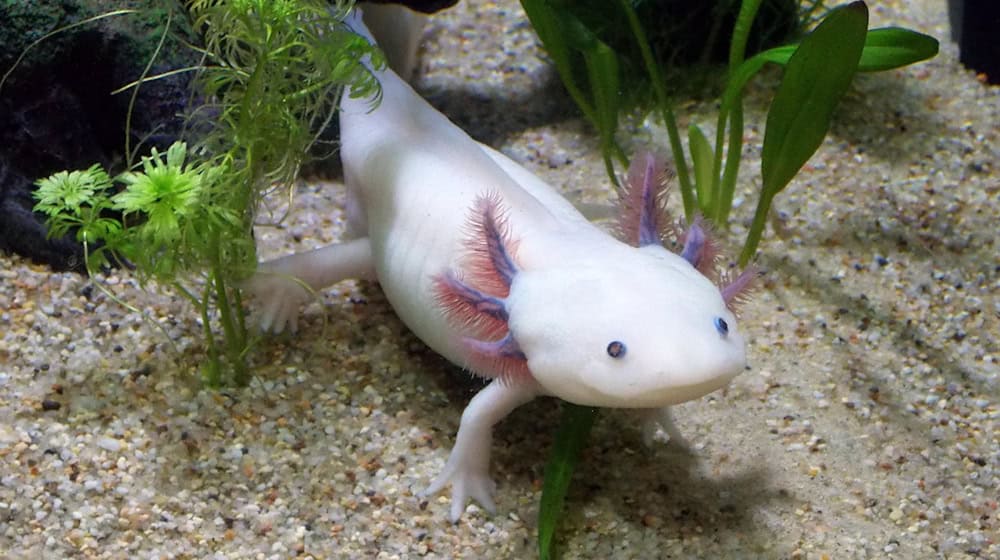
A salamander loses its leg. But instead of remaining mutilated forever, the limb simply grows back. Perfectly formed, with all the bones in the right place. And the most amazing thing is that the new leg always fits the animal's body size exactly. Regardless of whether it is a young or an adult axolotl. How does this work? Researchers from Dresden have now developed a mathematical model that solves this puzzle.
The scientists from the Cluster of Excellence Physics of Life (PoL) and the Center for Regenerative Therapies Dresden (CRTD) at TU Dresden published their results in the renowned journal PNAS. They focused on two important messenger substances. These so-called morphogens are called Sonic Hedgehog and Fibroblast Growth Factor 8, which the researchers call SHH and FGF8 for short. These two molecules are produced at opposite ends of the regrowing limb.
Nature's braking principle
The two messenger substances work together like an intelligent measuring system. Where their areas of action overlap, new tissue grows. The more the limb grows, the greater the distance between the two production sites of the morphogens. This reduces the overlap of their signal areas. This reduction in size acts like a brake. It stops growth exactly when the correct size is reached.
The researchers tested two theoretical models. In the first model, the parameters of the morphogens would constantly change during growth. The second model assumes that the parameters are fixed from the beginning. They are based on the overall size of the animal and remain constant during regrowth. The evaluation showed that the second model works. The scientists call it static scaling.
Importance beyond the axolotl
The model only explains the first phase of regeneration. But this phase is crucial. It determines how the new limb is built and how many bone elements are formed. The Dresden researchers suspect that their model describes a general principle. It could explain how size control works during development and regeneration in different animal species.
The findings apply not only to salamanders, but possibly also to other species that can regrow limbs. In the long term, such basic findings could also become relevant for regenerative medicine in humans.

