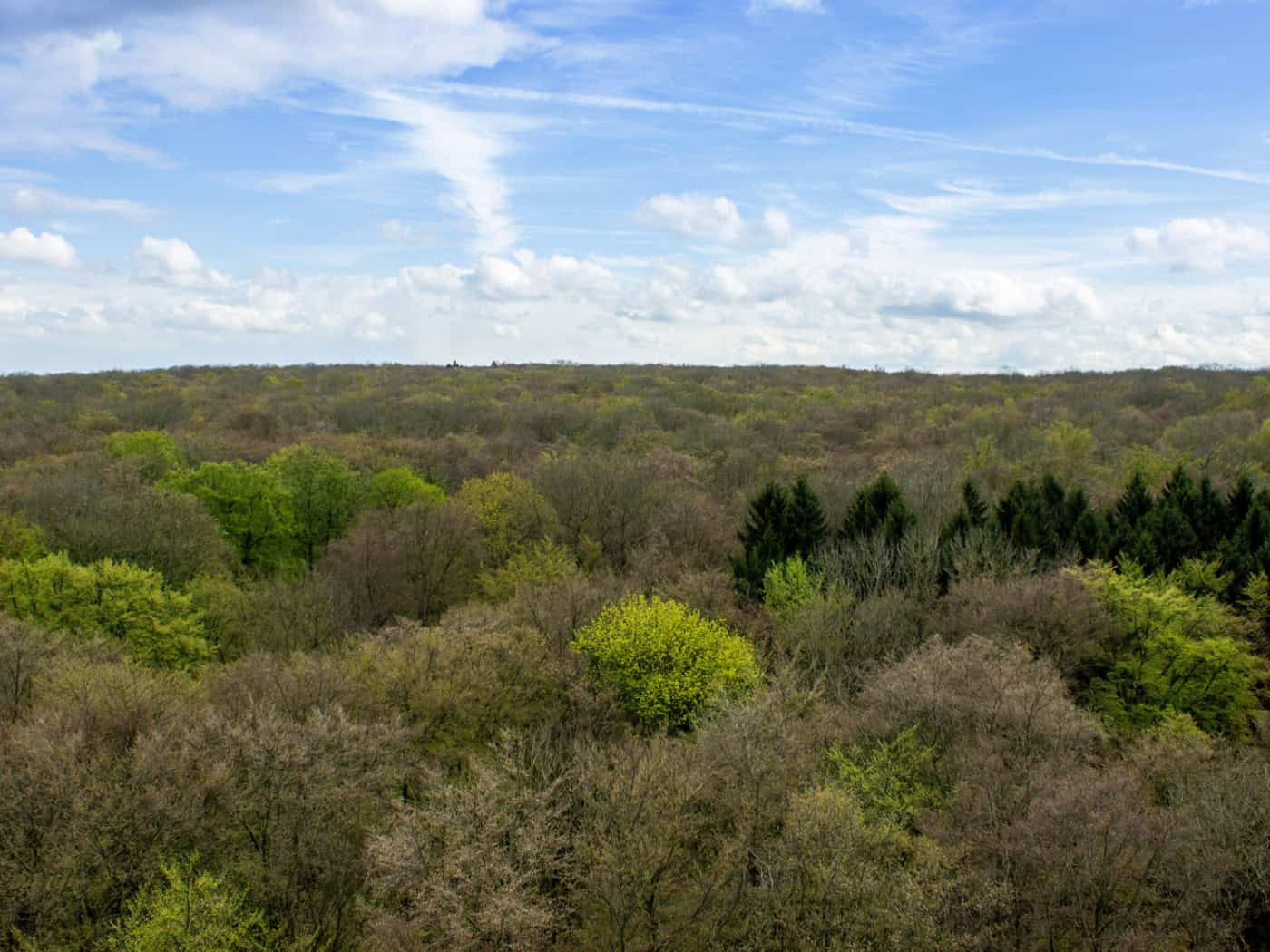
If you look out of the window in spring, you can see it every year: nature is awakening, meadows and trees are turning green. But this green is changing worldwide - and in a way that has surprised scientists. A research team led by the German Center for Integrative Biodiversity Research (iDiv), the Helmholtz Centre for Environmental Research (UFZ) and the University of Leipzig has developed a new method. It can be used to calculate and track the Earth's so-called "green center of gravity". This refers to the point around which the green plant parts are evenly distributed on land, comparable to the center of gravity of a body. It is considered an important indicator of the activity and condition of the world's vegetation.
"Imagine you are holding a perfectly round globe in your hands. You attach small weights to it, which represent the green plant parts on the mainland," explains first author Prof. Miguel Mahecha vividly. "If you place the globe in calm water, the center of gravity will always point downwards." Mahecha conducts research at the University of Leipzig and the UFZ.




The surprising discovery
For several decades, researchers have been following the green wave and came across something unexpected. The green center of gravity constantly shifts to the north, in all seasons. What was surprising was that even in summer in the southern hemisphere, when vegetation grows particularly strongly there, the center of gravity did not shift back to the south. "That really surprised us," says Mahecha. Longer growing seasons and milder winters could extend the green phase in the northern hemisphere, he hypothesizes. However, this still needs to be tested.
In addition, the focus is moving eastwards. Regions such as India, China and Russia, where vegetation is growing particularly strongly, are probably responsible for this. The new method opens up great potential. It can be used to link many changes on Earth - from droughts and forest fires to land use changes, animal migration and interactions between climate and biosphere.
Original publication:
Mahecha, M.D., Kraemer, G., Reinhardt, M., Montero, D., Gans, F., Bastos, A., Feilhauer, H., Flik, I., Ji, C., Kattenborn, T., Migliavacca, M., Mönks, M., Quaas, J., Sippel, S., Walther, S., Wieneke, S., Wirth, C., & Camps-Valls, G. (2025). Accelerated north-east shift of the global green wave trajectory. Proceedings of the National Academy of Sciences (PNAS).