


Tens of thousands expected: Germany demonstrates for the energy transition
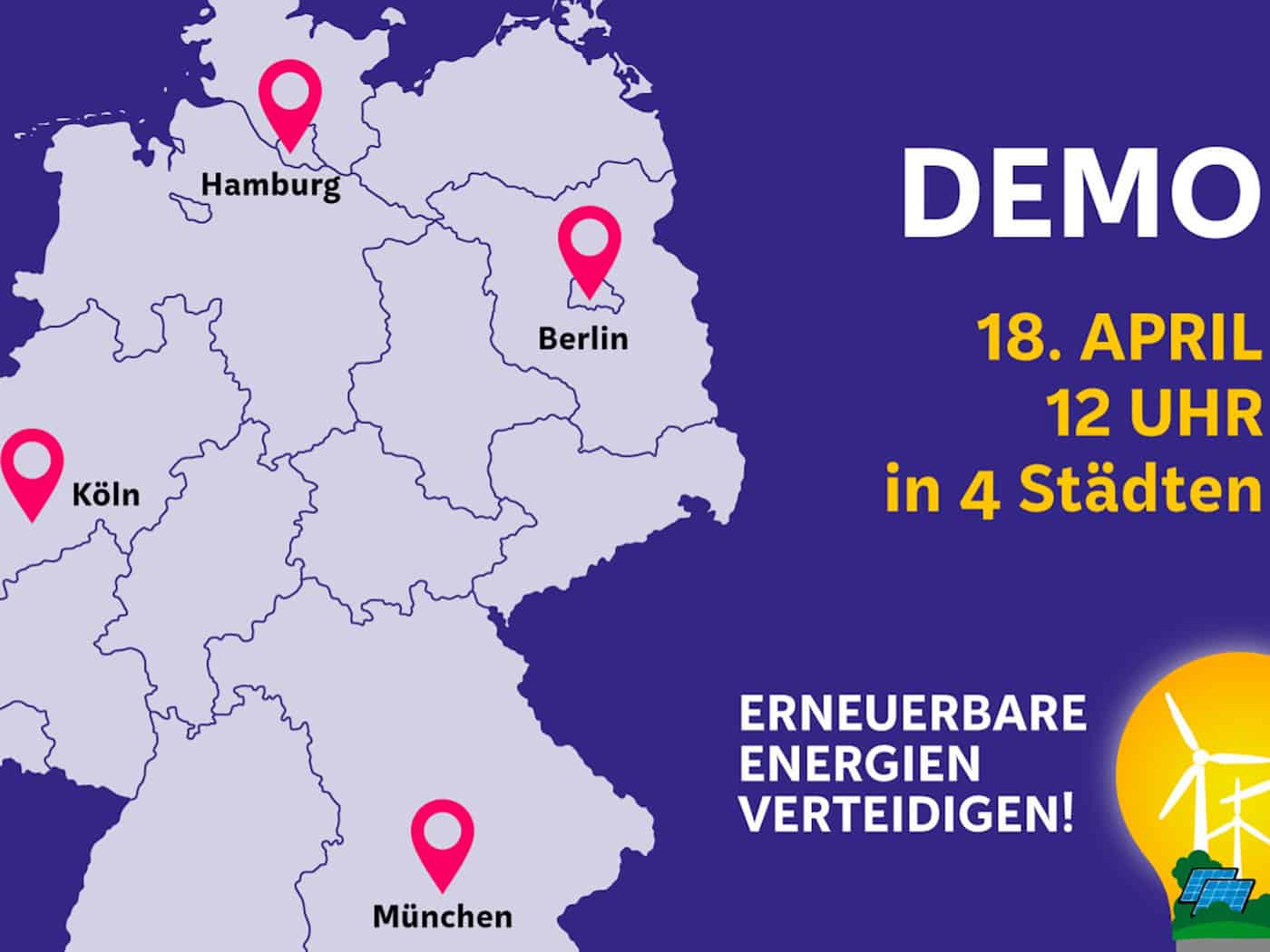
The time has come next Saturday: demonstrations for renewable energies will take place in Berlin, Hamburg, Cologne and Munich renewable-energy-defend - organized by a broad social alliance. People from all parts of society want to demonstrate side by side: Tenants and businesses, climate activists and the skilled trades. For clean energy, for independence, against fossil lobby politics. The call is backed by organizations such as Campact, Fridays for Future, Greenpeace, WWF, NABU and Deutsche Umwelthilfe.
What the demonstrators are demanding
The demands include more speed in the expansion of solar and wind power, faster distribution grids and electricity storage, digitalization of the grids as well as lower taxes on electricity and cheaper electricity for heat pumps. There are also calls for social support and tenant protection for affordable, climate-friendly heating.
The reason is concrete: the plans from the Ministry of Economic Affairs are intended to slow down the expansion of renewables and jeopardize an energy future that is clean, safe and affordable.
Who is Katherina Reiche - and what are her plans?
At the center of the controversy is Katherina Reiche, who has been Federal Minister for Economic Affairs and Energy in the Merz cabinet since 6 May 2025. Prior to her appointment, she was CEO of Westenergie AG, a subsidiary of the energy group Eon and one of Germany's largest gas network operators.
Reiche considers the previous government's plans to switch Germany's energy supply to climate-neutral sources to be "completely over the top". Her so-called ten-point plan and the planned amendment to the EEG have become a contentious issue. At the end of February 2026, the Ministry of Economic Affairs published a draft amendment to the Renewable Energy Sources Act, according to which the fixed feed-in tariff for new photovoltaic systems up to 25 kilowatts is to be abolished.
The planned new regulation on so-called "redispatch" is particularly critical: in particularly congested grid areas, newly connected operators will no longer receive compensation if their electricity cannot be passed on due to grid bottlenecks. Der Spiegel described the planned rules as "an energy transition stop through the back door".
Widespread criticism - including from within his own party
Criticism of Reiche comes from many directions. According to surveys, only 13% of voters are "satisfied" with Reiche's work - no cabinet member is more unpopular. More than 2,000 companies have spoken out against the plans.
Reiche's ten-point plan overlapped in key points with position papers from the energy companies RWE and E.on, which led to considerable criticism from the opposition and non-governmental organizations regarding its independence. Greenpeace also accused her of deliberately altering an expert report before publication.
Most recently, Christian Bäumler, vice-chairman of the CDU employee wing, called for Reiche's resignation and accused her of "seeking a coalition with the AfD".
Economic risks - billions at stake
The planned cuts also have tangible economic consequences. In Lower Saxony alone, investments of around 32 billion euros in renewable energies could be lost - five times the entire core budget of the Ministry of Economic Affairs.
Researchers warn of a historical déjà vu: "If this EEG becomes reality, the solar trade will plunge into the 'Reiche Gorge'. Fifteen years ago, similar measures destroyed thousands of jobs in the solar industry," warned Michael Sterner, Head of the Energy Networks and Energy Storage Research Center at OTH Regensburg.
The geopolitical context: energy dependency as a security risk
The demos are taking place at a heated geopolitical moment. Escalating energy prices, geopolitical crises and authoritarian regimes show how risky fossil fuels are - oil and gas are driving up costs and making Germany vulnerable. Reich's plans to build new gas-fired power plants with a capacity of 20 gigawatts would make Germany dependent on gas imports in the long term.
Reiche himself has recently taken a more nuanced position: In a guest article in the FAZ newspaper, she declared that she stands behind the energy transition - the 80 percent expansion target for renewables remains in place. Critics, however, see this primarily as a reaction to increasing public pressure.
Social resistance is growing
The demonstrations on 18 April are an expression of a broader social mobilization. Especially in times of wars, crises and sharp price rises, it is clear that oil and gas make us dependent and vulnerable to blackmail. Renewable energies protect consumers from fossil fuel cost traps, strengthen independence and are the best answer to the climate crisis - according to the organizers' message.
It remains to be seen whether the demonstrations will actually influence the German government's energy policy. One thing is clear: rarely has the dispute over the future of Germany's energy supply been so loud - and so fundamental.
Those wishing to take part can find all the information on the rallies in Berlin, Hamburg, Cologne and Munich at erneuerbare-energien-verteidigen.de.
Sources:
- Defending renewable energies - demo website
- Katherina Reiche: Federal Minister of Economics in the focus of the 2026 energy transition
- Katherina Reiche - Wikipedia
- Criticism of Reiche: Is the economy minister slowing down the expansion of renewable energy? - Euronews
- Katherina Reiche: Her role in the energy transition - Campact
- Stop the lobby minister: Defend the energy transition - Campact
- Energy policy of Katherina Reiche: She is ruining the climate and the economy - taz
- EEG reform 2026: Criticism of the rich grows - ZfK
- Katherina Reiche jeopardizes investments in renewable energies - Windkraft Journal
- Economy Minister Reiche defends the energy transition - Junge Freiheit

