Logo Die Sachsen News
News / Various news

A screen as small as a postage stamp

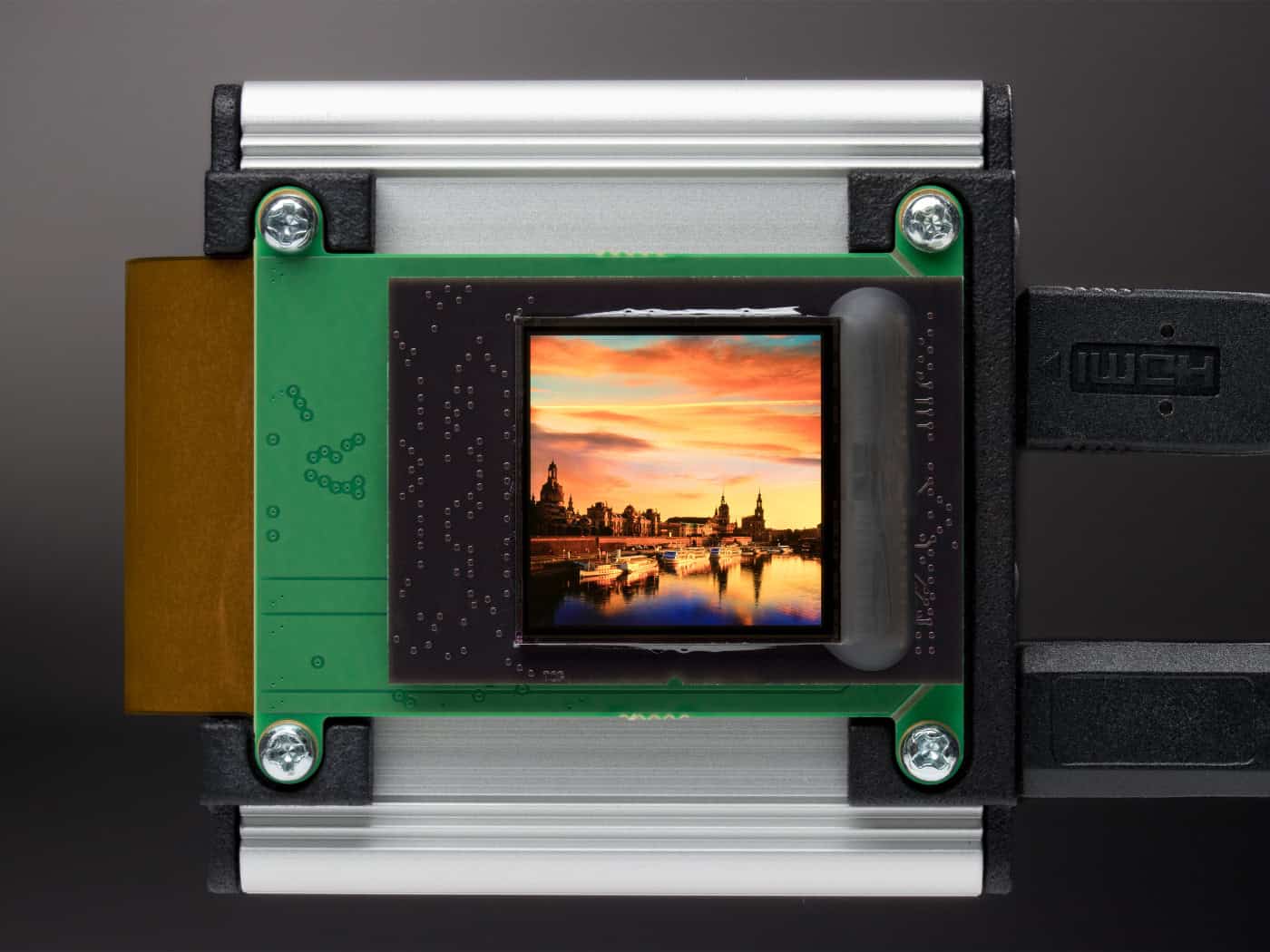
Four million pixels on 2.7 centimeters: The 2K OLED microdisplay from Dresden is to be used in data glasses and medical devices in the future.
A screen barely bigger than a postage stamp: the new 2K OLED microdisplay from Fraunhofer IPMS Dresden shows four million pixels in the smallest of spaces. © Fraunhofer IPMS/Sebastian Lassak
From: Wissensland
A screen barely larger than a postage stamp, yet packing more than four million pixels: researchers in Dresden have developed a microdisplay aimed at making augmented reality glasses brighter, sharper, and more practical for everyday use.

Data glasses and augmented reality are on the rise. Researchers in Dresden are working to make these technologies suitable for everyday use. Their latest component is a screen just a few centimetres in size.

Scientists at the Fraunhofer Institute for Photonic Microsystems have developed a so-called 2K OLED microdisplay. OLED is a technology also used in modern televisions and smartphones: organic materials emit light when electricity is applied, so each pixel lights up on its own without the need for backlighting. This results in particularly sharp, high-contrast, and bright images. A “microdisplay” simply means the screen is very small – measuring just 2.7 centimetres diagonally – yet it still displays around four million pixels..

More from this category

Easier to integrate

The key to the display’s performance lies inside. A specialized control circuit regulates the current and voltage supplied to each individual pixel. It operates at relatively high voltages, allowing multiple OLED layers to be stacked on top of each other. The result is a particularly bright image – crucial for applications such as augmented reality glasses, where digital content must remain visible against the real-world background.

“In addition to enabling a wide dynamic range for pixel control, the display can be driven via an integrated LVDS interface, which reduces the number of required connections,” explains Philipp Wartenberg, Head of IC & System Design at Fraunhofer IPMS. An LVDS interface is a fast, low-noise data connection. According to Wartenberg, frame rates of up to 120 frames per second are possible. The entire module requires only a single power supply, as it generates all necessary voltages internally. This simplifies integration into existing devices and could benefit manufacturers of data glasses, medical systems, and other compact optical technologies.

Part of a global trend

The work in Dresden reflects a broader international development. Companies and research institutions worldwide are working to make displays smaller, brighter, and more energy-efficient for applications such as augmented reality, medical devices, and industrial systems. Microdisplays are gaining importance because they enable high resolutions in very small spaces.

At the same time, alternative technologies such as micro-LED displays are being explored, promising even higher brightness. The goal is to create displays that remain clearly visible even in bright sunlight while consuming as little energy as possible. Fraunhofer IPMS is contributing to this effort with a focus on compact, high-brightness OLED microdisplays for specialized applications.


The translations are automated with the help of AI. We look forward to your feedback and your help in improving our multilingual service. Write to us at: language@diesachsen.com.
Wissensland
Article from

Wissensland

Wissensland is responsible for the content itself. The platform's code of conduct applies. The platform checks and treats content in accordance with the legal requirements, in particular the NetzDG.

METIS