


Deep insights into the world of atoms
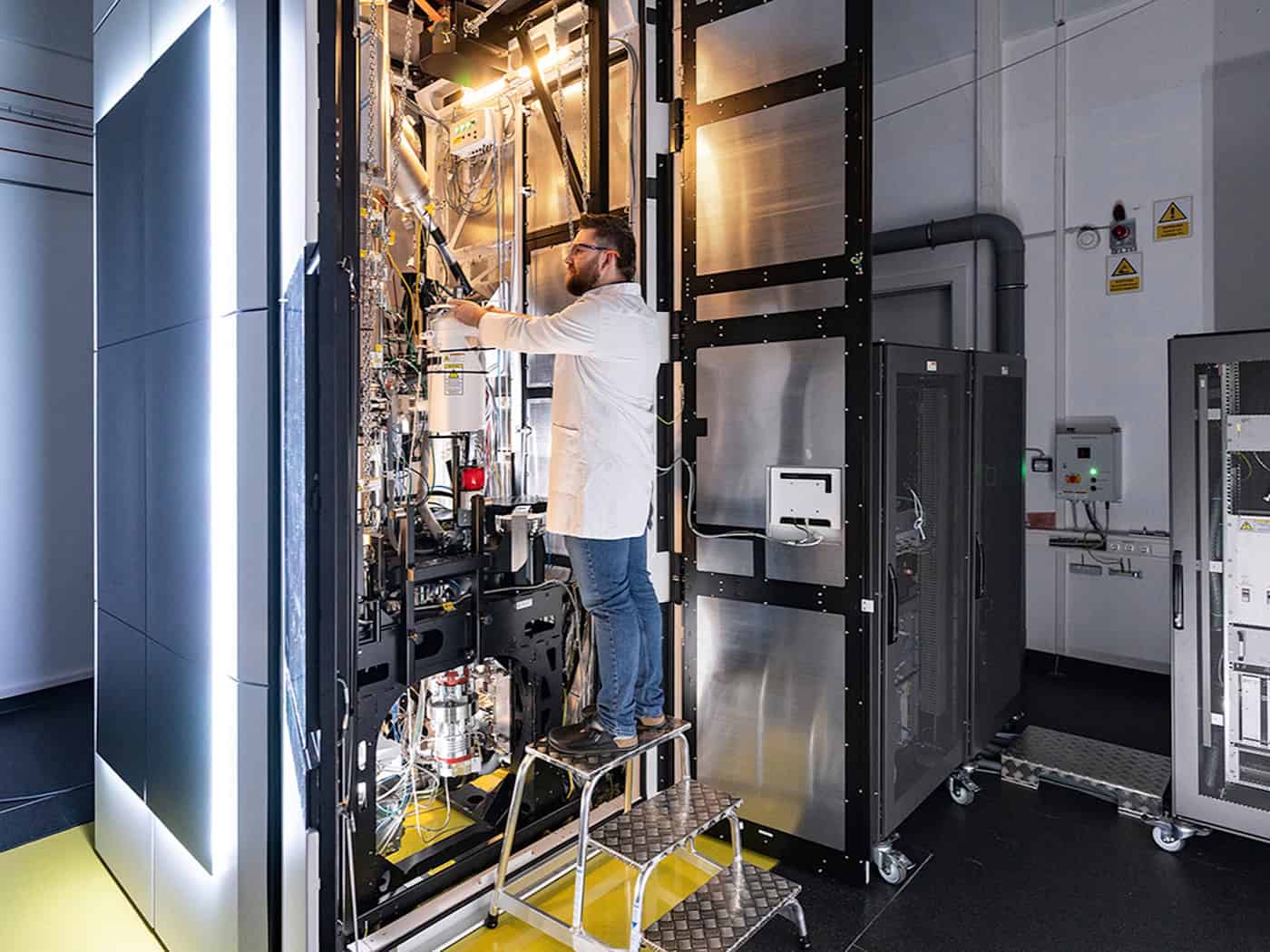
A cell phone, a car, a pair of glasses - all these things are only as good as the materials they are made of. But what happens deep inside a material, where individual atoms are located? Researchers at Chemnitz University of Technology can now see this.
Chemnitz University of Technology has now opened its new Transmission Electron Microscopy Center, or TEM Center for short. Two huge microscopes there make structures visible that are so tiny that even normal light passes them by. The devices are more than four meters high and work with electron beams instead of light waves. This allows them to image individual atoms and their compounds.
World-class technology on vibration-damping concrete
To ensure that the sensitive devices work precisely, they stand on a 1.4-metre-thick concrete slab. This absorbs every vibration. The rooms are also shielded against noise, magnetic fields and temperature fluctuations. The microscopes are operated by remote control from separate rooms. Before a sample even enters the device, it is brought to a thickness of just a few nanometers in a special facility. A nanometre is one millionth of a millimetre.
"At the heart of the new single-storey building are two highly sensitive transmission electron microscopes, which enable us to investigate the structure and properties of materials at molecular and atomic level deep inside them and then make the findings usable for new applications," says Prof. Dr. Andreas Undisz, who heads the center. For example, processes that lead to material damage can be investigated in great detail and more precise statements on the service life of components are possible.
One location for more than 20 research groups
In the past, the necessary technology was spread across the entire university. Now everything is in one place. More than 20 professorships from the fields of mechanical engineering, natural sciences and electrical engineering share the equipment. Fraunhofer Institutes and companies from the region will also benefit from this. That costs money: Around 13.1 million euros went into the construction, which was jointly financed by the Free State of Saxony and the European Regional Development Fund. The two microscopes themselves cost 3.5 million euros each, provided by the German Research Foundation and the Free State of Saxony.
Saxony's Science Minister Sebastian Gemkow sees this as a signal: "With this new building and the two electron microscopes, Chemnitz University of Technology is once again becoming a world leader in the field of materials research." Prof. Dr. Gerd Strohmeier, Rector of Chemnitz University of Technology, calls the new center an investment in the visibility of the university worldwide. Vice Rector Prof. Dr. Anja Strobel added that the center creates very attractive conditions for new research projects and the training of young scientists.

