


Robots instead of manual labor: Fraunhofer IWS automates the freezing of tissue
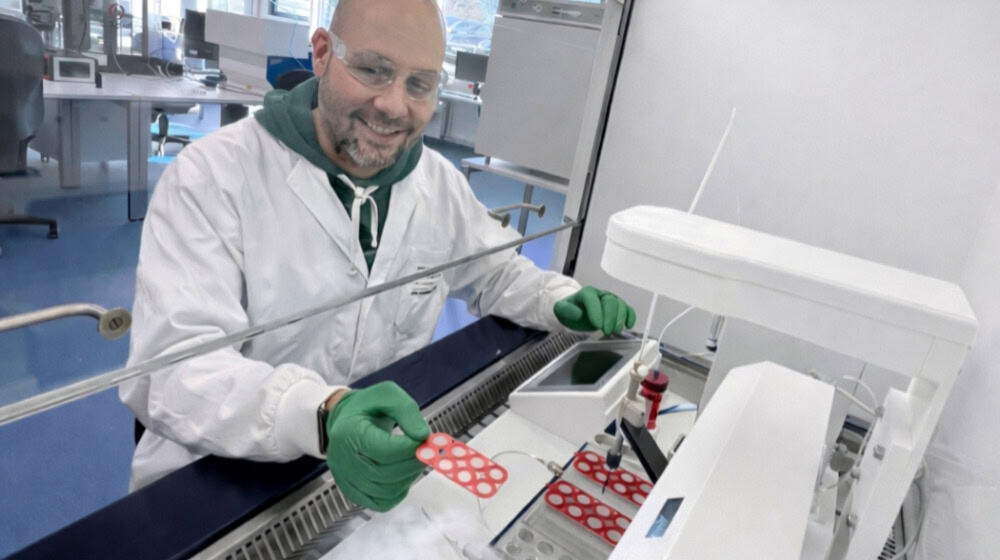
Whoever develops new drugs needs tissue samples for testing. These samples have to be preserved. Until now, this has usually been done laboriously by hand. An error during freezing can destroy the sensitive structures. The Fraunhofer Institute for Material and Beam Technology IWS in Dresden has now developed a solution together with other Fraunhofer Institutes. An automated system supports the work. The platform takes over central steps for freezing the tissue samples and makes the process around ten times faster.
The new technology uses vitrification. The tissue solidifies so quickly that no harmful ice crystals are formed. The process was previously considered difficult to master. The temperature and timing have to be exactly right. Experienced specialists managed around 20 samples per morning. The new platform processes up to 200 samples in the same period of time.
Robots instead of manual work
The system works according to principles from industrial production. The tissue sections are placed on special carriers. Sensors and cameras monitor every step. Media changes and cooling processes run automatically. Dr. Florian Schmieder heads the Micro- and Biosystems Technology Group at the Fraunhofer IWS. "We wanted to develop a process that works reproducibly regardless of individual experience," he explains.
Automation has several advantages. Firstly, errors are less frequent. Secondly, the results are easier to compare. Thirdly, the time required by staff is significantly reduced. This is important for pharmaceutical companies and research laboratories. They need reliable tests in larger numbers.
Technology with a view to practical application
Three Fraunhofer Institutes are working together on the COLDIMPACT+ project. In addition to the IWS, the Fraunhofer Institute for Toxicology and Experimental Medicine ITEM and the Fraunhofer Institute for Biomedical Engineering IBMT are also involved. The partners are pooling expertise from various fields. "We don't develop technology in isolation, but always with a view to the application and subsequent use," adds Schmieder.
The platform has a modular structure. It can be adapted to different types of fabric. Different protective fluids can also be used. The system has been designed in such a way that companies can adopt and further develop it. The researchers are already thinking about all the regulations or specifications for such work. The aim is to make the transition from laboratory to practice as quickly as possible.

