


How flawed diamonds are advancing quantum technology
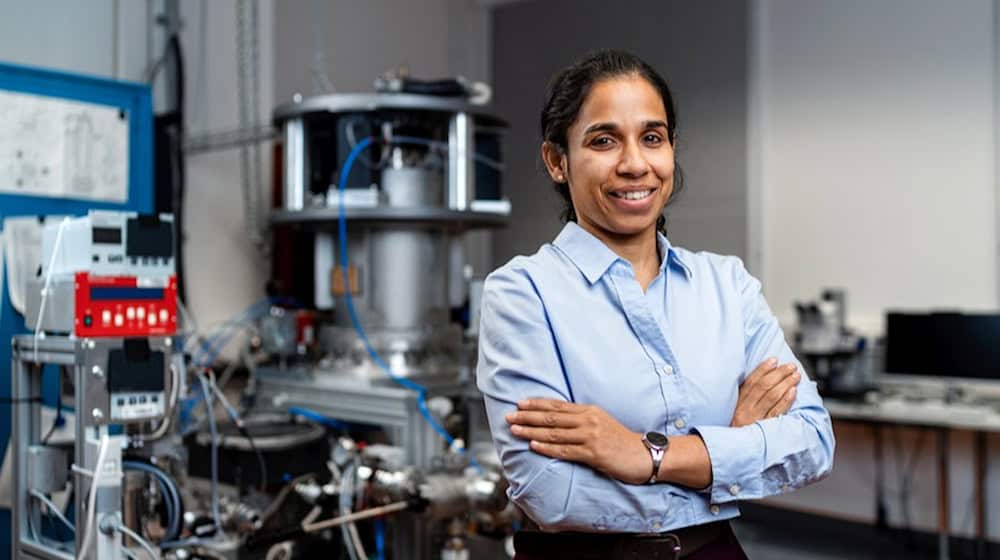
A magnet as small as an atom. Impossible to measure? Not for Aparajita Singha. The physicist holds the new professorship for "Nanoscale Quantum Materials" at TU Dresden. Her tools are diamonds with flaws. She uses them as ultra-precise sensors to detect the smallest magnetic signals in materials. Her work is an important basis for quantum computers and other technologies of the future.
Singha conducts research in the Dresden-Würzburg Cluster of Excellence ctd.qmat. "My passion for quantum sensors began when I wondered whether I could really measure the smallest magnet in the world," she says. What sounds abstract has concrete meaning. At the atomic level there are tiny elementary magnets, the electron spins. Their alignment stores information. While normal computers only calculate with zeros and ones, in the quantum world these spins can be zero and one at the same time. This makes quantum computers extremely powerful.
The trick with the imperfect diamond
In order to measure these tiny magnets, Singha needs a special sensor. "No diamond is perfect. Natural diamonds sparkle even more beautifully the more flaws they have in their chemical structure. We use these flaws as a tool for our research," explains the professor. For such a sensor, two carbon atoms are specifically removed from a synthetic diamond. One gap is filled with nitrogen, the other remains empty. This combination is called an NV center. Depending on which light the diamond emits, the researchers know how strong the magnetic moments in the material are.
So far, this measurement only works at minus 269 degrees Celsius. Singha's goal for the next five years is ambitious. "Together with my team, I want to measure the world's smallest magnet at room temperature. No one has ever managed that before." At normal temperature, her team can already measure 100 atoms simultaneously. For many quantum technologies, however, the measurement must be accurate to a single atom.
Method with great potential
Working with NV centers in diamonds is an important research trend worldwide. Things are also happening in Saxony. "Almost all Saxon quantum start-ups are working with defects in diamonds," says Matthias Vojta, spokesperson for the Cluster of Excellence in Dresden. These include several companies from the Saxon quantum network SAX-QT. "This enriches our research activities in collaboration with Würzburg and gives the local industry more quantum power."
Ten people work at Singha's professorship: two postdocs, six doctoral students and one technician. The measurements have to take place in an absolutely pure environment, as pure as in space. Only in an ultra-high vacuum can they achieve the necessary precision. The researcher is convinced that her method has great potential. After all, it is the only measurement method that can also work at normal temperatures.

