


Leipzig researchers find possible plague grave from the Middle Ages
In 1350, the plague raged particularly severely in Erfurt. Contemporary chronicles report that around 12,000 people died during the outbreak of the "Black Death". They were buried in eleven large pits outside the city walls. Until now, nobody knew exactly where these mass graves were located. Now a research team from Leipzig has tracked down one of them. It is the first plague grave in Europe to be found through a systematic search.
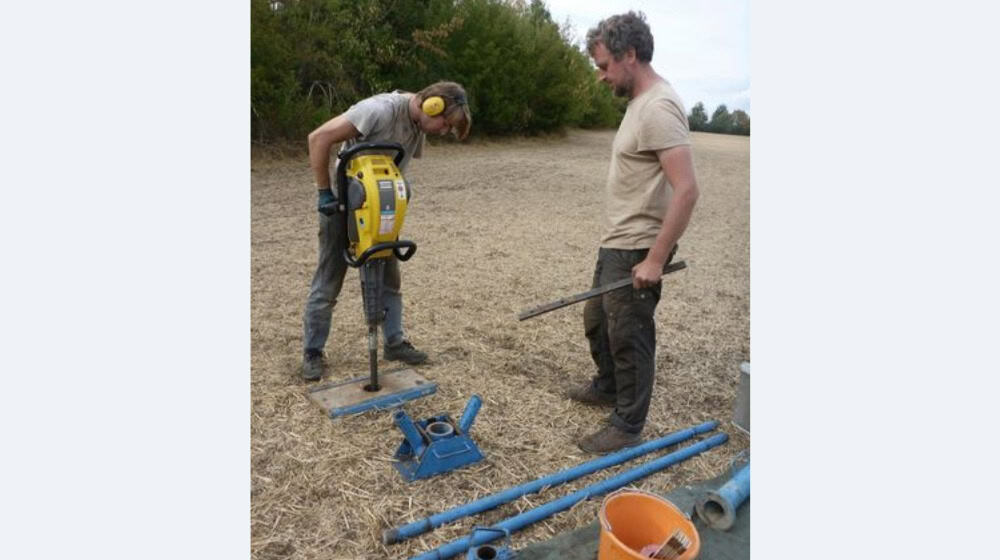
The scientists from Leipzig University, the Leibniz Institute for the History and Culture of Eastern Europe and the Helmholtz Center for Environmental Research combined various methods to do so. They analyzed old chronicles, measured electrical resistances in the soil and drilled sediment samples. This is how they discovered a huge structure in the ground near the medieval village of Neuses near Erfurt. The grave measures around ten by 15 meters and is three and a half meters deep. The researchers found human bone fragments in the mixed sediment. "Our results indicate that we have clearly located one of the plague mass graves of Erfurt described in the chronicles," says Dr. Michael Hein from the University of Leipzig. An archaeological excavation should bring certainty.
Soil reveals history
The researchers reconstructed the medieval landscape and discovered something surprising. The grave lies on dry black soil on the edge of the Gera Valley. Back then, people left out the damp floodplain soil directly next to the river. The reason lies in the so-called miasma theory. "This states that diseases are spread by bad air or vapors emanating from decaying organic material," explains Dr. Martin Bauch from the Leibniz Institute. Organic matter decomposes more slowly on wet soil. People therefore feared that it would be more difficult to contain the disease there. Together with legal requirements, this also explains why the grave is located far outside the city walls.
The radiocarbon analysis clearly dates the bone finds to the 14th century. So everything fits together. Between 1346 and 1353, the Black Death had killed half the population in some European regions. Thuringia was on the eastern edge of the affected area at the time.
Window to the past
Confirmed plague mass graves from this period are extremely rare. Fewer than ten are known across Europe. Such graves are usually discovered by chance during construction work. "However, a major achievement of the study is that this discovery was not made by chance during construction work, but as part of an interdisciplinary survey," emphasizes Dr Ulrike Werban from the Helmholtz Centre for Environmental Research. The researchers have shown that the combination of historical sources and modern measuring methods can be used to search for such sites in a targeted manner.
The scientists are now planning excavations together with the Thuringian State Office for Monument Preservation and Archaeology. The material will be genetically analyzed at the Max Planck Institute for Evolutionary Anthropology in Leipzig. The researchers want to learn more about the plague pathogen Yersinia pestis and understand why so many people died. "This discovery is not only of archaeological and historical significance," says Prof. Dr. Christoph Zielhofer from Leipzig University. It helps to understand how societies deal with mass deaths. In future, the method could also help to detect and protect other epidemic or conflict graves. Topics that remain relevant today.

