


Quantum vibe from the lab: Dresden musician makes research audible
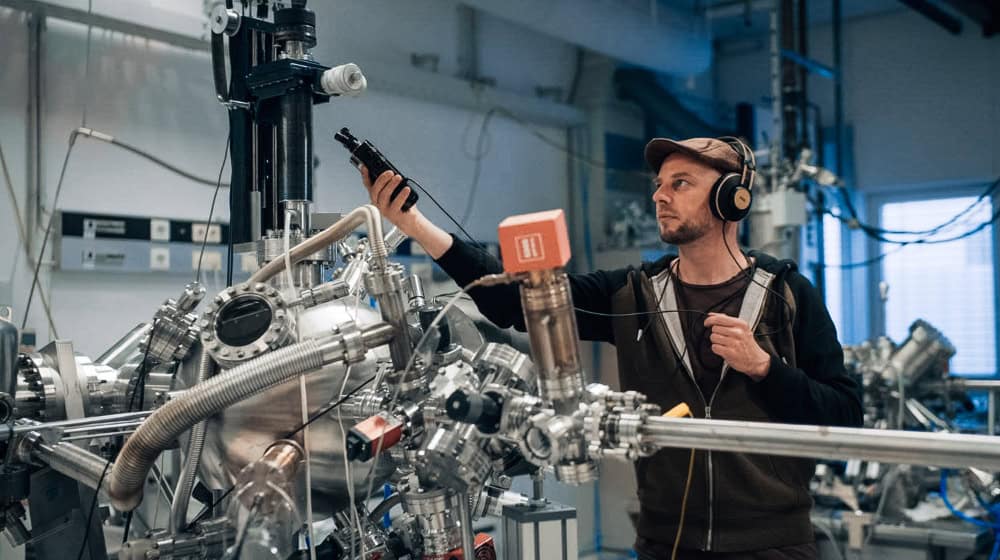
The whirring of measuring devices, the clicking of switches, the hissing of cooling systems - research laboratories have their own sound. Dresden musician Konrad Kuechenmeister toured the quantum research laboratories in Dresden and Würzburg and recorded these sounds. Using a looper, a device that plays pieces of music in loops, he mixed them into a soundtrack. Handmade loop music full of quantum vibes. It can be heard in a video that shows what researchers at the Technical University of Dresden and the University of Würzburg are working on.
The sound accompanies a new start. The Cluster of Excellence ctd.qmat has expanded its name and has a new research focus. The "d" in the name now stands for dynamics. "Quantum dynamics is the key to understanding the phenomena discovered in the first funding period in greater depth, controlling them in a targeted manner and being able to use them technologically," says Matthias Vojta. He is Professor of Theoretical Solid State Physics at TU Dresden and heads the cluster together with Ralph Claessen from the University of Würzburg.
How tiny particles behave
About 300 scientists from more than 30 countries are researching so-called quantum materials in the cluster. These are substances in which tiny particles behave differently than in ordinary materials. The researchers want to understand how these materials change over time. They are particularly interested in what happens when external influences act on the materials - electric currents, magnetic fields or pressure.
"Many applications in information processing, sensor technology or energy conversion are based on extremely fast switching and control processes," explains Ralph Claessen. The researchers develop theories and investigate phenomena that only occur under this fast control. To this end, they are expanding their measuring devices in order to record and control ultra-fast processes in real time.
From green hydrogen to quantum computers
One particularly important field of research is topological catalysis. Here, scientists are investigating how quantum materials can be used to make chemical processes more economical. This could help with the conversion of CO2 or the production of green hydrogen. Initial results show that the activity of these processes can be switched on and off through targeted control.
In addition, the cluster is working on new forms of superconductivity that could enable stable quantum bits for computers. Another topic is highly sensitive measurement methods. The aim is to develop quantum materials that work at room temperature and open up new possibilities for green energy technologies, energy-saving electronics and precise sensors. A new quantum research center with modern laboratories will open in Dresden in 2029 together with the Leibniz Institute for Solid State and Materials Research. Funding from the federal and state governments runs until 2032.

