


Mulch films made of cellulose to protect soils from microplastics
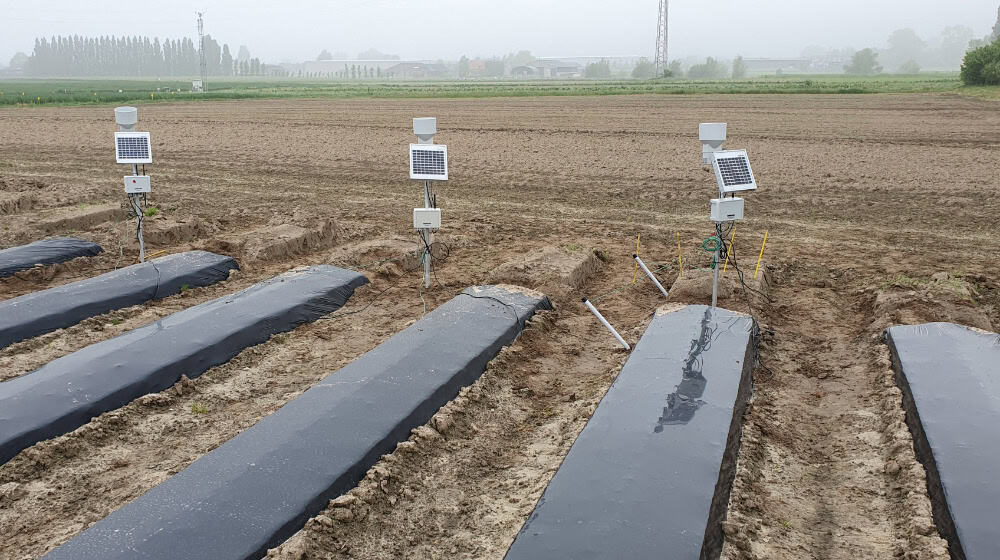
Every year, up to 24,000 tons of plastic film are left behind in Europe's fields. The consequences: Microplastics pollute the soil and cost time and money to dispose of. A research team led by the Fraunhofer Institute for Electron Beam and Plasma Technology FEP in Dresden is now developing an alternative that decomposes by itself after harvesting.
Farmers use mulch films to suppress weeds, retain water in the soil and warm the earth. In Europe alone, more than 80,000 tons are used every year. Almost all of them are made of plastic. The problem: up to 30 percent of these films are not removed from the field. They break down into microplastics and permanently pollute the soil. The films that are collected can hardly be recycled. Sludge and plant residues make recycling almost impossible. Most films end up in landfill sites or incinerators.
Water is directed specifically to the plants
In the EU project CELLAGRI, nine partners from seven countries are working on a solution. The basis is cellulose instead of crude oil. A biodegradable coating is applied on top. The special feature: Microscopically small structures are imprinted into this coating. They function like tiny channels and direct water specifically to the plant holes. "With CELLAGRI, we are creating a sustainable alternative that solves several problems simultaneously," explains Dr. Christian May, who is coordinating the project at the Fraunhofer FEP. The films are designed to optimize the plants' water supply and degrade completely in the soil after the growing season without leaving any harmful residues.
The structures are based on models from nature. Plasma treatment creates additional water-attracting and water-repellent areas on the film. This further improves water distribution. At the same time, the treatment prevents mold growth. This is particularly important in greenhouses. The Dresden researchers can complete all the work steps in a single pass. The film runs from roll to roll through the system.
Tests in fields in different climate zones
The four-year project will run until September 2029. Three field trials with different plants and climate zones will show whether the films work in practice. At the same time, the researchers are testing how safe and sustainable the new materials are over their entire life cycle. The focus is on biodegradability.
"Our experience in plasma treatment and surface functionalization enables us to precisely adjust the properties of the films and thus create optimal conditions for various applications," explains May. The environmental impact should be reduced by at least 30 percent compared to conventional plastic films. At the end of the project, the participants want to present a market-ready technology. The materials developed could later also be used for food packaging.

