

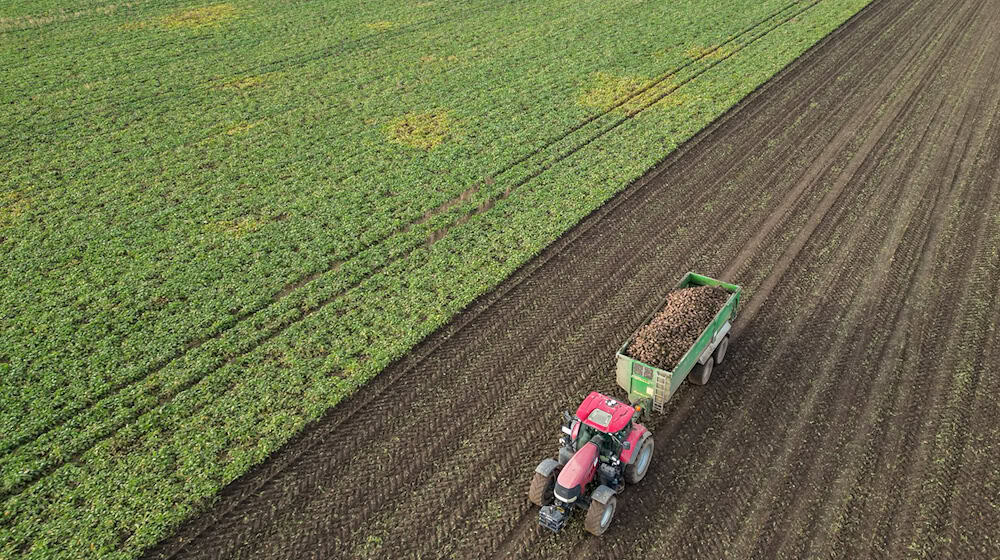
Free farmland in Saxony, Saxony-Anhalt and Thuringia is scarce - and expensive. Agricultural businesses have been competing for arable land on the East German land market for years, while prices and rents are rising in many places. At the same time, non-agricultural investors - such as insurers, real estate companies or corporations from outside the sector - are increasingly coming into focus. Criticism is coming from interest groups and politicians - for example from the left-wing parliamentary group in the Saxony-Anhalt state parliament: they warn of a concentration of land in a few hands. Politicians are struggling with the question of how the trend can be limited - and whether state laws against share purchases could help. Share deals are a central point of discussion. Investors do not buy farmland directly, but shares in agricultural companies. Critics see this as a loophole: anyone who buys into an agricultural company could gain access to land via the company without the usual control mechanisms that apply to a traditional land purchase, they say. The debate therefore revolves around the question of whether share purchases need to be more strictly regulated - for example through reporting obligations or upper limits. One possible way forward would be an agricultural structure law at state level that would restrict share purchases in certain constellations or at least make them more transparent. However, while such attempts have been discussed politically in some states, Saxony, Saxony-Anhalt and Thuringia are currently setting different priorities - or see no need. In Saxony-Anhalt, the issue of share purchases in agriculture is discussed time and again. The state has a strong agricultural character, while at the same time many farms are organized on a large scale - a structure that in part dates back to GDR times. The sale of Deutsche Agrar Holding (DAH) to the Australian fund Igneo Infrastructure Partners is an example of this. The left-wing parliamentary group sees dangers and consequences for the agricultural sector in East Germany. The sale is "the first time that a large-scale share purchase of this kind has been carried out in the East German agricultural sector", explained the parliamentary group. The investor now controls more than 20,000 hectares of land. The Arbeitsgemeinschaft bäuerliche Landwirtschaft (AbL) also criticized the takeover. The Ministry of Agriculture, on the other hand, sees no agri-structural effects. In an answer to a minor question from the Left Party, it states that there has been no concentration of agricultural land. The Left Party disagrees and points to risks such as land concentration, shifts in power on the land market and the possible outflow of profits abroad. The state government is focusing less on additional legal barriers than on a land fund. According to the Ministry of Agriculture, the fund is intended to benefit the agricultural structure. The land should "benefit farmers in particular", primarily through leasing. The ministry does not currently see a need for additional regulation for share purchases. The responsibility lies with the federal government, it said. In any case, the significance of share deals cannot be reliably assessed due to a lack of data. Only "spectacular individual cases" are known. An "agri-structural risk" is currently not seen. The Saxony-Anhalt State Farmers' Association is rather skeptical about the land fund. According to the association, an expansion of the existing guidelines is not necessary. At the same time, it emphasized that non-agricultural investors should not be seen as a problem in principle. It is only negative "where it intensifies regional competition for land and thereby increases purchase prices and rents in the surrounding area". In Saxony, an agricultural structure law is currently off the table, according to the Saxon Ministry of Agriculture and the state farmers' association. The farmers' association points out that in the last legislative period, it "contributed significantly" to the fact that a draft bill for an agricultural structure law was rejected and not pursued further. According to the farmers' association, the real price drivers on the land market are not the share deals, but "the allocation of BVVG land and ZFM land". This primarily refers to state-influenced land that is allocated via tenders: The federally owned Bodenverwertungs- und -verwaltungsgesellschaft (BVVG) has been privatizing and leasing out formerly state-owned GDR agricultural land since reunification. In Saxony, state-owned agricultural land is also managed by the state-owned company Zentrales Flächenmanagement (ZFM) and mostly leased out. The Ministry of Agriculture also sees no immediate pressure to act on share deals. Share purchases in the agricultural sector are not systematically recorded in Bavaria either - no data is available, it said. The risk of speculative farm buyers is currently "considered to be low". A precautionary data collection would also "lead to a further increase in bureaucracy". As in Saxony, an agricultural structure law is currently no longer an issue in Thuringia. The Thuringian Farmers' Association points out that such a law was rejected in earlier debates because it would have "restricted the entrepreneurial freedom" of farms. In addition, regulations on share purchases in drafts were considered to be constitutionally problematic. According to the Ministry of Agriculture, the responsibility for regulating share purchases also lies with the federal government. Attempts to regulate this at state level have always failed in the past. Copyright 2026, dpa (www.dpa.de). All rights reservedShare deals: investors buy shares instead of land
The situation in Saxony-Anhalt
The situation in Saxony
The situation in Thuringia


