


Dresden: Charles Heidsieck tasting at Stresa with Tobias Heldt's creative cuisine
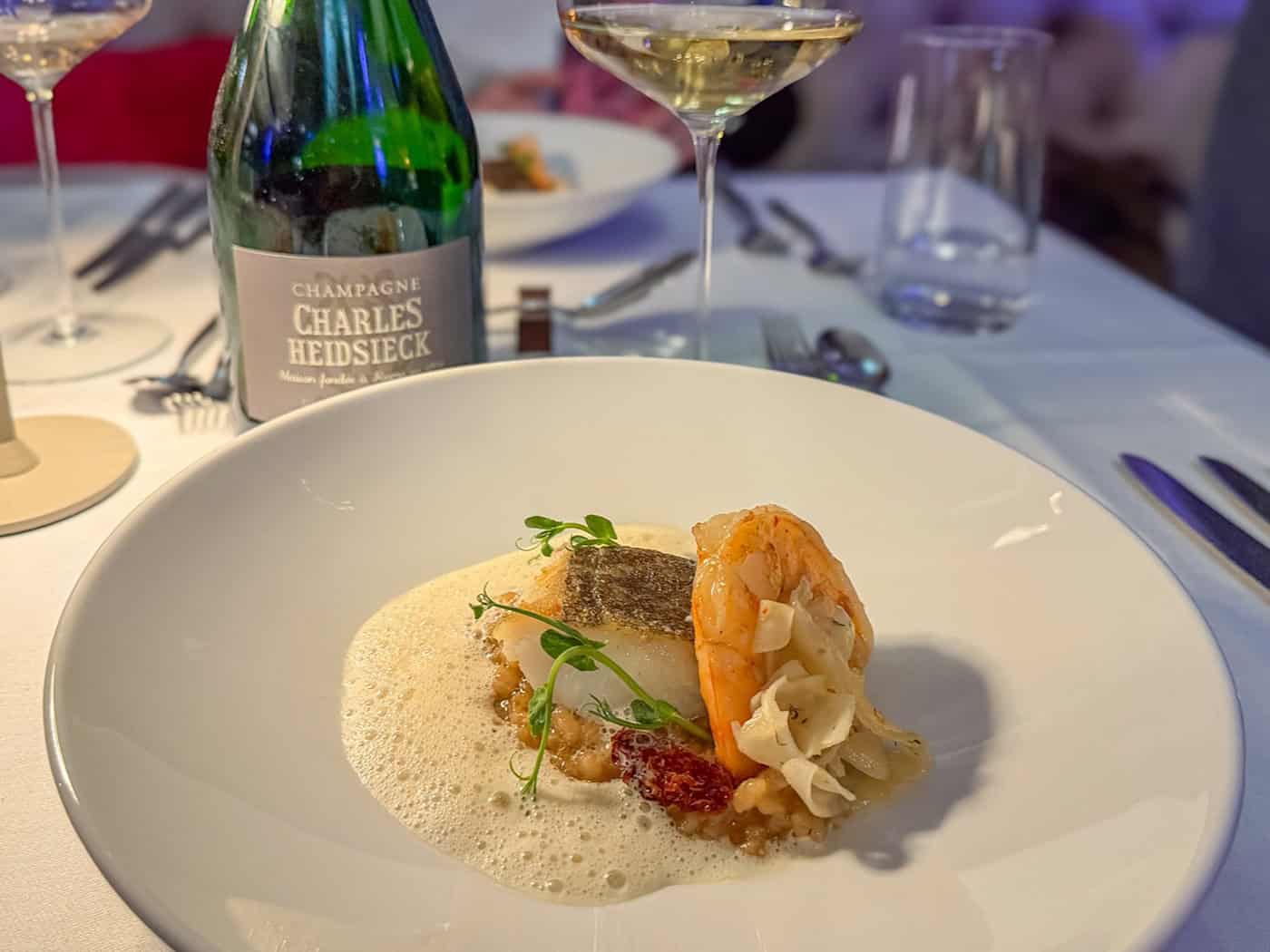
Champagne? But of course! But not just up front, but preferably with the whole meal! Will that work? Well, it's possible: at Stresa, they've now shown how it's done - albeit only on one evening during the cooking star hours. The Champagne Charles Heidsieck Brut Reserve, which is normally served as an aperitif, was followed by four other champagnes, all from the same house. Rouven Krüger, sales manager at the German importer Eggerssohn in Bremen, presented the champagnes on this gala evening (price for the menu including the champagnes: €195) - with "Hanseatic composure and constant good humor", as it says on the website of Eggerssohn.
Now it is still the case that, on the one hand, you could always drink champagne, but on the other, you prefer to do so only on special occasions. Such an occasion always arises at Stresa at the beginning of the cooking star hours, because on February 16, 2013, Stresa opened its doors for the first time, and since then you can enjoy (following the somewhat bumpy saying) in Striesen (here are the impressions of my first visit). Owner Sebastian Böhme landed a not-so-small coup when he hired Tobias Heldt as head chef last year, who of course also hosted the evening and presented the menu courses. He brings with him experience from the very best kitchens, having most recently cooked up a star himself for the Juwel in Kirschau before moving to Striesen. Does he want another one? What chef doesn't - as is customary in the upper fine dining segment, there have already been various greetings from the kitchen - on arrival (the very best oyster!) and before going home (funny shape, surprising taste).
Anyone who has ever tasted the air of a star (or was responsible for this air themselves) can't help but cook in a pointed and characterful way. And so the menu that the small team (four people) created from the kitchen, which is very small for ambitious cooking (14 square meters!), was also one that repeatedly created memorable moments. Most of them were - of course - related to the taste, but it wasn't just Instagrammers who will have noticed the plates (colorful, without ChiChi), which were always very cleverly arranged. But then, in passing, we learned from Sebastian Böhme that "Tobi is the marble king", because the smoked duck breast was indeed accompanied by miso marbles, among other things. Not only that, of course, but also a miso gel and kumquat as a gel and pickle. It all tasted good, it was the perfect overall picture on the palate (which, admittedly, is a bad picture, no one can see into the mouth, but it really did fit together perfectly). But the only thing that remained in my head were the miso marbles from the Kugelkönig...
The duck breast was - miso marbles or not - one of my two favorite courses. The other - perhaps a little further up the personal hit list - was the spicy beef consommé with dim sum and celeriac. Also because a good consommé may look like it's very simple, but in reality it's a bit more complicated to make. Who still makes it? But who dares to add a subtle hint of noticeable spiciness to this highly aromatic concentrate (I can already hear some people saying: a taste explosion!). Great! And it was nice to see that the champagne went perfectly with it - not only because champagne always works, but also because it buffered the slight spiciness. I would also have liked the wines recommended in the standard menu and would certainly have enjoyed them, but a rosé reserve sparkled for us that evening.
This was also my favorite champagne to go with my favorite course. Because not everything that is called rosé necessarily has to be simple - on the contrary. Of course, the same applies here: nothing comes from nothing, so let's take a little excursion into the production process. Three grape varieties are behind this Cuvee - two red and one white 40% Pinot Noir, 35% Chardonnay, 25% Pinot Meunier. We know Pinot Noir as Pinot Noir, Pinot Meunier is hardly known in Germany - but if it is, then as Müllerrebe or rather as Schwarzriesling (especially in Württemberg!). Incidentally, the white Brut Reserve is made from the same mix of grape varieties, but in different proportions and in white - but that's another story. What makes the two Reserves special is that in addition to the current vintage, a certain proportion of base wines from older vintages is always included. The rosé contains 33% réserve wines with an average age of 5 years. The special feature: the grapes come from different regions and therefore from different soils. It's the mix that makes the difference, this rose was complex and dense (and thanks to a dosage of 9 g/L also quite easy to drink). Of course, these reserve champagnes are not a quick fix either: they spend a long time on the fine lees in the chalk cellars - at least 36 months, on our bottle I read: stored 2020, disgorged 2024. What it didn't say: drunk 2026 - but you could safely leave them a little longer.
Menu
- Smoked duck breast from Feinkost Müller
Pumpkin | Miso | Kumquat - Spicy Beef Consommé
Dim Sum | Celery - Fried Loin of Skrei
Black Tiger Prawn | Crustacean-Risotto | Fennel | Date Tomato | Beurre blanc - Pink Fillet and Braised Cheek of Angus Beef
Spiked Cabbage | Potato | Pink Ginger | Tagetes - 36 Month Aged Comté AOC
Apple | Hazelnut | Stresa's Fruit Bread - Cheesecake 2.0
Butter Biscuit | Caramel | Grapefruit | Vanilla
Complementary drinks Champagne evening
- Champagne Charles Heidsieck Brut Reserve
- Champagne Charles Heidsieck Rosé Reserve
- Champagne Charles Heidsieck Blanc de Blancs
- Champagne Charles Heidsieck Brut Millésimé 2018
- Champagne Charles Heidsieck Rosé Millésimé 2018
Complementary drinks normal
- Champagne Charles Heidsieck Brut Reserve
- Sake
Premium Sake 100% from Yamadanishiki rice
OUR
2024er Pinot Gris Studier | Palatinate | Germany - 2022er Rotschiefer Riesling Kabinett Van Volxem | Moselle | Germany
OUR
2024er Grüner Veltliner Jurtschitsch | Langenlois | Austria - 2024er Chablis AOC Château de Chemilly | Burgundy | France
ODER
2024er Niersteiner Weißer Burgunder Weingut Gröhl | Rheinhessen | Germany - 2024er Jongieux Mondeuse Carrel & Senger | Savoie | France
OR
2017er Weißer Burgunder II Von Winning | Pfalz | Germany - Tawny Port from 4.5 l bottle
- 2024er Pinot Noir Rosé Eiswein, Weingut Hirsch | Württemberg | Germany
Information
- 3 courses: 59,00 € (starter or soup | intermediate course or main course | dessert or cheese)
- 4 courses: 75,00 € (starter or soup | intermediate course | main course | dessert or cheese)
- 5 courses: 89,00 € (starter | soup | intermediate course | main course | dessert or cheese)
- 6 courses: 105,00 € Matching drinks accompaniment: 9 € per course (with alcohol or non-alcoholic possible)
Restaurant Stresa
Augsburger Straße 85
01277 Dresden
Tel.: 0351 - 656 157 30
restaurant-stresa.de
[Visited on February 7, 2026]

