


Fish are getting smaller - and that changes everything
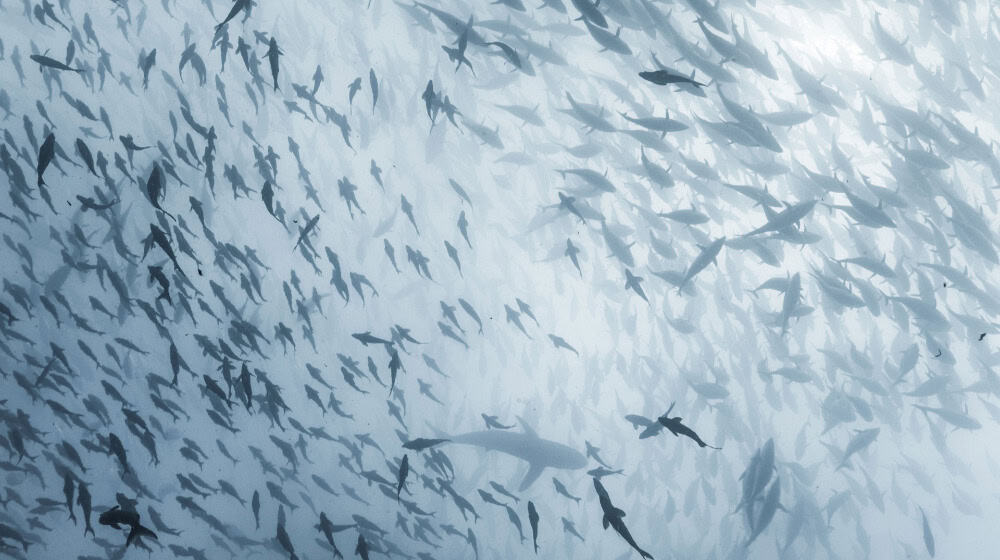
The big pike eats the small perch. The perch eats the minnow. The minnow eats insect larvae. This structure of eating and being eaten keeps bodies of water in balance. However, this is currently changing worldwide. Not necessarily because species are disappearing, but because the composition of fish communities, their body sizes and their roles in the food web are shifting.
Researchers from the German Centre for Integrative Biodiversity Research (iDiv) in Leipzig, together with colleagues, have analyzed data from almost 15,000 fish communities from around the world - over a period of up to 70 years. Their findings have been published in the scientific journal Science Advances: Even where the overall number of fish species shows no clear trend, a lot has changed.
Small fish, big impact
The species composition has shifted significantly in many bodies of water. The proportion of large predatory fish such as sharks, muskellunge and giant groupers is decreasing, while smaller and less specialized species are increasing. "It is said that the small ones are eaten by the big ones - and in nature this is indeed the case: it is a basic ecological rule," says first author Dr. Juan Carvajal-Quintero, who conducted the study during his time at the iDiv synthesis center sDiv. Predatory fish are generally larger than their prey, and this size difference determines who can eat whom. "If the size of predators or prey changes, the feeding relationships shift. This changes the food webs and ultimately the functioning of entire ecosystems."
Food webs are also becoming denser. Individual species interact with a wider range of prey than before. This indicates an increase in so-called generalists, i.e. species that are less specialized. This can mean more flexibility in the short term, but at the same time changes the structure of the entire system.
When disturbances spread faster
Prof. Ulrich Brose, research group leader at iDiv and at the Friedrich Schiller University Jena, explains the ambivalence of the findings. "Increased connectivity can cause disturbances to spread more quickly between species. At the same time, it can also increase the ability to absorb stresses such as warming, nutrient enrichment or fishing pressure." How future food webs will react to global change therefore remains highly uncertain.
Similar patterns have been observed in oceans and freshwaters around the world. It is not a coincidence, but a global trend. Prof. Jonathan Chase, research group leader at iDiv and at Martin Luther University Halle-Wittenberg, emphasizes that the full picture only emerges when thousands of studies are combined. This is the only way to recognize how consistent and widespread this restructuring actually is.
For research, this means that the mere number of species is not enough to assess the state of an ecosystem. Changes in body size, feeding habits and interactions provide decisive indications of the extent to which a system has already changed. Anyone who wants to protect water bodies must also keep an eye on food webs in the future.
Original publication:
Juan D. Carvajal-Quintero, Maria Dornelas, Lise Comte, Juliana Herrera-Pérez, Pablo A. Tedesco, Xingli Giam, Ulrich Brose, Jonathan M. Chase (2026). Degradation of fish food webs in the Anthropocene. Science Advances

