


Arrival of the messengers of happiness: The first storks are back
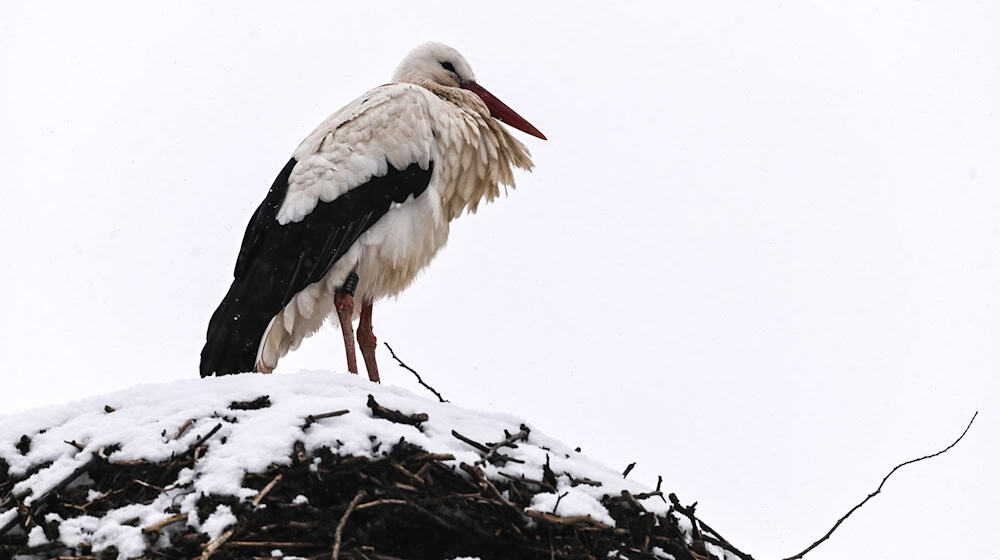
You can rely on Germany's storks: regardless of the current capricious weather conditions, the first white storks have landed on time in their homeland to prepare for the breeding season. Last Sunday, stork Anton landed in Loburg, home of the Storchenhof Loburg bird sanctuary in Saxony-Anhalt, as the first harbinger of the coming spring. In Oberröblingen in the south of Saxony-Anhalt, the first returnee already appeared in January, and in Magdeburg, a pair of storks was even spotted at the train station in December. According to biologist Sophie Hoffmann from Storchenhof Loburg, such behavior is not unusual. In other federal states such as Hesse, up to 300 breeding pairs now spend the winter and roost on wetlands. "They don't sleep in trees, but in shallow water," says the expert. In Loburg, too, a stork that had been released into the wild did not want to head south, but returned to the stork farm after a short time, where it had been treated as an injured animal. Experts distinguish between storks that migrate from the west and those that migrate from the east. The former spend the winter in Spain and have to cover a distance of around 2,500 kilometers in about two weeks - depending on the flying weather. Eastern migrants fly over Poland and the Balkans to Israel and from there on to East Africa. The former stork celebrity from Loburg, Prinzesschen, achieved special flying feats, migrating as far south as the African continent and covering 10,000 kilometers or more in the process. Although this route is longer, it also has advantages in terms of food supply. The westward migration often ends in Spain at many open garbage dumps. Although there are also such dumps on the eastern route, the storks usually continue their journey there and are often referred to as locust birds in some African countries, reports Hoffmann. "Storks are pure carnivores and have a broad food spectrum. This includes everything from snails, insects and earthworms to amphibians, reptiles, fish, mice and moles." Carrion is also gladly taken. The current winter weather is no problem for Adebars. They can even manage without food for a few weeks, explains Hoffmann. In addition, there is still the "winter flight": storks quickly fly to where there is food. In any case, their migration behavior is programmed. "Even injured animals that can no longer fly become restless in the fall. They have the feeling that they have to leave. It's innate to them." However, "innate" does not apply to the migration route: "Whether the first journey of a young stork goes east or west depends on which migration group it joins after it has left its nest, says Hoffmann. The parents usually don't show them the way." Normally, young birds leave the nest about two weeks earlier than their parents, who stay in the breeding area a little longer. "It's as if they finally want to enjoy some peace and quiet." The vast majority of storks that make their home in eastern Germany choose the eastern route for the winter. The "western storks" in south-western Germany, on the other hand, migrate more often to the Iberian Peninsula and take the undecided young storks with them. Only 15 to 20 years ago, the eastern population was dominant in Germany, but since then the populations in the west in particular have developed very strongly. In both East and West, however, storks are considered lucky charms and messengers of spring, which stands for new beginnings and fertility. It is said that where a stork nests, the house is protected from adversity. Christoph Kaatz is considered the father of storks in Saxony-Anhalt. He believes there is still plenty of need for research into the "national bird" of Germany. Although there are no optimal feeding conditions here, the population of white storks is developing very well, especially among the western migrants. "We still have to be vigilant and have a special responsibility. There are still considerable fluctuations in the population." According to figures from 2024, there were around 13,000 breeding pairs in Germany. Every now and then, storks have to survive a catastrophic year. "Young storks in particular find it difficult to cope with heavy rain or long periods of drought. Infections such as bird flu could also have an impact on the population," says Hoffmann. Plastic in landfill sites and composting facilities pose a major threat. The Nature and Biodiversity Conservation Union (NABU) in Thuringia also warns of this. Rubber bands and plastic parts are increasingly being disposed of in organic waste and end up in the food chain via composting facilities or fields. Adult storks gather food there and feed their young with the waste. In Thuringia, the Werra Valley between Meiningen and Creuzburg and the Thuringian Basin north of Erfurt are considered good stork territories. In some places, webcams provide insights into the lives of white storks during the breeding season from March and April. The cameras are used to observe nature, conduct research and promote public interest in species conservation. The first returnees were also spotted in Saxony and Thuringia. According to NABU stork expert Klaus Schmidt, a third of the white storks in Thuringia had already arrived at their nests by last weekend. Depending on the weather, the return of the storks is expected to continue for weeks. In Saxony, the first arrivals were recorded in Schkeuditz, Glauchau and Cunnersdorf. The population trend for storks is positive in all three states. In Thuringia, exactly 180 breeding pairs and 333 young were counted in 2024, compared to only 45 and 86 respectively ten years earlier. In Saxony, there were recently around 470 breeding pairs - also with an upward trend. In Saxony-Anhalt, 775 pairs of storks occupied an eyrie last year. Copyright 2026, dpa (www.dpa.de). All rights reservedMany storks now spend the winter in Germany
Iberian Peninsula and Africa as wintering grounds
Sturrels can cope with winter weather
White stork population developing well
Danger for storks: rubber products in organic waste
First returnees also in Saxony and Thuringia

