


Butterflies on Facebook - and research benefits
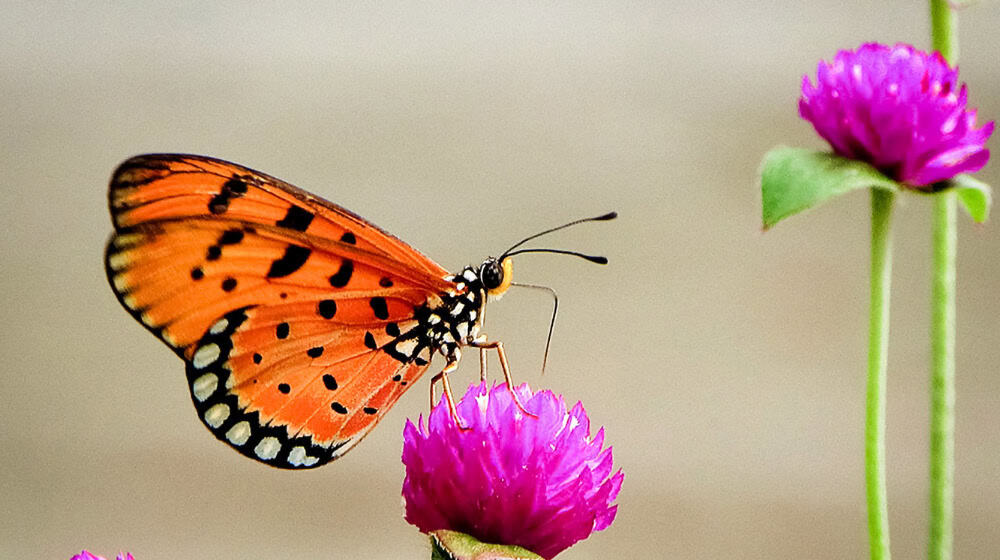
If you take a picture of a colorful butterfly on vacation and post it on Facebook or photo platforms such as Flickr, you're hardly thinking about science. But precisely such photos could help us to better understand the state of our natural world - and to protect it.
A new study confirms this. Researchers from the German Centre for Integrative Biodiversity Research (iDiv) in Leipzig, the Friedrich Schiller University Jena, the Helmholtz Centre for Environmental Research (UFZ) and Monash University have analyzed photos of a South Asian butterfly from Flickr and Facebook. The number of documented sightings of this species increased by 35 percent as a result. The study was published in the journal "Conservation Biology".
Why butterflies count on Facebook
The South Asian butterfly Acraea terpsicore was studied - a striking, easily recognizable species that is currently spreading from India, Bangladesh and Sri Lanka to other parts of South and Southeast Asia. Precisely because it is so distinctive, it often appears in photos on social networks. The researchers combined these images with data from the Global Biodiversity Information Facility (GBIF), an international database for species records. The expanded data set improved so-called species distribution models. These models help to estimate where species occur and how their distribution is changing.
The additionally included social media data provided evidence from regions that were previously hardly represented in scientific databases - for example from higher altitudes or areas with less precipitation. Such conditions in particular play an important role when species shift in the course of climate change. "Social media is not just noise, but provides data that can revolutionize our understanding of species distribution - and often exactly the information we need most urgently," explains lead author Dr. Shawan Chowdhury from Monash University.
Everyone can participate - with limits
Not every species can be reliably identified using a cell phone photo. Moths and beetles, for example, are much less common on social platforms and are often difficult to identify. In addition, species can be confused or photos misinterpreted. Professional verification therefore remains necessary. Nevertheless, the researchers see great potential. Prof. Dr. Aletta Bonn from the UFZ, iDiv and the University of Jena emphasizes how important individual observations are "in order to be able to assess rapidly progressing changes in biodiversity in connection with climate change."
Those who want to make a targeted contribution can use apps such as iNaturalist or the German app Flora Incognita. The observations recorded there are fed directly into scientific databases. The study shows: Photos from social media can also make an important contribution to biodiversity research - if checked by experts.
Original publication:
Chowdhury, S., Hawladar, N., Roy, R. C., Capinha, C., Cassey, P., Correia, R. A., Deme, G. G., Di Marco, M., Di Minin, E., Jarić, I., Ladle, R. J., Lenoir, J., Momeny, M., Rinne, J. J., Roll, U., Bonn, A. (2026). Harnessing social media data to track a species range shift: A case study using the tawny coster butterfly. Conservation Biology.

