

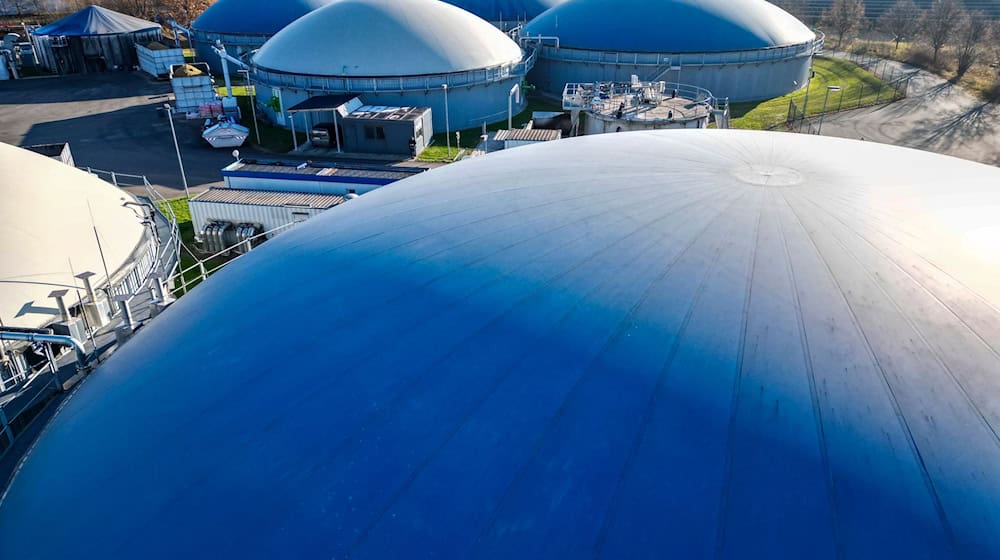
The mood in the German biogas sector was depressed for a long time. Low electricity prices, uncertain political guidelines and higher investment costs put the brakes on expansion. However, there are now increasing signs that the industry is regaining momentum - including in eastern Germany. New investments by large energy suppliers, political signals from Berlin and a slight market recovery are making companies more optimistic about the future. In addition, there is a development in the electricity system as a whole: wind power and photovoltaics have recently achieved record shares - in the third quarter of 2025, 64.1% of the electricity generated in Germany came from renewable energies, according to the Federal Statistical Office. With the growing share of weather-dependent sources, the need for flexible energy sources is also increasing. This is precisely where experts see an important role for biogas. Biogas is produced from liquid manure, dung, plant residues or organic waste and is considered a flexible component of the energy transition. Because it can generally be stored, it can be supplied specifically when electricity is needed, unlike wind and solar power. The Federal Ministry for Economic Affairs and Energy (BMWK) refers to it as a contribution to balancing out the "fluctuating feed-in of wind and solar energy". Dominik Möst, Professor of Energy Economics at TU Dresden, puts it in perspective: Biogas covers around six percent of electricity generation in Germany and therefore has a stable role in the energy mix. However, the theoretical flexibility is often hardly used. "The plants do not have too much flexibility and largely convert the biogas produced into electricity continuously," says Möst. The reason for this is usually small gas storage facilities; larger ones are technically possible, but hardly economically attractive. A visible step comes from Leipzig: in October, the energy supplier VNG took over ten biogas plants in Saxony, Saxony-Anhalt, Brandenburg and Mecklenburg-Western Pomerania via its subsidiary Balance. With a thermal output of around 245 megawatts, the plants can supply more than 221,000 households. Balance operates around 40 plants in northern and eastern Germany, most of them in the new federal states, as well as other sites in Lower Saxony. "Biogas will remain an important growth area for VNG in the future," the company announced in response to an inquiry. The Group plans to invest up to five billion euros in decarbonized business areas by 2035. Biogas and biomethane are considered to be "strategic cornerstones". The new locations are particularly practical for Balance: many are close to existing plants, which facilitates operation, substrate procurement and cooperation with regional service providers. In response to an inquiry, the Federal Ministry of Economics stated that biogas is an important contribution to the energy transition; investments in regional clusters are welcomed because they can provide economic impetus in rural areas. At the same time, new legal framework conditions are being worked on. Bioenergy should be given a clear perspective in the electricity mix of the future. The German Farmers' Association (DBV) sees additional sales opportunities and regional value creation in biogas. At the same time, it warns of unclear political guidelines and fluctuating demand. "Politicians urgently need to take countermeasures," says DBV Secretary General Stefanie Sabet. The association is sending out an ambivalent signal: on the one hand, it sees clear benefits for farms, but on the other, it does not expect the sector to expand without better framework conditions. "Planning security is therefore the most urgent concern of agriculture," emphasizes Sabet. The eastern German biofuel producer Verbio, headquartered in Saxony-Anhalt, which recently suffered from low prices, also sees the market picking up again. The course has been set for a recovery of the biofuel market in Germany, said CEO Claus Sauter recently. New investments, political signals and an improved market situation mean that the industry is regaining hope after a prolonged period of weakness. The Federal Ministry of Economics emphasizes that biogas and biomethane could contribute to reducing greenhouse gases and reducing dependence on natural gas imports. For eastern Germany with its many plants, this could mean An energy source that has long stagnated is once again gaining in importance. Copyright 2025, dpa (www.dpa.de). All rights reservedWhy biogas is important at all
East German gas wholesaler significantly expands biogas portfolio
Federal government signals support
Agriculture: opportunities - and uncertainty
Industry senses slight recovery


