

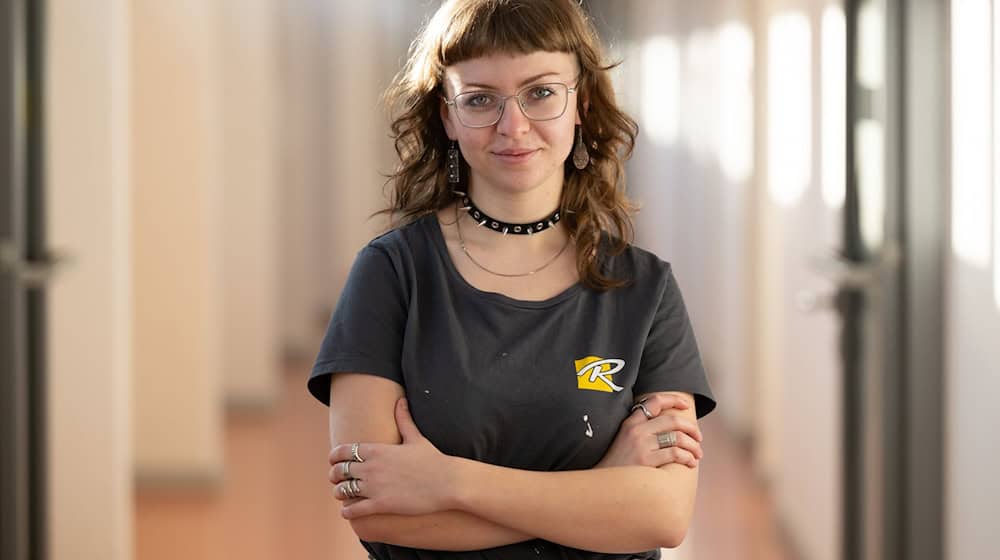
"The AI can't do what you're doing right now," says Paulina Ließner. Advice that her father gave her early on. Using a thin brush, she mixes colors on a palette and carefully strokes a sheet of paper. A color design for a stencil work, she explains. She can later use it to transfer the pattern to a wall or plinth. Ließner is training as a painter and decorator. "Doing what I wanted to do was definitely the main focus," says the 20-year-old. She has a creative mind and wants to express herself instead of sitting at her laptop. But purpose and security were also important to her. "Everyone needs craftspeople," says Ließner. She is in her second year of training at the Dresden-based company Raumkunst Arndt. Like Ließner, other young people in Saxony are also increasingly drawn to the skilled trades. According to the Dresden Chamber of Crafts, around 5,930 new apprenticeship contracts were signed in October 2025 - 17 percent more than ten years ago. In contrast to other sectors, the skilled trades are generally future-proof and therefore attractive for career starters. Most of the new apprenticeship contracts were recently for automotive mechatronics technicians, followed by electronics technicians and plant mechanics for sanitary, heating and air conditioning technology. "But bakers, roofers, hairdressers, bricklayers, painters and carpenters also have more new apprentices in Saxony compared to the previous year," says Andreas Brzezinski, Managing Director of the Dresden Chamber of Skilled Crafts. "AI cannot yet replace craftsmanship and manual skills," says Brzezinski. Nevertheless, artificial intelligence (AI) has long since arrived in the skilled trades. This sector is not immune either, says Bernd Fitzenberger, Director of the Institute for Employment Research (IAB) in Nuremberg. "Nevertheless, fewer jobs are likely to be lost in the skilled trades and the demand is still there," he says. "From smart planning to robotics, AI is a helpful tool in the day-to-day operations of businesses," says Brzezinski. Goldsmiths and carpenters use AI-supported image generation to create designs for jewelry or furniture, and bakeries and painting companies are now also using them. In ophthalmic optics, they help with the analysis of retinal images. "In this respect, AI offers great opportunities for the skilled trades." One person who is open to such applications is Thomas Vogel. "We've been using telephone AI for some time now," says the Managing Director of Dresden-based heating and air conditioning company HTS Haustechnik. The company has been relying on digital solutions for almost 15 years and was relatively early to the game. According to Vogel, the company software is currently undergoing further development. In the coming year, for example, it should be possible for fitters to record their construction diaries and use them to create written and linguistically consistent reports. This will save time and effort. "I think we in the trade will be a big beneficiary of AI," says Vogel. And the changes are already being felt in training too. "When we have time at vocational school, we always like to ask: Can AI do this or not? Or is the textbook the better tool after all?" says Jannis Klein. He is a trainee electronics technician for energy and building technology at Frequenz Elektro in Radeberg. AI can be helpful for longer calculation tasks - at least sometimes. After a temporary job, Klein actually wanted to work in the event industry after school. "But nobody wanted to take me on because nobody could give any guarantees for anything," he recalls. That was during the coronavirus pandemic. So he looked for something "crisis-proof" that he would enjoy. "In our company, AI and the fact that everything is becoming more digital means I definitely won't be out of work next year," says the 21-year-old. WLAN will be upgraded, fiber optics expanded. "The construction-related skilled trades will generally become more attractive because the risks of job losses there are very low," says IAB Director Fitzenberger. With a few exceptions, young people are increasingly avoiding industries in which the use of new technology causes more uncertainty and job losses. This is because security is particularly important to people in this country. However, there is still a lot of catching up to do in the skilled trades. "Many skilled trades are suffering from a decline in applicants. This also has to do with attractiveness problems," says Fitzenberger, such as relatively low wages. "The use of technology can make many of these professions more demanding and therefore also increase earning opportunities," he says. What's more, young people are often tech-savvy anyway. Trainee Ließner originally wanted to study restoration and did voluntary service in heritage conservation. "That was so great," she enthuses today. She restored stucco and uncovered ceiling paintings. But studying was too theoretical for her. "I wanted to do something practical, I wanted to work with my hands," she says. Nevertheless, she can also imagine that new technologies in the skilled trades could appeal to many young people. "Because young people want to do a lot with AI," says Ließner. Creating digital construction diaries, for example, is a good idea. "I think something like that could also help us in the business," she says. Copyright 2025, dpa (www.dpa.de). All rights reservedIncreasing number of apprenticeship contracts in the skilled trades
AI as an opportunity for the skilled trades?
Speak the construction diary, and the report is ready
Event manager or electronics technician?
Attractiveness problems
"Because young people want to do a lot with AI"


