

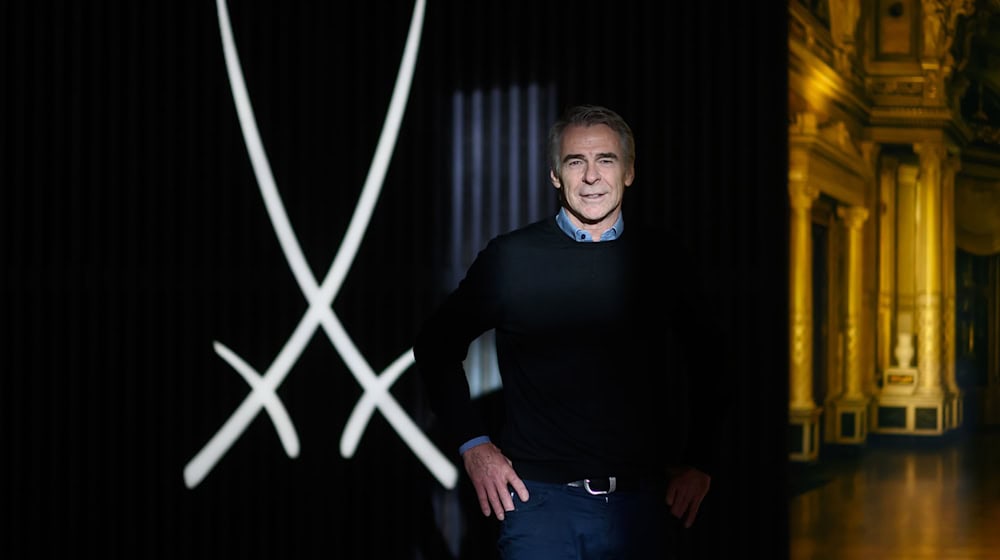
Coffee mugs for on the go, plates in bright colors and baubles for the Christmas tree: Meissen porcelain has long been more than just the good dinner service in grandma's cupboard. "We want to get out of the showcase and into life," says Managing Director Tillmann Blaschke, who has been at the helm of the state porcelain manufacturer Meissen for around ten years. The company with the world-famous crossed swords logo wants to become younger and more modern - and thus out of the red. The porcelain market has changed, reports Blaschke. "The products have to be contemporary and reflect the needs of today." While hand-painted figurines and artistic fine art are particularly in demand in Taiwan, Japan and China, the domestic market has become more fragmented. Porcelain is no longer as much of a status symbol as it used to be, and the large service for the Sunday roast is less in demand, says Blaschke. Instead, tableware for sushi, pasta or ramen is in vogue. In addition to traditional porcelain painting, prints suitable for everyday use have also found their way into the market. The manufactory is also focusing on new markets: next year, the eighth store will be opened in China via trading partners, and the porcelain from Saxony is also to be established in the USA and the Gulf region. In the Arab world, figurines such as the falcon by sculptor Maximilian Hagstotz are in demand. The manufactory boss also sees "huge potential" in Singapore, Malaysia, Thailand and the Philippines. So far, only a few pieces have been sold to these countries - for example to the family of the Thai king. "We want to establish structures there so that we have a continuous business," explains Blaschke. The head of the manufactory believes that the porcelain manufactory, which was founded in 1710, is on the right track. Although the company was not in the black in 2024, it reported sales growth of five to ten percent, and even double-digit growth in the web store. "That gives all those behind Manufaktur a bit of confidence that the work we are doing is going in the right direction." Europe's oldest porcelain manufactory is in a state of flux following the failure of its transformation into a luxury group under former boss Christian Kurtzke. He also produced jewelry, clothing and accessories. The concept failed and the manufactory accumulated millions in losses. The company wants to turn things around by refocusing on its core business of porcelain. Not an easy undertaking: Corona and energy crisis, plus the Russian market with its high purchasing power has collapsed. This alone means a "seven-digit turnover figure" is missing each year. Blaschke points out that several porcelain manufacturers have gone bankrupt in recent years. There are now only four porcelain manufacturers in Germany. Saxony's Finance Minister Christian Piwarz emphasizes the importance of the company and refers to a porcelain tradition that is unique in Europe. "European porcelain was not only invented here, but also produced here for the first time in Albrechtsburg Castle," says the CDU politician, who grew up with Meissen in his parents' home. The Free State feels committed to this heritage. The manufactory is not a museum, but a living production facility, Piwarz continued. This also includes meeting the needs of the respective market. According to Piwarz, it is precisely from this that innovations arise. The aim is for the manufactory to be self-sustaining. Piwarz emphasized that the manufactory is actually doing this quite well. It has increased its turnover in a difficult economic environment. Manufaktur and the Ministry of Finance did not provide specific turnover and profit figures for 2024. The manufactory had made losses in 2023. The operating result fell to minus 3.6 million euros and the overall result after taxes to minus 3.9 million euros. Turnover fell by four percent compared to the previous year to 31.2 million euros. As a shareholder, the Free State is examining "whether and to what extent it can legitimately support the cultural part" depending on the situation, explained Piwarz. Saxony is committed to the continued existence of the manufactory. "This does not mean that individual branches of production - as in the past - will not be reviewed," said the Finance Minister. The manufactory currently employs 480 people in 450 positions, including 40 trainees. 120 men and women work as porcelain painters in Meissen. With fine brushstrokes, they create accents, for example on the famous crater vase or on colorful murals with Amazon motifs. Throughout Germany, only Meissen still offers training in the craft of porcelain painting. "300 years of knowledge must be preserved and passed on," says Blaschke. According to figures, around 200,000 visitors come to the manufactory in Meissen every year, half of them from Germany. Despite the difficult conditions, Blaschke is optimistic: "If the overall economic situation improves, we have a good chance of returning to black." Copyright 2025, dpa (www.dpa.de). All rights reservedHoping for new markets
Oldest porcelain manufactory in Europe
Free state stands by Manufaktur


