


How animal movements influence the survival of entire species
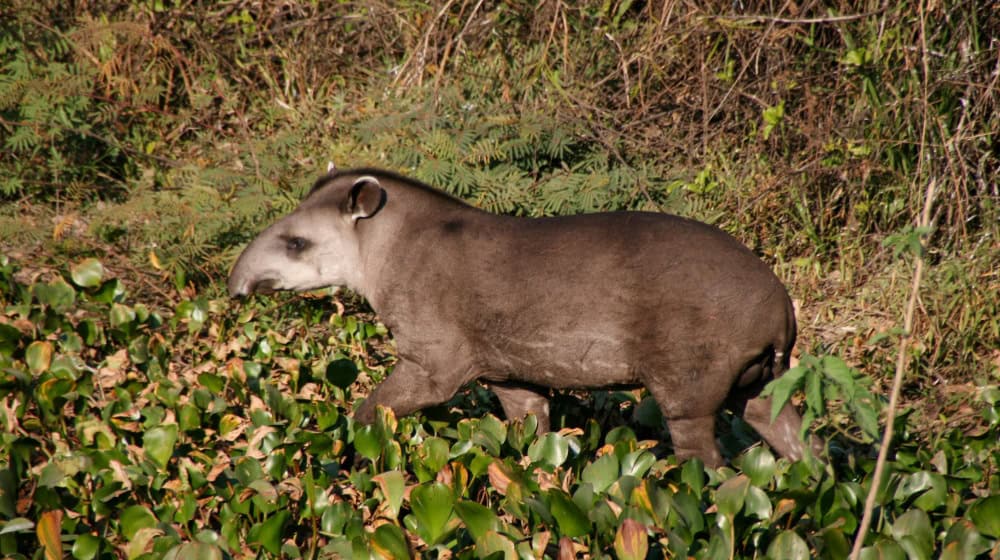
A new highway cuts through the habitat of endangered tapirs. How many animals will cross the road? How many will be run over? And can the population survive in the long term? Conservationists around the world are asking themselves questions like these. But until now, there have been no models that provide reliable answers. Researchers from the Center for Advanced Systems Understanding (CASUS) at the Helmholtz-Zentrum Dresden-Rossendorf have now developed a new theory together with Brazilian scientists. For the first time, it links animal movements directly to the dynamics of entire populations.
"In the 1950s, ecologists began to systematically describe animal movement patterns. Since then, they have been looking for a theoretical bridge to population dynamics," says Dr. Ricardo Martinez-Garcia, lead author of the study, which was published in Ecology Letters. Classical models explain how populations grow and reach resource limits. However, they ignore how individual animals actually move through space.
Old models could not explain observations
Animals use their habitats very unevenly. They usually stay in limited action spaces and only encounter conspecifics in certain areas. "In many cases, observed population sizes could not be explained by previous models," says Martinez-Garcia. The researchers suspected that this was precisely where the key lay.
Modern GPS transmitters and new statistical methods made it possible to precisely record animal movements. Prof. Justin M. Calabrese from CASUS, co-author of the study, explains: "Our theory uses the same movement model that is used to evaluate tracking data. This means that movement analysis and population modeling are based on the same foundation for the first time."
How often do animals really encounter each other?
The biggest challenge was the step from individual animals to entire populations. The solution is a so-called crowding index. It describes how strongly movement patterns affect encounters between animals. "The index shows whether animals avoid each other, specifically seek each other out or behave largely indifferently towards each other," explains Rafael Menezes, who worked on the study.
The comparison with classic models shows clear differences. Depending on the conditions, the new model predicts populations that are sometimes twice as large and sometimes half as large. "A difference that can make a difference," says Martinez-Garcia. The new tool is particularly important where roads, settlements or fences dissect habitats. Only with a realistic description of animal movements can it be estimated whether populations can withstand such interventions in the long term. The new theory thus provides a tool that could fundamentally change species conservation.
Original publication:
R. Menezes, J. M. Calabrese, W. F. Fagan, P. I. Prado, R. Martinez-Garcia: The Range-Resident Logistic Model: A New Framework to Formalize the Population-Dynamics Consequences of Range Residency, in Ecology Letters, 2025 (DOI: 10.1111/ele.70269)

