


No more annoying bike noises
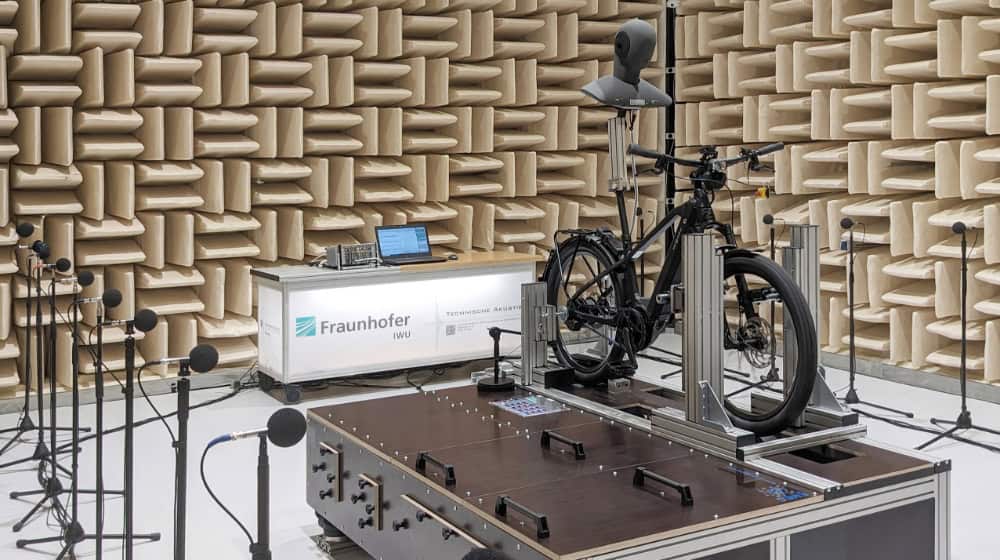
A rattle here, a crack there. Anyone riding their new e-bike for the first time pays close attention to the noises. Is everything in order? Does it sound high quality? These questions often play a part in deciding what to buy. Researchers at the Fraunhofer Institute for Machine Tools and Forming Technology IWU in Dresden have now developed a new test procedure that allows manufacturers to make their bikes quieter even before series production.
Bike enthusiasts value reduced noise as a special quality feature. Quiet running has a positive impact on the riding experience. Rattling or other noises, on the other hand, immediately attract negative attention. "Effective noise optimization is particularly successful when sound sources and their contribution to the overall noise are identified at an early stage," explain the experts. This means that improvements can be incorporated into development in good time and products can be ready for series production more quickly.
Real driving simulated in the laboratory
The Fraunhofer IWU Dresden is working together with EMEC Prototyping GmbH. The partners have developed a special test bench. It simulates real driving situations in the laboratory. Uneven surfaces, load changes when pedaling or vibrations can be simulated in a targeted manner. Even a real driver can pedal during the test.
The test stand is located in an anechoic chamber. This means that sound is not reflected by the walls. This is the only way to precisely measure even the finest noises. High-resolution sensors record airborne sound and structure-borne sound. They detect exactly where disturbing noises arise. Is it the engine? The gearbox? Or a connection on the frame?
From prototype to series production without nasty surprises
Manufacturers can use this technology to test their e-bikes as prototypes. They don't have to wait for customers to complain. The measurements reflect what riders actually hear. A special artificial head records noises as if it were two human ears. This allows developers to know exactly how their bike sounds.
The acoustics team at Fraunhofer IWU contributes its scientific methods. The researchers analyze the entire chain from generation to transmission to sound radiation. They not only provide measured values, but also explain the causes. Noise is usually caused by forces from the electric motor or gearbox. These forces are transferred to the frame and become audible as sound.
The goal of the Dresden researchers is clear: premium bikes should not only look good and be strong, but also sound pleasant.

