


Chimpanzees share better in a group
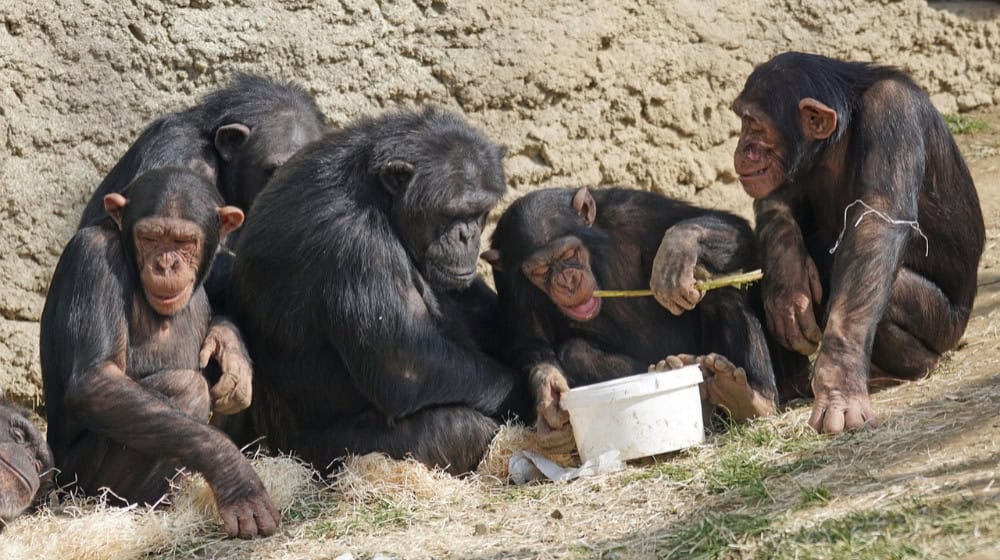
Who hasn't experienced it: the last box of chocolates at Christmas, the shared buffet at the family party. If you grab too greedily, you annoy the others. If you wait too long, you end up empty-handed. Situations like this don't just happen to us humans. Researchers at the Max Planck Institute for Evolutionary Anthropology in Leipzig have now investigated how chimpanzees deal with shared resources. The surprising result: the great apes can definitely act sustainably.
The scientists set the animals a tricky task. A bowl contained yogurt, a favorite food of the chimpanzees. The monkeys were able to reach the treat with sticks. But these sticks also held a lid open. If the animals pulled out all the sticks, the lid slowly closed and no one could reach the yoghurt. "There was a clear conflict between individual food intake and ensuring the availability of the resource for the group," explains first author Kirsten Sutherland.
Four are smarter than two
The researchers tested the behavior in groups of different sizes. This revealed something unexpected. When only two chimpanzees worked together on the task, they usually failed. They pulled out all the sticks and lost access to the yoghurt. The groups of four were completely different. They left a stick in the bowl for an average of 83 seconds longer. "The same chimpanzees that were unable to solve the dilemma in pairs showed more sensitivity in a larger group," says Sutherland. A total of 24 groups took part in the experiment.
Tolerance beats aggression
Groups in which the animals treated each other peacefully were particularly successful. Chimpanzees that usually spent a lot of time close to each other and rarely argued also shared better in the yoghurt test. The Leipzig scientists discovered another important factor: the role of the leader. Chimpanzees live in strict hierarchies. If the highest-ranking ape did not have its own stick and held back, the whole group benefited. "This shows that dominance does not necessarily undermine cooperation," says lead author Daniel Haun. However, if the boss took more than his share, cooperation often collapsed.
The study also has implications for research itself. Until now, many scientists have tested great apes in pairs. The new findings from Leipzig show: This may not be enough. "Chimpanzees are adapted to living in groups," says Haun. If you want to understand how well the animals can work together, you have to observe them in larger groups. For us humans, the message could be: Using resources sustainably works better if we are tolerant of each other and if the powerful set a good example.

