
A greeting from the kitchen is often part of larger menus - as a tasty introduction to what's to come in the next hour or two. At Anna im Schloss, however, the service also sends a greeting as part of the cooking star hours, and a really great one at that: The four-course menu is accompanied by wines from the Schuh winery in Saxony - and a glass of sparkling wine is now added as a surprise greeting. Incidentally, the debut was premiered at the Semper Opera Ball, which took place just in time for the start of the Kochsternstunden. The base wines for this sparkling wine come from Pinot Blanc grapes from the 2023 vintage and were matured half in stainless steel tanks and half in wooden barrels. After traditional bottle fermentation, the sparkling wine matured on the fine lees for 16 months. From the base wine to the disgorgement, each bottle was produced entirely at the winery.
This was a tasty, sparkling start - and also a good introduction to the topic of Saxon wine. For Tim Graul, who has been running Anna im Schloss since April 2022, one thing is clear: "The Cooking Star Hours are intended to strengthen the region's gastronomy - but we also want to support our regional suppliers!" A good and important idea that is clearly reflected in the menu: the char in the second course comes from Forellenhof Ermisch, the cheek of the Saxon straw pig has the Genießergenossenschaft Sachsen as a proven source (they were winners of the Innovation Award Animal Welfare 2024).
Saxon wines from Weingut Schuh to accompany the menu
When it comes to accompanying wines, Graul almost has a unique selling point, as Saxon wines have a hard time finding their way onto the menu at competing restaurants. One explanation is certainly that the local wines are still quite price-intensive - but that is ultimately all a question of calculation, other good wines also have their price. Of the 50 participating restaurants (if I haven't miscounted), only just under a third (16 to be precise) offer wine from Saxony. The full program - i.e. a wine with every course - is of course available in the three participating wineries - but otherwise only at Anna and the pop-up at Küchen Weigelt in Pirna. The statistics table counted 36 wines from Saxony out of 233 in total - that's just 15.45 percent.
The menu started with a Beeftatar - a popular starter this year. I had it the day before at Caroussel and was to have another version the next day at 1328. It's exciting to see how different chefs interpret this classic differently. At Anna, I liked the lightness and the hint of spiciness that came from the mustard. Because even light spiciness is still too much for some guests, the kitchen arranges the mustard separately. That's not a bad thing - but it's a shame that many people's tastes seem to have settled at a very moderate level (especially when it comes to spiciness and bitterness, which, unfortunately, is then consequently bred out of the radicchio or chicory). The accompanying wine was a 2024 Pinot Blanc & Chardonnay - aged partly in barriques (225 l) and partly in 600-liter half-barrels. Two different types of barrels, two different grape varieties - that adds up to a certain complexity.
Experienced restaurant operators work out in advance how well a wine goes with the accompanying food (or was it the other way around? Never mind!). Experience plays a major role, but sometimes you also have to be lucky. So it was only at the rehearsal dinner (together with winemaker Matthias Schuh) that Scheurebe was served with the sashimi of Saxon char from Forellenhof Ermisch
. A Scheurebe can sometimes come across as a little rough, but this one is on the light side, and the 11.5% alcohol content underlines its freshness. The ideal lunchtime wine and - as you can see if you study the label closely - also a sign of help among winemakers: the 2024 vintage was very minimalist in Saxony due to frost, this is a German wine with grapes from additional purchases. Is that a bad thing? I wo: it should taste good, and the wine does. The char was in line with the trend towards lightness, with a little bite and spice coming from the bacalao and the mix of orange, radish, chili and coriander.
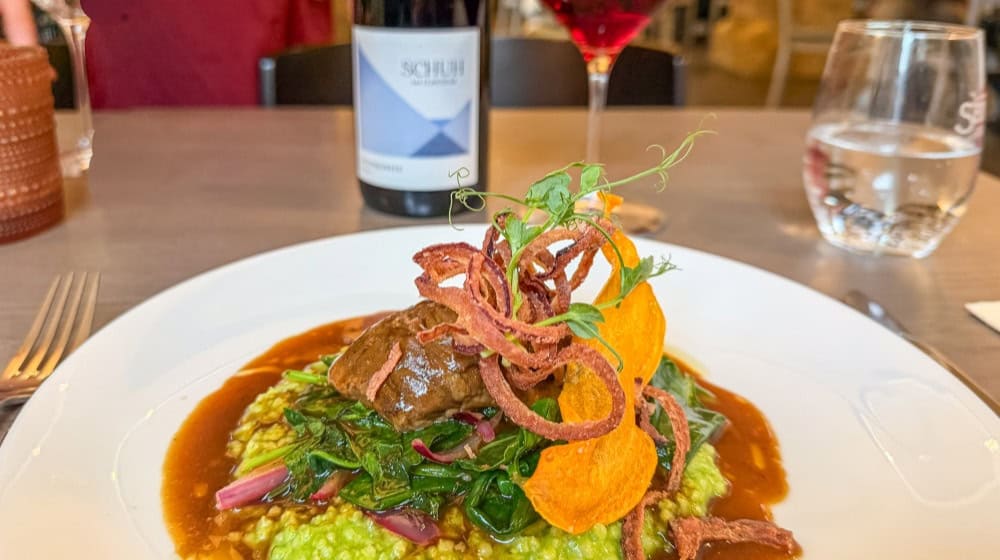
You rarely see dishes with pork outside the pork shank houses anymore - industrial animal husbandry has spoiled many people's appetite for it (and the watery parts don't really taste good either). But there are still farmers who look after their animals with heart and mind - resulting in excellent meat on the plate. At least when the chef continues his careful work and treats the meat in such a way that you rave about it afterwards. The cheek was enthroned on top of only lightly steamed crispy spinach, which in turn lay on top of a sloppy millet risotto. Together with a good sauce, this not only created a beautiful appearance, but also a wonderful combination of flavors. The accompanying wine was a 2023 Pinot Noir Barrique - drinkable proof that the mineral-rich soils in the Elbe Valley can produce elegant Pinot Noirs with lively fruitiness, perfectly harmonious acidity and wonderfully fine tannins.
Menu
- Beeftatar
Tomato | leek | mustard - Sashimi of Saxon char (Forellenhof Ermisch)
Bacalao | orange | radish | chilli | coriander | hazelnut - Beck of Saxon straw pork (Genießergenossenschaft Sachsen)
Spinach | millet | chives - Limoncello cake
Mascarpone | hazelnut
Paired with drinks
- 2023 Pinot Blanc Brut Nature
- 2024 Pinot Blanc & Chardonnay, Weingut Schuh, Saxony
- 2024 Scheurebe, Weingut Schuh, Saxony
- 2023 Pinot Noir Barrique, Weingut Schuh, Saxony
- 2024 Riesling Kabinett, Weingut Schuh, Saxony
Info
- 3-course menu 54 €
incl. Wine pairing 74 € - 4-course menu 67 €
incl. wine pairing 92 €
Anna im Schloss
Schloßstraße 27
01067 Dresden
Tel. +49 351 79511535
anna-dresden.de
[Visited on February 11, 2026]