

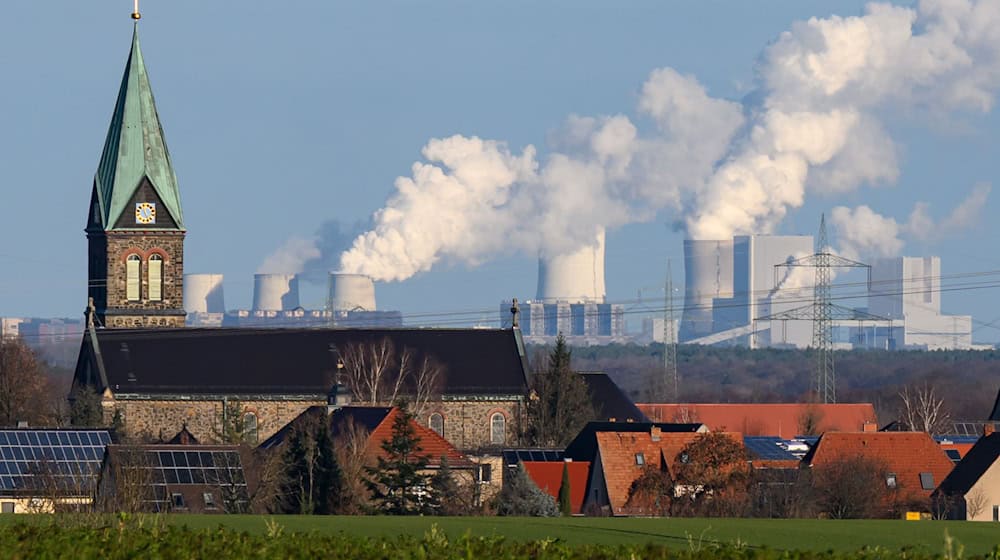
In Upper Lusatia, people are concerned about the success of structural change. This is because the region in the districts of Bautzen and Görlitz continues to be characterized by emigration and job losses. "In the Coal Commission, we wanted to send a clear signal to the younger generation: It's worth staying in Lusatia," Bautzen state parliament member Marko Schiemann told the German Press Agency. However, after the first third of the envisaged timetable, the CDU politician does not see sufficient impetus for this goal and the structural change is at risk. "The coal phase-out is a reality - the new factory buildings in Upper Lusatia are not yet. We finally need more speed for this," explained Schiemann. Only industrial jobs, infrastructure, education, research and development as well as an improvement in the quality of life in the communities could ensure the future viability of Upper Lusatia. According to Schiemann, 10,000 replacement jobs must be created in industry to compensate for the phase-out of lignite. In addition, the region must finally be better connected to the transport infrastructure - through a six-lane expansion of the highway 4 (Dresden-Görlitz), electrification of the railroad line from Dresden to the Polish border and the expansion of federal and state roads. Other points concern locations for research and development, help with education and training. "We need more impetus to strengthen competitiveness and create well-paid and attractive jobs. To this end, the German government must finally define growth-promoting framework conditions," said Schiemann. "The motto must be: Not manage, but shape." The CDU politician points to drastic upheavals in Upper Lusatia. Since 1990, around 100,000 jobs in industry have been lost here - especially in the textile industry, mechanical engineering, wagon construction, lignite and the energy sector, as well as in the glass industry, agriculture and the automotive industry. After 1999, the existing economy had adjusted to the competitive conditions and the equity ratios of medium-sized companies had risen. The construction crisis up to 2004 and the banking crisis up to 2012 then caused another shock. "After that, SMEs stabilized further and became competitors with good quality. 95 percent of all industrial products are sold from Upper Lusatia to various regions in Europe and the world," explained the MP. However, the high energy costs and subsequent inflation would threaten the development of structural change. Energy-intensive companies in particular would be affected and would have to close by 2025, Schiemann emphasized. Examples he cited included the Bernsdorf and Schwepnitz glassworks with 100 jobs each, the Tschernitz glass factory in neighboring Brandenburg with 300 jobs, the Wetro fireclay factory (200 jobs) and the MFT Motorenwerk Cunewalde (90 jobs). The development can also be seen in the falling population figures. "In 1995, there were still more than 717,000 people living in the districts of Görlitz and Bautzen; in 2024, there were 180,000 fewer," said Schiemann, calling for a change in federal policy. The mistakes of an expensive energy policy must be corrected and regulations must be put in place to create new jobs. "The federal government must finally recognize the dramatic nature of the development." Copyright 2026, dpa (www.dpa.de). All rights reservedCoal phase-out is a reality - new factory buildings are not
Upper Lusatia needs 10,000 replacement jobs
"Don't manage, shape"
Drastic upheavals in Upper Lusatia since reunification
High energy costs threaten structural change
Population in Upper Lusatia is shrinking


