

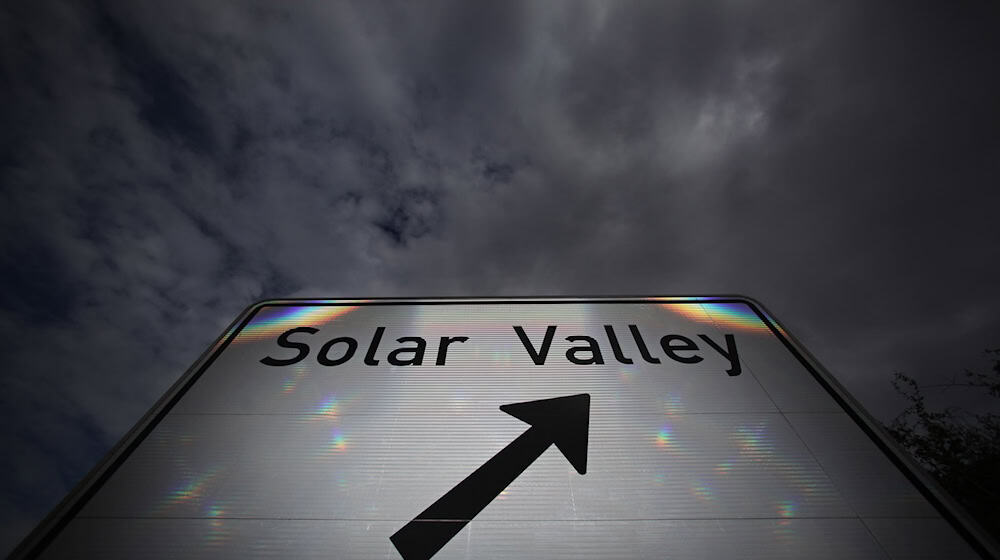
The end of Solar Valley stands in a corridor more than a hundred meters long and is stacked on pallets almost to the ceiling. Solar modules wrapped in foil are lost in the darkness of the corridor. Shortly before the end of the year, small groups are led past them through the production halls where ministers and top politicians used to have their photos taken in front of shiny black solar modules. Now, small numbers are stuck to shelving systems, production facilities, tables - even office potted plants. The inventory of Meyer Burger, the last major solar module manufacturer in Germany, is going under the hammer. "The rise was pure departure - you could feel what people achieve when they are enthusiastic about a mission," says Gunter Erfurt. Until the fall of 2024, he was Managing Director of the Swiss manufacturer Meyer Burger with its production sites in Bitterfeld-Wolfen and Freiberg in Saxony. Erfurt is considered one of the most committed representatives of the solar industry in Germany. Meyer Burger filed for insolvency in 2025. Today, Erfurt says: "The solar industry in Germany is in a pitiful state." With the demise of Meyer Burger in 2025, the last great hope of a return to industrial photovoltaic production in Germany has been dashed for the time being. Once again. At the same time, the expansion of PV systems continues. It seems like a paradox: Germany is expanding solar, but is hardly producing any solar. The Solar Valley in the east of Saxony-Anhalt is an example of the development of the market in Germany. Here, the upheaval is not abstract, but visible: halls that once promised a future are now being emptied, their inventory auctioned off at industrial auctions. The old reception building of the industrial area at the entrance to "Sonnenallee" stands like an abandoned frontier. "Unfortunately, Solar Valley has not existed in its original form for ten years now," says Carsten Körnig, Managing Director of the German Solar Industry Association. He has been following the development of the solar industry for 30 years. "Germany was once a pioneer in the solar industry." The "Solar Valley" emerged shortly after the turn of the millennium and was considered one of the largest centers of the solar industry in Europe. Numerous companies settled in the industrial area in the Bitterfeld district of Thalheim. There were up to 3,500 jobs. Then, around 15 years ago, the first decline of the manufacturers of solar modules and their preliminary products began, says association head Körnig. With massive, sudden cuts to subsidies, the black-yellow coalition around 2012 caused domestic demand to plummet by 80 percent. Companies suffered a drop in turnover of between 80 and 90 percent. At the same time, China massively expanded production and flooded the global market with cheap solar modules. Numerous companies in Solar Valley went bankrupt. According to the industry association, the German solar industry lost around 100,000 of its 130,000 jobs at the time. The market is now in Chinese hands. According to the International Energy Agency (IEA), China accounted for 75 percent of global module production in 2022. "The figures speak for themselves and the situation has not improved since then," says Körnig. In 2021, Meyer Burger tried to bring production back to Germany by setting up its sites in Saxony and Saxony-Anhalt - to no avail. "We have allowed a technology that comes from Germany and was developed here to be handed over," says the former Meyer Burger CEO Erfurt. In the meantime, there are no longer even any announcements in the industry that anyone takes seriously. "I wouldn't say that the solar industry is dead," counters Ralph Gottschalg. He is the director of the Fraunhofer Center for Silicon Photovoltaics in Halle (Saale) and a professor at Anhalt University of Applied Sciences. The institute was founded at the time to support Solar Valley. "Unfortunately, the first trough was already there." The market has changed dramatically over the past 20 to 30 years. Germany will not be able to compete for standard products - "for everything that is packed in containers". China will always be cheaper. But there are niche products, such as façades with photovoltaics, which cannot be packed in containers. The market is still huge there too. At the same time, Germany continues to be a leader in research. And also in the so-called downstream market, i.e. the trade, installation and maintenance of systems. "In terms of economic benefits, this is also not to be sneezed at," says Gottschalg. The German Solar Industry Association speaks of around 150,000 employees in the solar industry in Germany. There are more than 20,000 companies in Germany that offer photovoltaic systems or services for the solar industry. In terms of research, some companies are still based in eastern Germany, he said. The original Solar Valley is therefore still radiating into the present day, says Managing Director Körnig. Innovative companies from the Solar Valley region are still internationally sought-after technology partners. However, they need clear prospects for the future. "In principle, there is still the possibility of a renaissance of the solar industry in Germany and Europe." However, the best research cannot deliver in the long term if the industry is no longer there, argues former company boss Gunter Erfurt. However, there are various approaches among experts as to how the industry can be saved, for example, there could be incentives or bonuses for the use of German solar modules. However, opinions differ on the subject of subsidies and tariffs. The fact is, says Erfurt, that there are no more options if politicians do not take action now. "I am hopefully known as an optimist: It's only too late when we lose the technological basis to do anything." Copyright 2026, dpa (www.dpa.de). All rights reservedRise and fall in Solar Valley
Sales slumped by up to 90 percent
Massive expansion in China pushes down prices
"I wouldn't say that the solar industry is dead"
Tariffs, bonuses, subsidies: Experts see various options


