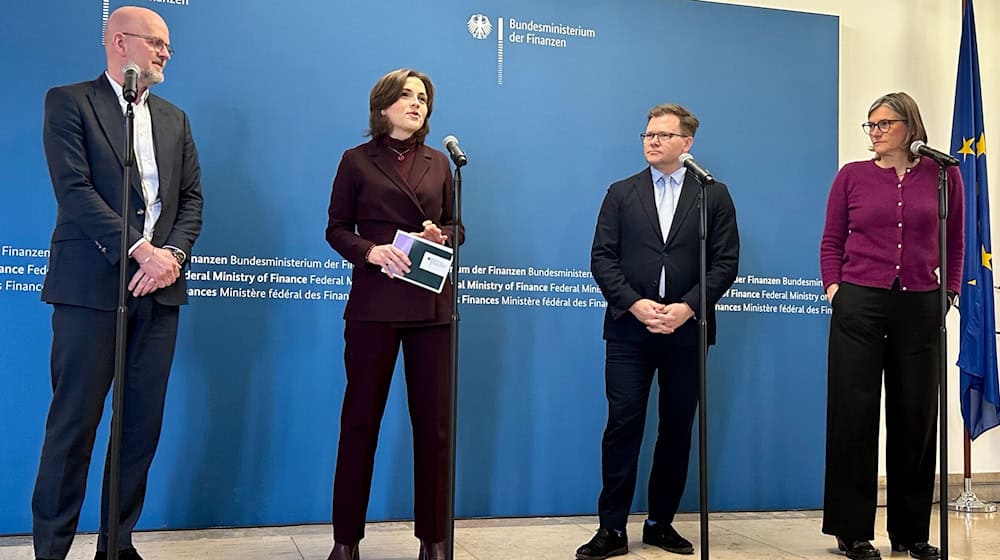
Most cars are produced in western Germany - but many jobs in the eastern German states also depend on the industry. Electric cars in particular have a strong foothold here. However, the conditions for the locations could be better, as became clear at the so-called Automotive Industry Dialogue, at which representatives from industry, trade unions, the federal government and the federal states met at the invitation of Elisabeth Kaiser (SPD), the Federal Government Commissioner for Eastern Germany. One problem: according to participants, suppliers have difficulties getting money from banks. This is one of the reasons why he wanted to send a clear signal with the purchase premium for electric cars that vehicles with range extenders and so-called plug-in hybrids should also be subsidized in addition to purely electric cars, said Federal Environment Minister Carsten Schneider (SPD). Plug-in hybrids are cars that can run on both electricity and fuel. Range extenders are small combustion engines that increase the range of electric cars. Winning skilled workers is also necessary, said Kaiser, especially in view of a shrinking population, particularly in eastern Germany. In addition to training young people, this also requires immigration. Schneider praised VW's decision to focus on recycling at the Zwickau plant. This is very job-intensive and helps to secure the location. The recovery of raw materials from old cars is important, also to make the company less dependent on foreign suppliers. IG Metall boss Christiane Benner agreed with him, saying that batteries in particular could be recycled. Andreas Rade, Managing Director of the German Association of the Automotive Industry (VDA), said of the future of eastern German car production sites: "We have invested billions." Now it is important to accelerate the ramp-up of electromobility through the purchase premium and cheaper charging current. "And the second thing is that we have to be competitive compared to the global situation." Prior to the meeting, Benner had called for clear, binding location commitments, which Kaiser had also demanded. A total of 60 percent of all passenger cars produced in eastern Germany last year were electric cars. This is according to calculations by the Leipzig-based initiative Automotive Cluster East Germany (ACOD) based on figures from the German Association of the Automotive Industry (VDA). By comparison, electric cars account for 35.1 percent of production in western Germany and 40.2 percent in Germany as a whole. In absolute figures, however, more electric cars are produced in the west, as are more cars overall. The focus is on Bavaria, Lower Saxony and Baden-Württemberg. The high proportion of e-cars in the eastern German plants is mainly due to the pure e-car locations of Tesla and VW. By 2020, the Wolfsburg-based company had converted its plant in Zwickau into the first pure e-car plant, where Audi and Cupra models are also built. In 2022, the US e-car pioneer Tesla opened its only plant in Europe in Grünheide near Berlin. There were no car factories in the state until then. Brandenburg was therefore the first federal state in which only e-cars were built. However, Saxony accounts for the largest number of units in the east. In addition to VW Zwickau, there are also the BMW and Porsche plants in Leipzig, where e-cars are built alongside combustion engines. With the launch of the BMW i3 in 2013, BMW Leipzig was even the first German plant to build electric cars. However, demand for the small, original electric car remained negligible. The Managing Director of the ACOD, Jens Katzek, told dpa that well over 200,000 people work in the automotive industry and its suppliers in eastern Germany. This means that proportionally more industrial jobs in eastern Germany are linked to the automotive industry than in western Germany. However, the pressure to make the transition to electromobility work is also particularly high. Copyright 2026, dpa (www.dpa.de). All rights reservedFinancing problems for suppliers
Recycling at VW in Zwickau
High proportion of electric cars in eastern German production
More cars are produced in western Germany
Only e-cars are built in Brandenburg
Economic factor automotive industry