


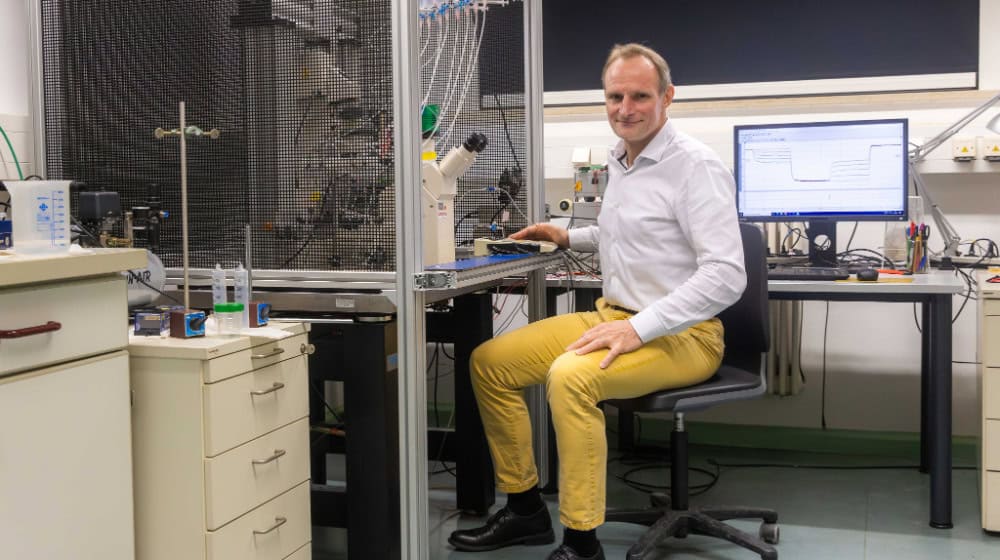
When the heart races or the gut rebels, complex processes take place in the body. Researchers at Leipzig University and TU Dresden can now control such processes with light. They have developed tiny switches that turn biological functions on and off using light pulses.
The scientists are using a clever trick. They combine active substances with a light switch. Violet light opens certain passages in the cells, blue light closes them again. These passages are called ion channels. "With this new method, we can control the functions of cells and organs very precisely," explains Prof. Dr. Michael Schaefer. He heads the Rudolf Boehm Institute for Pharmacology and Toxicology at Leipzig University.
Like a light dimmer for bodily functions
Ion channels function like gates in the cell wall. They regulate which minerals enter or leave the cell. Sodium, potassium and calcium, for example. These gates are normally opened and closed by electrical signals or messenger substances. The Leipzig researchers are investigating two such channels called TRPC4 and TRPC5. They are important for the brain, adrenal glands and digestion.
The special thing about the new molecules is that they act like a dimmer for light. Depending on the color of the light, the effect is stronger or weaker. Violet light activates the ion channels, blue light inhibits them again. The researchers have already tested the method. They were able to activate nerve cells in the brain using light. The release of the stress hormone adrenaline from the adrenal gland could be controlled by light impulses. Even the movements of the small intestine reacted to the light stimuli.
Where exactly the switches dock
Together with colleagues from Leeds and the Max Planck Institute in Dortmund, the Leipzig researchers found out exactly where the light switches dock to the channels. They used a special microscope to visualize the binding sites. Experiments with mice showed that the switches work very precisely. They only affect the desired channels and nothing else.
Prof. Dr. Oliver Thorn-Seshold from TU Dresden is leading the project together with Schaefer. The teams are currently investigating other organs in which the two ion channels are active. They are also developing new variants that work with longer wavelength light. Red light penetrates deeper into the tissue than violet or blue light. The light-controlled switches could help to better understand bodily functions and develop new therapies in the future.

