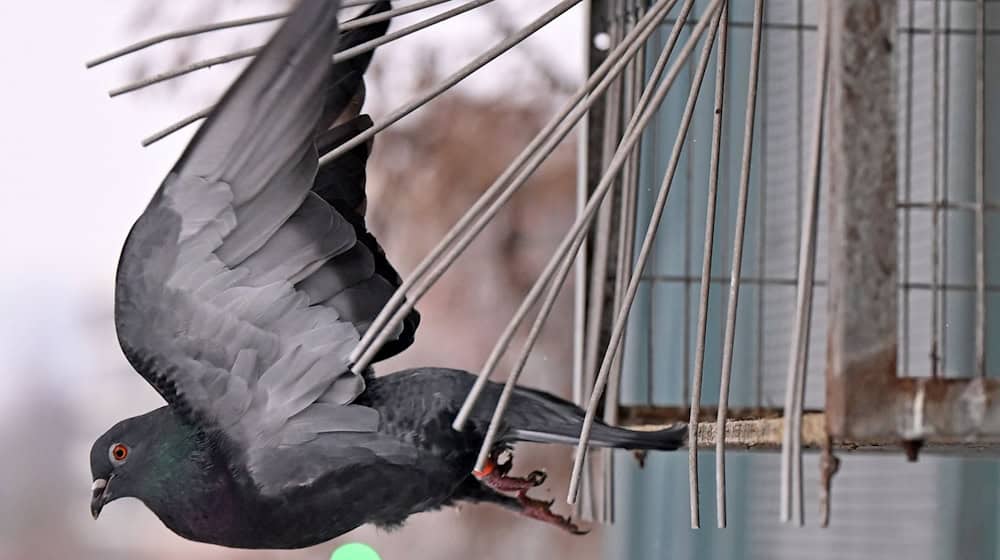
Care for them or leave them to their own devices: Whether at the Bayerischer Bahnhof in Leipzig or the main station in Dresden - pigeons quickly become a problem. Too many animals creating too much mess. So how to deal with the birds? While the cities rely on feeding bans, voluntary initiatives focus primarily on animal welfare. Care and good food should put an end to the endless filth. The cities are not yet convinced. But why are measures necessary at all? Too many pigeons are often seen as a problem. Whether homeowners or the local authority: in large flocks, they quickly become unwelcome guests. City pigeons find a good range of nesting opportunities in cities in particular, explains Sabine Krause from the Dresden City Pigeon Initiative association. As descendants of the rock pigeon, the animals feel particularly at home on and in stone walls, adds Konstanze Radke from Stadttaubenhilfe Leipzig. At the same time, a number of homing and breeding pigeons end up in the city every year, according to Radke. According to a study from 2022 to 2024, between 12,000 and 24,000 breeding pairs live in the Free State of Saxony alone, according to the State Ministry for the Environment. Local authorities are not legally obliged to take care of the animals. Pigeons are considered stray animals, explained the city of Leipzig on request. Care and maintenance are therefore voluntary. The three largest municipalities in Saxony nevertheless intervene to regulate the situation. In Leipzig, Chemnitz and Dresden, for example, there are bans on feeding the animals. Leipzig and Dresden justify the ban primarily on the grounds of infection control, while Chemnitz focuses on wildlife protection. A violation can lead to a fine of up to 5,000 euros in the state capital as well as in Leipzig. However, the food supply is not at all decisive for the size of the population, says Krause. "All the food they find here is not appropriate for the species," she explains. Above all, this leads to a lot of diarrhea in the animals. The feral pets are also not used to looking for food in meadows. Instead, they fall back on garbage. The two associations therefore consider feeding bans, as they exist in the largest cities in Saxony, to be ineffective. According to Marta Broll, also from the Dresden City Pigeon Initiative, it is cruelty to animals, as the birds have no chance of finding species-appropriate food. The animals, often the offspring of domestic, breeding and racing pigeons, often breed all year round. The pigeons lay eggs even under the most adverse conditions, Radke confirms. According to Broll, domesticated pigeons breed between six and eight times a year. Wild pigeons, on the other hand, only lay once or twice. So far, there are no overall municipal concepts for dealing with urban pigeons. The city of Dresden refers to private pigeon lofts in the city. The Stadttauben-Initiative Dresden association maintains four in Dresden. For example, a pigeon loft with 350 pigeons was set up at Mitte station in the fall of 2018. The pigeon lofts, in which the eggs of the breeding pairs are replaced with artificial eggs, are used to regulate the population. Every year, over 1,800 eggs are replaced at the station alone, explains Broll. Across the city there are almost 4,500 eggs. In addition, volunteers collect up to 10 kilograms of droppings from the pigeon loft every day. The animals spend almost 80 percent of their day here. This has significantly reduced pollution in the surrounding area. The concept is based on the Augsburg model. More than 20 years ago, lofts were built for all pigeons and eggs were exchanged. The effectiveness of these pigeon lofts in regulating the population is unknown, according to the city of Dresden. The association confirms that there would have to be a pigeon loft at every hotspot for efficient population control. However, this would require more support from the city: above all, there is a lack of space for new pigeon lofts. More volunteers can be found. The city of Chemnitz speaks of three pigeon houses, which are looked after by the "Tierschutzverein Chemnitz und Umgebung e.V.". However, as the association announced on request, these pigeon houses were closed due to a lack of funding. Some of the pigeon lofts have been demolished. There is currently a lack of any initiative for the pigeons in Chemnitz. In Leipzig, the number of pigeons is not known, according to the city. However, the public order office assumes there are several thousand. There is currently no money to support a voluntary project, explains a spokesperson. However, the effectiveness of pigeon lofts is doubted. The Stadttaubenhilfe association in Leipzig has three pigeon lofts. One of them is located behind the Bayerischer Bahnhof train station. Around 200 animals are cared for here in a similar way to Dresden. Together with Deutsche Bahn, the aim is to get the pigeon problem at the station under control. In order to manage the pigeon population in Leipzig even more effectively, the association would need support from the city. Empty buildings in particular offer the animals favorable conditions for breeding. Here, too, the association would like to exchange eggs to reduce the spread. But the association is also happy to accept new places for a dovecote. "It would just be nice if they would listen to us," says Radke. After all, the animals are only in the city because of people. Copyright 2026, dpa (www.dpa.de). All rights reservedCities as a paradise for pigeons
The status quo: thousands of breeding pairs in Saxony
Animals breed under all circumstances
Voluntary initiatives instead of municipal concepts
Lipzig helpers also rely on pigeon lofts