190 years is not exactly a round anniversary - but hey: who knows what will happen in ten years' time? You have to celebrate the festivals as they fall! So let's head to Count Wackerbarth and his successors, where they are committed to the 190-year-old Saxon sparkling wine tradition and are celebrating accordingly. On average, 250,000 bottles of sparkling wine are produced every year in the cellars at the foot of the Wackerbarth mountain - but the Wackerbarthers often sail under the radar in their home country with their good quality. So it's off to the estate's own restaurant for further training, where the wines and sparkling wines are of course always available, but where you can get a guided insight into the variety of bottle-fermented sparkling wines (that's what it's called!) during the cooking star hours under the motto Sekt & Sterne.
So the magic number is 1836. That was the time when people were still quite uninhibitedly imitating the model of the eight champagne. The pioneers were Kessler in Esslingen in Württemberg, Grempler in Grünberg in Silesia (now Zielona Góra) and then Bussard in Radebeul - all with the active support of cellar masters who had been poached from Champagne. But what the heck: it had to taste good - and it did! The three Saxon vineyard owners who founded the Actienverein zur Fabrikation moussierender Weine in 1836 (which later became the Bussard sparkling wine cellar, which joined Wackerbarth much later in the 1970s) also enlisted the help of cellar master Johann Joseph Mouzon from Reims. His skills continue to have an effect, even if today (EU law wants it that way) the term champagne is reserved only for sparkling wines from Champagne - as a Dresdener you know that, it's not much different with Stollen...
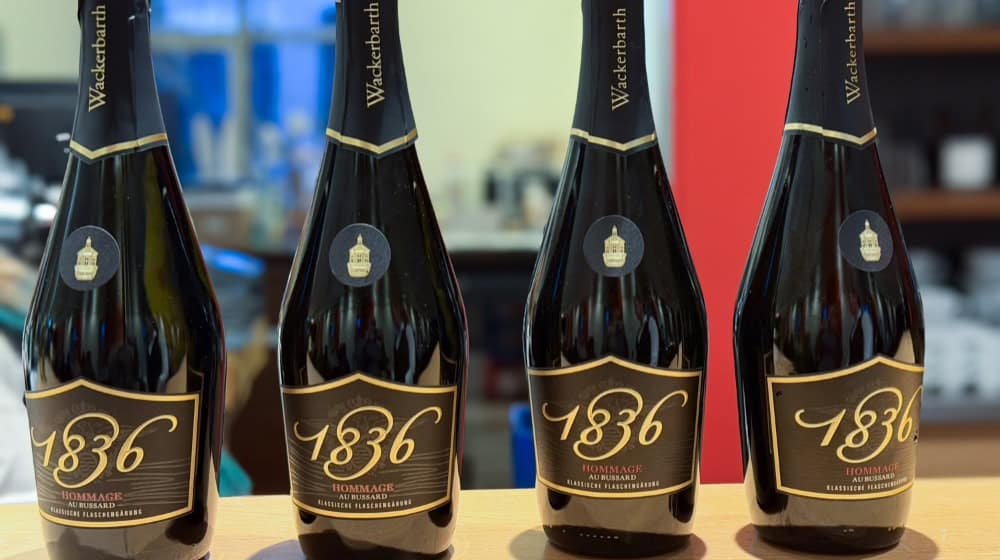
But in the meantime, many sparkling wine makers in Germany are also producing remarkably cool stuff, which means that the first sparkling wine is now (finally!) coming into the glass! It's called 1836, strictly speaking: 1836 Hommage au Bussard weiß extra trocken (retail price at the winery: €17). The style is traditional bottle fermentation with 24 months of ageing on the lees (the regulation for sparkling wine is 9 months), and the mix of grape varieties in the cuvée is a bit Saxon: Riesling, Pinot Blanc and Pinot Gris. Extra dry could confuse inexperienced drinkers (m/f/d), but the designations for sparkling wine are rather misleading: where it says dry, the taste is already quite sweet, and extra dry with (in this case) 12 g/l residual sweetness is no longer fart-dry (since you don't write that on labels, of course, it says Brut Nature...). However, as the Riesling has a nice acidity, you don't really taste the 12 grams of residual sugar, and sometimes even more residual sweetness goes down with food.
Cooked to match the sparkling wines
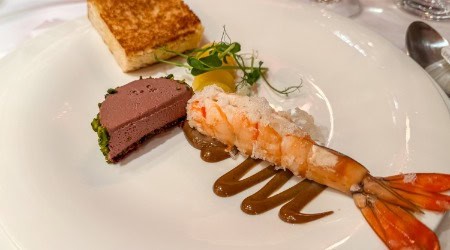
Wackerbarth's head chef Karsten Häusler knows this, of course, as he knows the wines and sparkling wines of the house. And so the 1836 not only played the role of aperitif, but also made a great accompaniment to the venison crispy praline in a strong game consommé. The service had to pour more! At this point, we should perhaps pass on one or two observations about this very service. There were six of them, which sounds like a lot - but with just under 50 guests who all wanted to be served at the same time (the menu runs as an event with a common start), it was just right. Under the direction of restaurant manager Claudia Bellmann, the trainees were in the majority - but they did their job like old hands. It was a pleasure to watch them: smiling, with a firm gastronomic stride and then with proper explanations to the guest. They'll be something - if they can keep it up in their exhausting everyday lives...
The menu reflected a best of some of the long-standing event formats at Schloss Wackerbarth - the consommé is served with wine & game, and the second course comes from the champagne &truffle evening. Raviolo | egg yolk | ricotta | truffle | Parmesan espuma was also an example of how even convinced dry drinkers (i.e. the real dry) can get along with a drink that is only called dry. The Edition Frauenkirch trocken is one such example: with 28 g/l residual sweetness, it's something that doesn't please my palate at all (and of course: other people have different tastes and like it!). But in combination with egg yolk, truffle and espuma, the impression of sweetness disappeared as if by magic. Crazy!
Encore: a very special Riesling
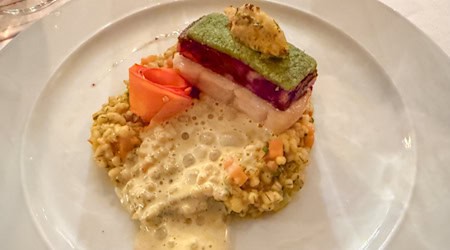
The white version of the traditional coq au vin, which is usually made with red wine, was served with the main course - as Pollo fino "Coq au Riesling". I thought that you should actually drink a Riesling with it! But that wasn't on the menu, so a glance at the restaurant's extensive menu brought me closer to the solution: it had to be a Protze. Protze: this is the name of the plot in the Goldener Wagen, which is even more special than the Goldener Wagen vineyard, which is already very good overall. Protze Riesling is awesome, but unfortunately there are only ever a few bottles (around 900 - the 30-year-old vines there don't produce any more). So I ordered a glass and got two - with different vintages (2022 and 2021). How nice that this is possible, I thought to myself, who in Saxony has even more mature vintages on tap? The third glass contained the sparkling wine I had in mind: a 2018 Pinot brut (winery price of the bottle: €19). Pinot Noir, Pinot Blanc and Pinot Gris come together in this cuvée (the red is pressed white, of course) and then matured for five years on the fine lees. The service team attests to the sparkling wine's delicate mellowness and invigorating freshness - and then explains that the team had deliberately chosen this - the Riesling Brut simply didn't go well with the main course. And indeed, the Pinot cuvée turned out to be almost ideal (and the two Protzes were also fabulous variations on slightly matured still wines!).
We made a leap to more special sparkling wines with the 2019 Blanc de Noir (estate price/bottle: €49). White Pinot Noir grapes, classic bottle fermentation, matured for more than 54 months: a vintage sparkling wine full of character! Character was also necessary, because goat's cheese (hidden in the strudel, but clearly tasty), a banana and pepper sabayon and, as the icing on the cake, black walnuts from the castle's own garden were not to be accompanied arbitrarily, but properly. Mission accomplished!
As a nightcap, the Countess Cosel came into play with a praline on a skewer on the glass. A rosé with a palatable sweetness, but the praline had that too. Let's call it that: A sweet farewell, even if it didn't sound like a Cosel tear at all...
Menu
- Wild consommé | Venison crispy praline
- Raviolo | Egg yolk | Ricotta | Truffle | Parmesan espuma
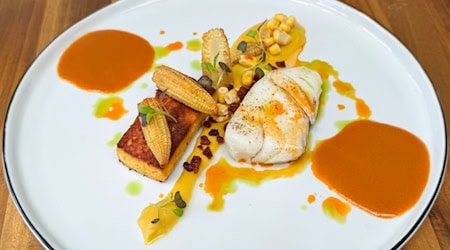
- Pollo fino "Coq au Riesling" | Ratatouille | Balsamic honey mushrooms | Lemon polenta
- Goat's cheese in strudel pastry | Banana and pepper sabayon | Blackberry sabayonPepper sabayon | Black walnut from the castle garden
Paired with drinks
- Hommage 1836 white extra dry
- Edition Frauenkirche dry
- 2018 Pinot brut
- 2019 Blanc de Noir brut 49€
- Gräfin Cosel rosé 18€
Info
- 4-course menu incl. Champagne, water and coffee €99
Wackerbarth Castle
Wackerbarthstraße 1
01445 Radebeul
Phone +49 351 89550
schloss-wackerbarth.de
[Visited on February 20, 2026]