

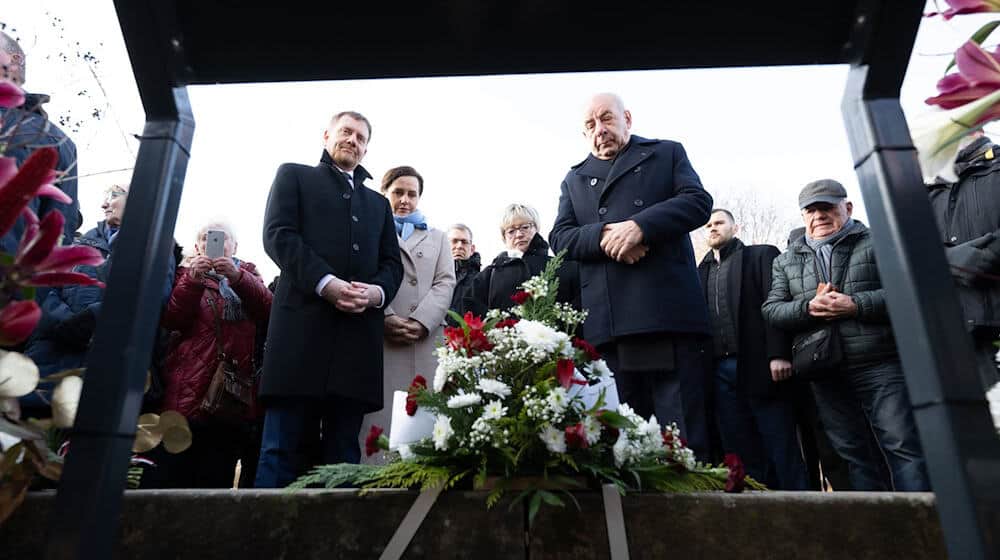
Michael Kretschmer, Prime Minister of Saxony, and Tamás Sulyok, President of Hungary, jointly commemorated the expulsion of German-speaking inhabitants of Hungary after the Second World War in Pirna this morning. The CDU politician and the Hungarian head of state jointly laid a wreath in front of a memorial plaque at the "Gray Barracks" in Pirna. The building had served as the first reception center for expelled Hungarian-Germans in Saxony. In Hungary, January 19 has been a national day of remembrance for the expulsion of Hungarian Germans since 2012. "This makes Hungary very different from other countries where such expulsions have taken place," said the Prime Minister at an event following the wreath-laying ceremony. Even in the GDR, the history of the Hungarian-Germans was not addressed. "This resulted in trauma, not only for those who experienced it directly, but also for future generations," said Kretschmer. This makes it all the more important to talk about it today and keep history alive. The community of Hungarian Germans had made a great contribution to the country and its culture, said President Sulyok. "They built Hungary together with us." The country was their home and the expellees were an integral part of the Hungarian nation, said the politician from the Hungarian ruling party Fidesz. "The expulsion of the Hungarian Germans was a harmful sin against the people. After the bloody world war, the wounds were not healed, but rather new wounds were opened." According to the Saxon State Chancellery, German-speaking people had been living in Hungary since the 12th century. According to the report, there were over two million Germans living in the then territory of Hungary in 1910, which corresponded to 9.8 percent of the population. The first transport of displaced Germans from Hungary arrived in Bavaria on January 19, 1946. A total of 33 rail transports with around 50,000 Hungarian Germans arrived in Saxony. The displaced persons were distributed throughout Saxony from the initial reception center in Pirna. Today, the building is used as a space for art, culture and creative industries, among other things. Copyright 2026, dpa (www.dpa.de). All rights reservedSulyok: Expulsion of Hungarian Germans a "sin against humanity"


