


Lithium mining in the Ore Mountains: two projects, many hurdles
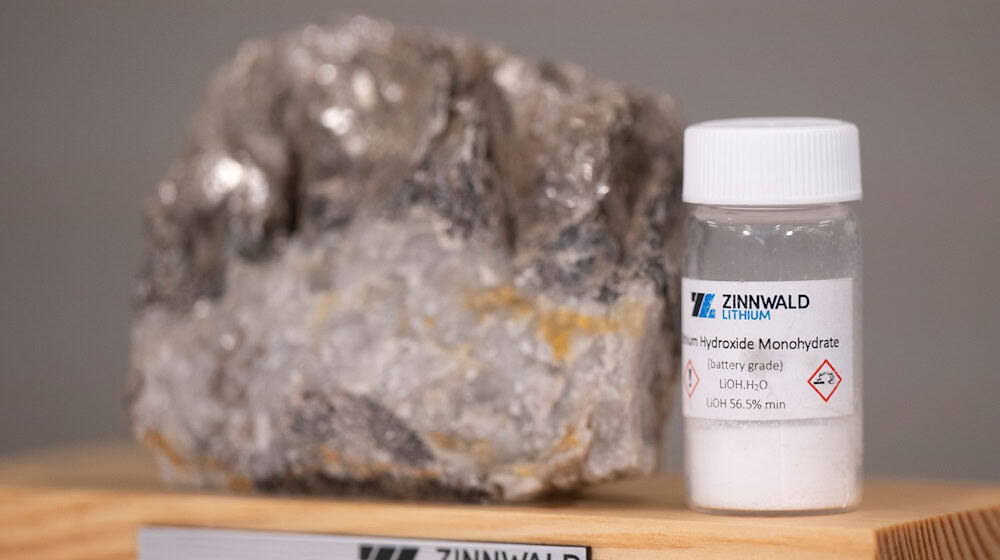
Domestic raw material extraction is coming more into focus in Germany. No country in the EU has received more applications for the status of a critical raw materials project from the EU Commission this January, said Matthias Koehler, Ministerial Director at the Federal Ministry for Economic Affairs and Energy, at the Saxon Raw Materials Conference in Freiberg. According to the EU regulation, such a status promises preferential treatment for faster approval procedures. Saxony's Minister of Economic Affairs Dirk Panter (SPD) emphasized that raw materials are "the basis for our prosperity" and are crucial for the future of Saxony as an industrial and automotive state. Plans to extract lithium from rock under the Ore Mountains on both sides of the Saxon state border have been maturing for around ten years. While the project in the Czech Republic can count on political backing and state funding, the Saxon side is still struggling to get a clear signal from Brussels. In Cínovec (German: Zinnwald), the company Geomet wants to extract around 3.2 million tons of ore per year and extract 37,000 tons of lithium carbonate from it - enough for batteries for up to 1.3 million electric cars, according to a feasibility study by the company. According to the study, 2,000 jobs could be created immediately. According to the company, there are no "technical obstacles" to the construction and operation of the plant. The shareholders are now to decide on implementation and financing. The project has been on the EU list of strategic raw materials projects since last year. The former Czech government had promised subsidies amounting to 8.8 billion crowns (around 361 million euros). Almost 33 million euros in EU funding was also approved. Before mining can begin, an environmental impact assessment has to be carried out by the Ministry of the Environment. Environmentalists and citizens' initiatives are warning of the consequences for nature, the water balance and tourism with regard to the UNESCO World Heritage Ore Mountains mining region. In contrast to the Czech project, Zinnwald Lithium was denied the status of an EU project for critical raw materials last year. There have already been several high-ranking political visits. However, the lithium project in Saxony has not yet received the kind of financial support that the Czech government has promised for lithium mining. According to the company, around 1.5 million tons of lithium ore could be mined each year. The locations of a processing plant and a spoil tip in particular are causing opposition from citizens' initiatives. In mid-January, Zinnwald Lithium reapplied for the status of a critical EU raw materials project, said Managing Director Marko Uhlig. For investors, the status is "an important signal", said the manager, adding that without visible progress, investors would "eventually become skeptical". Uhlig would also like to see financial involvement from the state in Saxony. The Free State could thus gain "very strong influence". The federal government has been supporting critical raw materials projects since 2024 via the KfW development bank's raw materials fund. However, Uhlig criticized the fact that the instrument is based on "completely the wrong starting point". It requires a completed feasibility study and supply contracts. At this point, additional money is usually superfluous. A spokeswoman for the EU Commission pointed out that all projects must meet the necessary criteria. In addition to a significant contribution to security of supply, technical feasibility and sustainable implementation in terms of the environment and social aspects, "cross-border benefits" are also important. In principle, it is "theoretically" possible for two separate projects in the same geological deposit complex - such as Cínovec and Zinnwald - to receive strategic status at the same time. However, Brussels does not comment on specific applications. The Commission now has 90 to 180 days to examine the applications received in mid-January, the statement continues. For the Saxon Mining Authority, a project classified as a critical EU project would formally "not be treated any differently" than other mines, as President Bernhard Cramer explained. Environmental and safety standards should not be watered down. "Mining that cannot be approved according to our value systems cannot simply be rushed through," said Saxony's top miner. In practical terms, however, Cramer sees political pressure: a critical raw materials project would be "highly political, highly publicly effective" and the Free State could not afford for its own authorities to put the brakes on. A kind of "task force" made up of experienced people would be formed, other procedures would be put on hold and the state would have its own claim to complete such projects in the required time. Saxony claims to be a "European leader" in exploration projects for new ore deposits and, according to Cramer, has had 88 permits for new ore mining since 2006, with around 33 projects currently underway. Take Tellerhäuser on the Fichtelberg, for example: Saxore is planning a completely underground tin mine with no visible stockpiles or processing - Managing Director Matthias Faust speaks of the "world's first stealth mine", which is intended to leave "no lasting traces" on the surface. But here too, there are doubts among citizens' initiatives and affected communities. At the same time, the Ore Mountains are a Unesco World Heritage Site and are densely interspersed with old tunnels. This makes new projects technically and financially challenging, Faust continued. Oberbergamt President Cramer has not observed a simple pro or con mood among the population, but rather "a more differentiated" debate between mining tradition, environmental protection and tourism. In the end, whether the lithium projects actually go ahead is likely to be more than just a question of commodity prices. Copyright 2026, dpa (www.dpa.de). All rights reservedWhat is the Czech Republic planning in Cínovec - and how far along is the project?
Where does the lithium project in Zinnwald stand - and why is there a problem?
What does the EU Commission say?
Would EU status speed up approval in Saxony?
Is the mining revival continuing or are there conflicts?

