

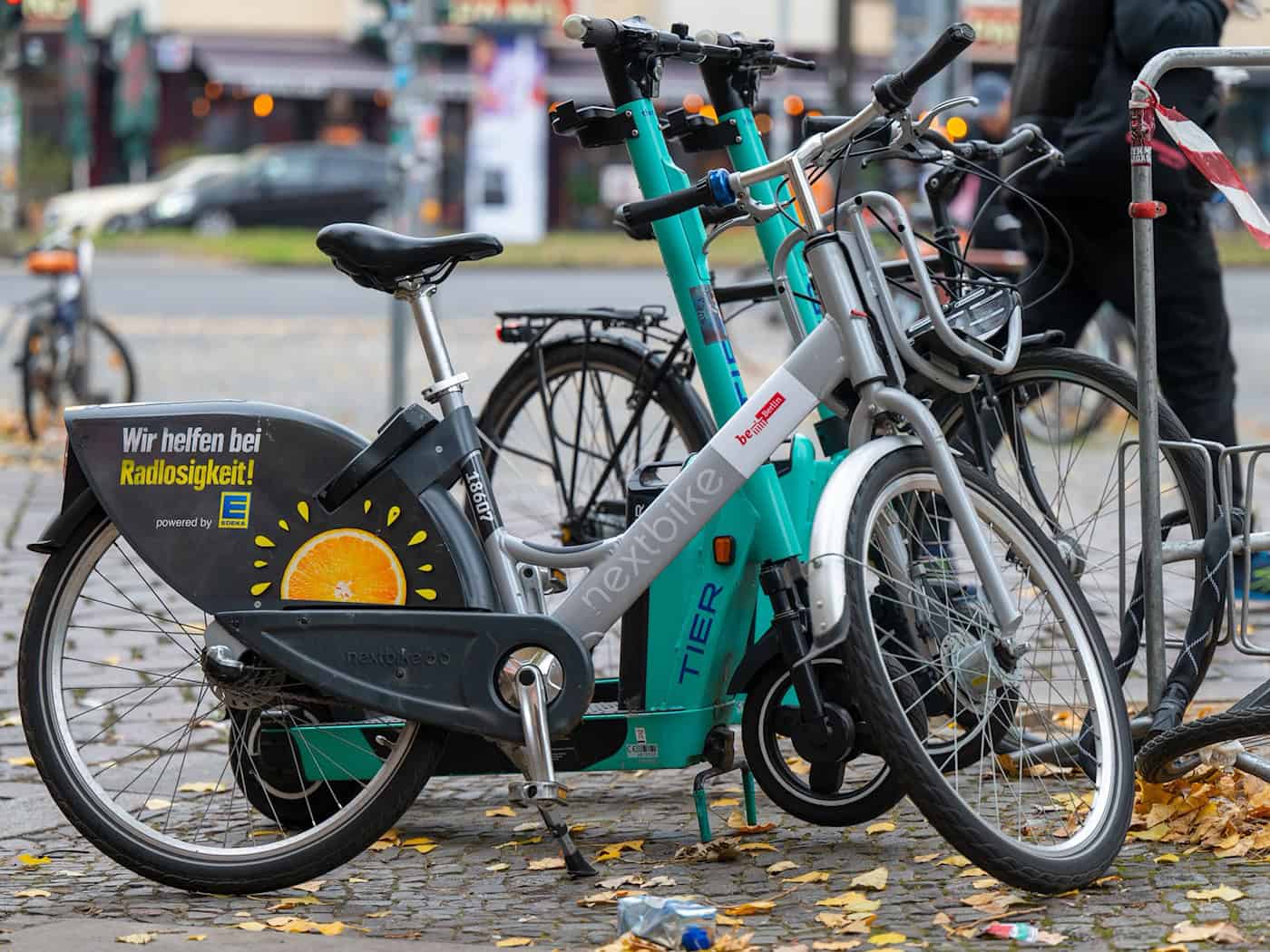
A court ruling on the rental bike market leader Nextbike in Berlin brings the issue of rental bikes and e-scooters on the streets into focus. The Berlin Higher Administrative Court has ruled in favor of the German capital's plan to impose charges on the Leipzig-based sharing provider. The court also justified this by stating that parked bikes or bikes lying around have become an increasing hindrance to other road users. Is the rental bike principle now facing a similar threat in other cities in the east? A dpa survey shows: In most of the larger cities in Saxony, Saxony-Anhalt and Thuringia, e-scooters are now part of the standard picture, with rental bikes being added in some cases. Dresden, Leipzig and Halle rely on bike-sharing services, some of which are large-scale and closely linked to local public transport. In Erfurt, Jena, Gera, Chemnitz and Zwickau, Dessau and Magdeburg, e-scooters dominate, often with a single provider that operates in the urban area on the basis of a contract or special use permit. In Magdeburg, for example, the city council has selected the provider Voi as the sole e-scooter operator with up to 600 vehicles. According to the city's concept, the aim is to integrate the scooters into a public transport subscription. Most municipalities clearly treat e-scooters as special use requiring a permit and impose conditions such as fees, zones, maximum numbers and detailed operator obligations. Rental bikes are usually classified differently where they are connected to local public transport. According to the company, Nextbike bikes are available in around 150 German cities - mostly through contracts with the public sector. "We operate either directly on behalf of the city council or the public transport company and are therefore exempt from the special use requirement," a spokesperson told the German Press Agency. This is the case in Leipzig, for example, where Nextbike operates the system on its own, but the bikes in the "LeipzigMOVE" app are closely integrated into the public transport service. In Dresden, Nextbike organizes the "MOBIbike" for the city's public transport operators and is exempt from charges. In both cities, public transport users receive discounts when using the rental bikes. In Berlin, this is now set to change for Nextbike following the expiry of the contract with the city. This is where Nextbike's criticism comes in: From the company's point of view, bikes should be classified differently to e-scooters, for example. The classic bike has a "far greater social benefit". In Berlin, the special usage fees already applied to other providers. Sharing providers also have to pay in other eastern cities. Halle an der Saale, for example, charges 2.50 euros per vehicle per month - both for e-scooters and Nextbike rental bikes. Dresden currently charges 3.35 euros per vehicle per month, regardless of location in the city - but not for the service operated by Nextbike, which is run by the city's own transport company. Gera has introduced a seasonal model: From April to October, the providers represented in the city pay three euros per vehicle for e-scooters, and 1.50 euros from November to March. Magdeburg charges for the use of street space not per scooter, but per square meter of parking space - at 4.69 euros per square meter per month. In Erfurt, the city council is planning to introduce charges, provided the city council agrees. Chemnitz also considers fees to be "conceivable in the future". Zwickau and Jena have stated that they are not planning to charge a fee. Dresden regulates the supply and parking options for bikes and scooters via red zones in sensitive inner city areas, general bans on bridges, green spaces and at bus stops, upper fleet limits for e-scooters and bikes and binding quotas for distribution in the city center and on the outskirts. From 2027, only defined sharing stations will be permitted as parking locations in the city center. According to the city council, users must document the correct parking of bikes and scooters with a photo. Leipzig relies on mobility stations where e-scooters, Nextbike bikes and, in some cases, car sharing are available. Gera, Erfurt and Jena are working with no-go zones and fleet limits for e-scooters. Magdeburg has also adopted a restrictive concept and defined fixed locations and an upper fleet limit from the outset. Chemnitz does not yet regulate the parking of e-scooters, but wants to change this "because the improper parking of e-scooters is increasingly leading to dangerous situations in public traffic areas", the city announced on request. Except for Erfurt and Chemnitz, none of the cities surveyed have plans to introduce or expand fees for sharing providers. However, the answers show that providers of scooters and rental bikes are increasingly being forced into a tight regulatory corset. Fees, quotas and prohibited zones are intended to create order and limit conflicts in public spaces on the one hand, and to ensure a certain degree of fairness between the city center and outlying areas on the other. Targeted integration into public transport is also intended to establish rental systems as a building block of the transport transition. Copyright 2026, dpa (www.dpa.de). All rights reservedHow widespread are sharing services in eastern German cities?
How do cities differentiate between e-scooters and rental bikes?
Where are fees already due?
How do cities regulate where scooters and bikes can be parked?
What's next for sharing services in the East?


