

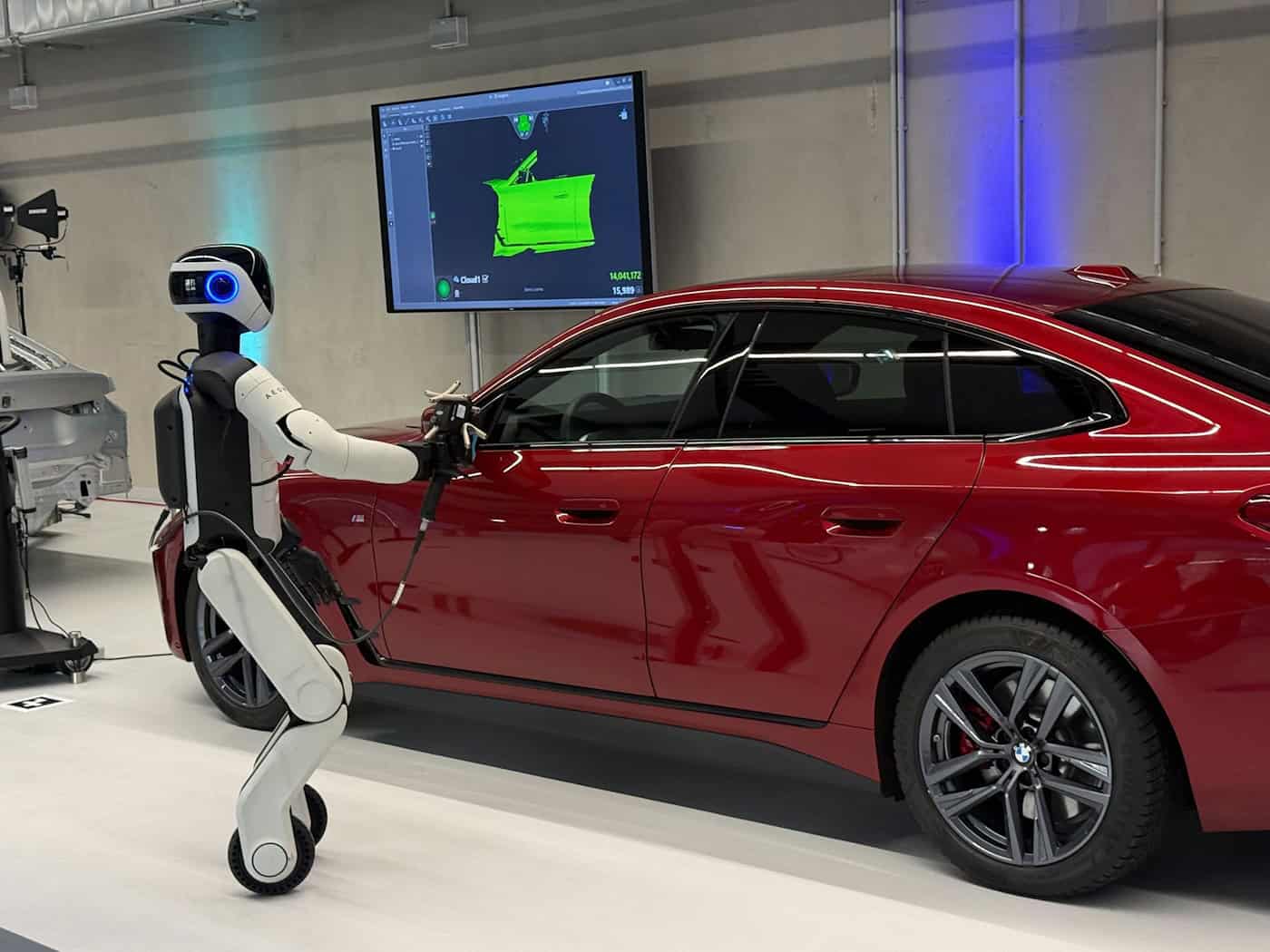
BMW is testing humanoid robots in its production facility in Leipzig. The company has only just announced that initial trials started in December, and following a further test in April, a pilot project with a single-digit number of robots from the manufacturer Hexagon is to begin in the summer. According to BMW, the aim of the project is to integrate humanoid robotics into the existing series production of cars and to test further possible applications in battery manufacturing and component production. "Pilot projects help us to test and further develop the use of physical AI - i.e. AI-supported, adaptive robots - under real industrial conditions," says Michael Nikolaides from BMW. This is not the first time the Munich-based company has used AI. At their US plant in Spartanburg, they used two robots from Figure AI for ten months. The robots removed and positioned sheet metal parts for welding processes on around 30,000 cars. In this context, BMW speaks of real added value under real production conditions. "This year, we are focusing on the gradual integration into our production system in order to test a wide range of possible applications," says Michael Ströbel from BMW. "The focus is on researching the In operation, the robot rolls on two legs. At 1.65 meters tall, it weighs 60 kilos. The battery lasts for 3 hours, but it can change its own batteries. Although it only travels at 2.5 meters per second, it is currently still being used in segregated areas for safety reasons. According to BMW, the aim of the deployment is to outsource unpleasant or dangerous work to robots. There are no plans to cut jobs. At the moment, the robots are still quite expensive. Arnaud Robert, President of Hexagon Robotics, did not give an exact figure, but spoke of a six-figure range. Copyright 2026, dpa (www.dpa.de). All rights reserved1.65 meters, 60 kilos and 2.5 meters per second
multifunctional use of the robot in various production areas such as battery production for energy modules and in component production for exterior parts."


