

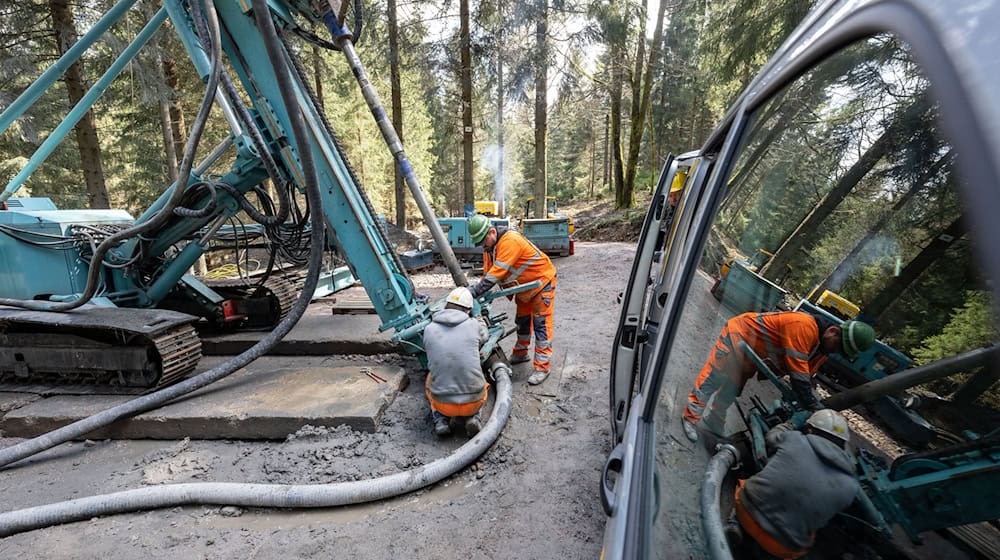
Saxony may have more potential in tin mining than previously assumed. This is suggested by a reassessment by Freiberg-based mining company Saxore for the Gottesberg project in the Westerzgebirge mountains. The updated resource estimate assumes around 37 million tons of ore with around 90,900 tons of tin that could be mined economically, Managing Director Matthias Faust told the German press agency dpa. This is almost three times as much as previously assumed. The international hunger for raw materials and the EU's goal of becoming more independent in the supply of important raw materials is making deposits in Germany interesting again for mining companies. The Ore Mountains, which once gave its name to its wealth of raw materials, are particularly in the spotlight. According to the Upper Mining Authority, more than 30 exploration and extraction projects for ore and spar are underway in Saxony. In addition to lithium, for which a mining project is being promoted in the Osterzgebirge, tin also plays an important role in a possible comeback of ore mining in the Free State. The metal is used in electrical engineering, but also for the production of bronze and tinplate. In the fall of 2024, the mining authority approved plans for a new mine in Pöhla in the Ore Mountains. The company Saxony Minerals & Exploration (SME) wants to extract tin in particular, but also tungsten, fluorspar and indium. Saxore is also pressing ahead with plans for a mine. The so-called framework operating plan for the deposit in Tellerhäuser is currently being examined by the mining authority, explained Faust. "If this is approved, we will start excavating the mine." Trial operation is not realistic until 2029 at the earliest. 500,000 tons of tin ore are currently expected to be produced annually. Around 2,500 tons of tin could be extracted from this. And what will happen in Gottesberg (Vogtlandkreis)? "Our plan is to get the Tellerhäuser project off the ground first," emphasizes Faust. After all, such projects require a lot of patience and money. According to Faust, an investment of around 150 to 200 million euros is required for such a mine. And work on the Tellerhäuser project has already been going on for 15 years. "Our goal is not to start mining in the short term," explains Faust with regard to the deposit in Gottesberg. "Rather, it is about sound, medium-term preparation. Should supply bottlenecks or interruptions occur in the future, we want to have reliable data on which resources are available and how they can be developed responsibly." But how did the company come to the conclusion that far more tin could be mined in Gottesberg than initially assumed? According to Saxore, it has held a permit to explore for mineral resources there since 2019. According to Faust, 16 boreholes were drilled in 2021 and 2022 to explore the deposit in more detail. Data from mining archives was also consulted. The price of tin has also increased significantly. The new estimate was then made by an external expert. A look at the price trend has recently spoken in favor of corresponding mining plans in Saxony. The market price for tin recently climbed to more than 55,000 US dollars per tonne at times, compared to less than 30,000 a year ago. But what if the price curve swings in the other direction? "For our current projects, the profitability threshold is well below 20,000 US dollars," explains Faust. Copyright 2026, dpa (www.dpa.de). All rights reservedOre Mountains back in the focus of mining
Mining projects need staying power - and a lot of money
Resurvey of the Gottesberg deposit


