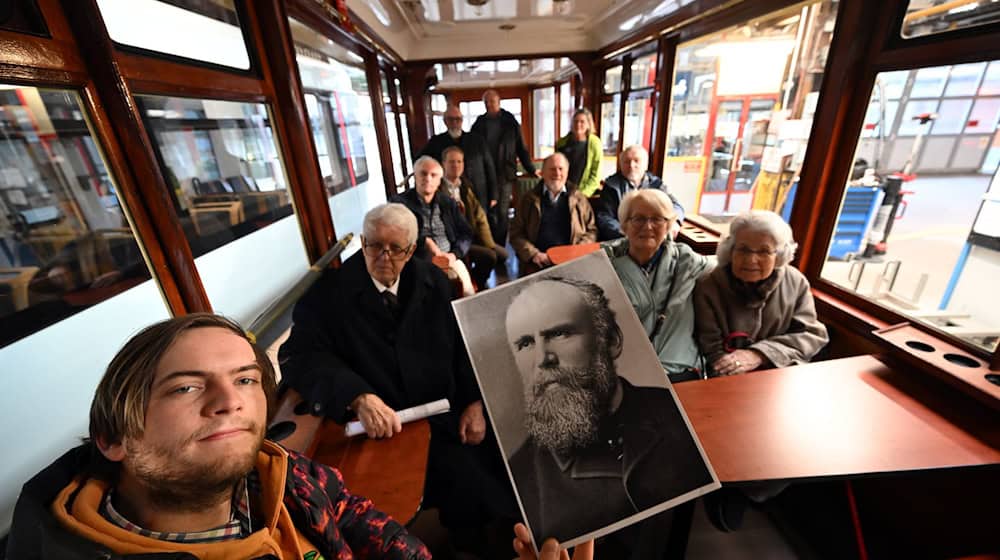
Who can claim to be an ancestor or relative of the inventor of a public transportation system and city landmark? In the case of the suspension railroads in Wuppertal and Dresden, there are hundreds. Many family members of the once powerful Langen entrepreneurial dynasty still live on the Rhine and Ruhr today. On-site appointment in Wuppertal. Some of them used to ride the suspension railroad every day. Around a dozen family members aged between 25 and 87 have come to share anecdotes about the suspension railroad and the life of its inventor Eugen Langen. The well-heeled Cologne entrepreneur tragically died of fish poisoning in 1895 and did not live to see the Wuppertal suspension railroad go into operation on March 1, 1901. The suspension railroad ultimately remained a by-product of its inventor, who pursued a number of more successful projects, everyone agrees. At the time, suspension railroads were used as a means of transportation in factories. The sugar manufacturer, who also invented sugar cubes, transferred the system to passenger transportation. The suspension railroad seemed tailor-made for the narrow Wupper valley with its numerous businesses and major traffic problems. The suspension railroad took less than three years from the start of construction to commissioning. Further sections were added later. For long stretches, the 13.3-kilometre route runs directly above the Wupper. The new means of transportation brought the region even closer together. However, Barmen, Elberfeld, Vohwinkel and other municipalities only became the city of Wuppertal in 1929. A civic festival is planned for the suspension railroad anniversary in late summer 2026. "The suspension railroad was opened to traffic this morning without fanfare," reported the "Barmener Zeitung und Handelsblatt" on March 1, 1901. The very first carriage was only occupied by a few people, "because the public had no idea about the opening". This changed as the day progressed and many people had to wait. "At one point, the crowd got so big that a large window was smashed," it said. A mountain suspension railroad went into operation in Dresden a good two months later on May 6, 1901, based on the Langen system. It is 274 meters long and overcomes a height difference of 84 meters. According to the Dresden transport company, property owners in Oberloschwitz demanded a connection to their properties on the hillside. According to the description, there was a veritable building boom. During this time, numerous villas were built in the Art Nouveau style. Hopes for major follow-up projects for Eugen Langen's suspension railroad in major European cities such as Berlin were not fulfilled. "His penultimate son, my grandfather, later tried to somehow get this suspension railroad out into the world. And he even went to Brazil on this occasion, he wanted to climb the Sugar Loaf Mountain in Rio. But that was all too late," says Rosemarie Rossberg. These efforts were not successful. The family quickly turns to the important engine construction in Cologne, to Nicolaus August Otto, with whom Eugen Langen built the first factory exclusively for combustion engines, a forerunner of Deutz AG. Gottlieb Daimler was also active in Cologne. Otto created the four-stroke engine in 1876. Over 100 years ago, the Langen family considered itself to be one of the wealthiest and most influential families in Germany, with a network of more than 30 companies on three continents. They also see themselves as co-founders of the Mannesmann Group as well as one of the predecessors of the Salzgitter steel group and the Siemens Group. The Langens also owned a factory that went on to build subway cars. "For Reichskanzler Bismarck, the Langens were the first point of contact for the interests of the industrialists of the Rhine and Ruhr, and when the German Reichskanzler was in the Rhineland, he did not stay in a hotel, but in the Langen family villa in Cologne," according to one account. There is also a touch of melancholy: "Out of modesty, Eugen Langen left the name for the jointly invented internal combustion engine to his friend Nikolaus Otto - the "Otto-Motor", and out of modesty, the Deutz gas engine factory was named after its location in Cologne-Deutz, but not after its owner Langen." Langen is only known in the Rhineland. The first passengers on the suspension railroad were Kaiser Wilhelm II and his wife Auguste Viktoria during a test ride on October 24, 1900. The so-called "Kaiserwagen" (Imperial Carriage) is once again taking up the glory of the old days: After years of renovation, the nostalgic train is set to return from May 2026. It can be used for weddings. Fittingly, a great-great-grandson of Eugen Langen, Johannes von Langen, also got married in the ornate vehicle, as he recounts. For young family members, the story of Tuffi is almost a must-read. On July 21, 1950, the young elephant was riding in a circus promotion and panicked. The animal survived the deep fall from the moving carriage from a height of around ten meters almost unscathed. Until April 12, 1999, the Wuppertal suspension railroad had a reputation as the safest means of transport in the world. During construction work on the track, a 100-kilogram iron claw was forgotten. The early morning train derailed and plunged eight meters into the Wupper. Five people died and 47 were injured. Copyright 2026, dpa (www.dpa.de). All rights reservedSuspension railroad is just a by-product
Construction time less than three years
Surprising start without fanfare
Construction boom in Dresden
Influential family association
Reichskanzler as a guest
The imperial carriage returns
The incredible fall of the elephant Tuffi
Myth of the safest means of transport