

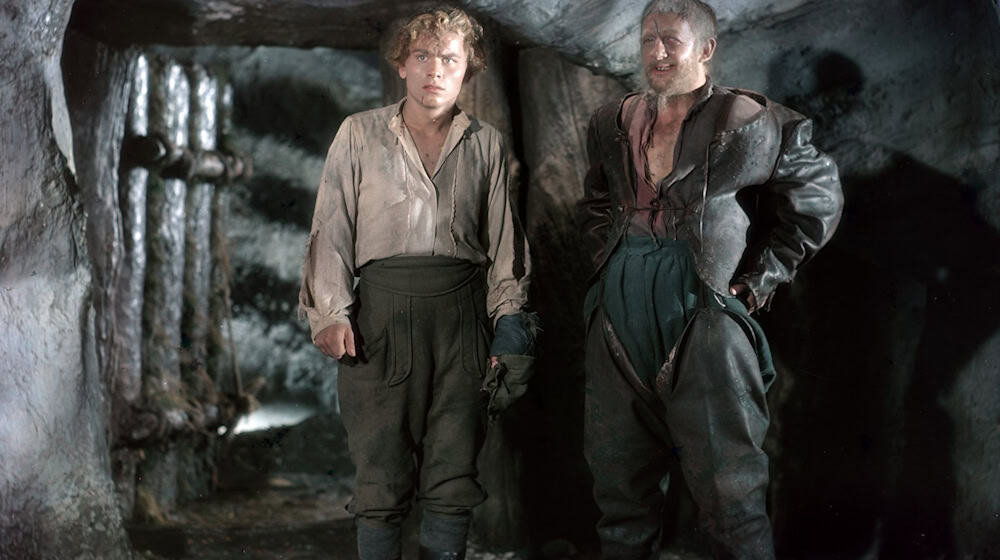
For decades, this Defa film from 1950 has been one of the most popular fairytale classics around Christmas: With his adaptation of Wilhelm Hauff's "The Cold Heart", Munich director Paul Verhoeven attracted almost ten million people to cinemas in the GDR. And even today, not an Advent season goes by without the story of poor Peter and his dream of quick riches being shown several times on television. This Monday (December 8) 75 years ago, the film celebrated its premiere in two East Berlin cinemas. "Treasure house in the green fir forest, you are already many' hundred years old. You own all the land where there are fir trees, only Sunday children can see you." In his attempt to escape the simple life of a charcoal burner, Peter (played by Lutz Moik) turns to the Schatzhauser, also known as the Glass Man (Paul Bildt). The friendly forest spirit initially fulfills his immature wishes: Peter becomes a proud glassworks owner and wins the affection of the beautiful Lisbeth (Hanna Rucker). When he runs out of money, Peter seeks help from the demonic Dutchman Michel (unforgettably gruesome: the great Erwin Geschonnek), who eventually offers him a heart made of stone. This makes Peter rich and successful, but also hard and proud. Only when his happiness with Lisbeth is violently shattered does he find the courage to reclaim his warm heart with the help of the Glass Man. Verhoeven's adaptation of the Black Forest fairy tale is the first GDR feature film in color. It was shot at the film studio in Babelsberg and in the Thuringian Forest. According to the Defa Foundation, the cost of "Das kalte Herz" was 3.2 million marks - a relatively expensive production for the time, exceeding the budgeted sum by several hundred thousand marks. The costumes and the animation technology, for example, were elaborate. "The many miniaturizations of the Glass Man and the enlargement of the Dutchman-Michel were particularly appealing," the cameramen were once quoted as saying. This was done using the mirror trick method or perspective constructions, for example. To transform Geschonnek into the creepy Dutchman Michel, his mouth was stuffed with absorbent cotton and his ears bent. A white-painted contact lens makes one of his eyes appear dead. The original by the Swabian poet Hauff from 1827 is one of the most important works of late Romanticism, in which he interweaves the world of fairy tales with real life. At that time, the plundering of timber from the densely wooded Black Forest made the forest owners and glassmakers rich, while raftsmen and charcoal burners had to work for a pittance. On the one hand, the Dutchman-Michel stands for merciless prosperity and wealth through speculation, while on the other, the little glassman stands for prestige and satisfaction through hard work and humanity. With their view of man's relationship to goods and money, the Hauff fairy tale and the Verhoeven film adaptation reach far beyond their eras. Copyright 2025, dpa (www.dpa.de). All rights reservedA heart of stone - and the price of happiness
First Defa color film with immense costs
Hauff's fairy tale is based on real life in the Black Forest


