

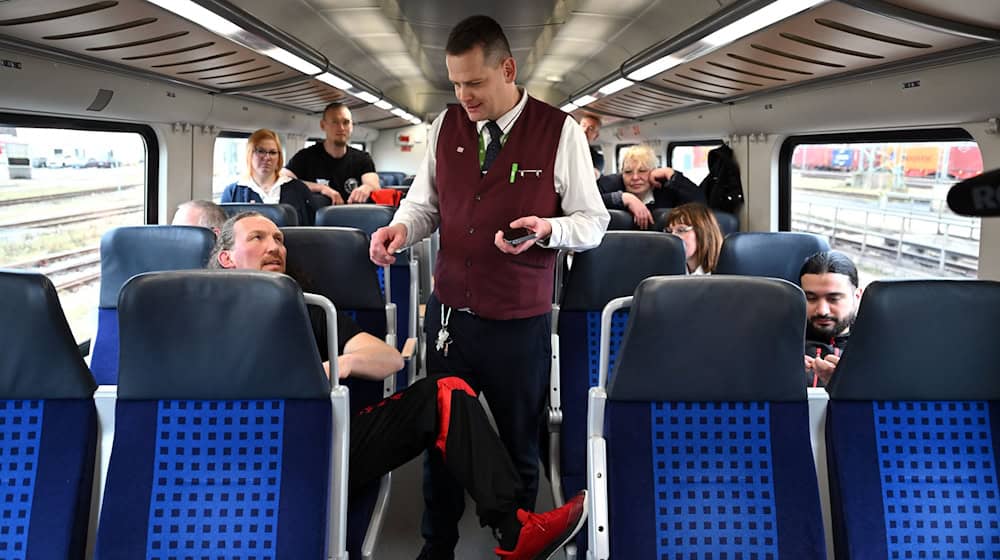
The tall, aggressive-looking man sits up in the seat of the regional express and juts his chin out. Instead of showing a ticket, he snarls provocatively loudly at the ticket inspector and makes it clear that he won't let him talk to him either. "Get lost!" he shouts. The situation looks dicey. In this case, the scene is only staged and part of an assertiveness training course for train attendants on Deutsche Bahn's local services in Erfurt, Thuringia. But inspectors on trains are increasingly finding themselves in situations like this or even worse with passengers. A fatal attack on a train attendant during a ticket inspection in Rhineland-Palatinate at the beginning of February drew particular attention to how dangerous the job can be. "There are insults almost every day. We already get angry about delays," says training participant Jonas Weiß. Fortunately, he himself has not yet been injured at work, explains the 25-year-old customer advisor in Thuringian local transport. "I'm on a fairly quiet route with lots of schoolchildren and senior citizens." Nevertheless, looking at his colleague in Rhineland-Palatinate, he says: "It could have been me." When the news of the 36-year-old colleague's death broke, he was working. "I made an announcement about it on the train." Passengers approached him about it and he had to wipe tears from his eyes. In 2025, Deutsche Bahn recorded more than 3,000 physical attacks on staff alone, not to mention cross-border insults. Half of the attacks were directed against employees on regional services. The Federal Police in Pirna have more regional data on acts of violence in connection with train services. However, they emphasize that their counting system differs from that of the railroads. However, the police data clearly shows that the number of recorded violent crimes has risen in recent years: 177 cases were registered in the area of responsibility in Saxony, Saxony-Anhalt and Thuringia throughout 2023; 225 in 2024 and finally 314 cases in 2025. A look at the figures for Thuringia alone makes the trend clear: after 19 violent crimes in 2023 and 43 in 2024, there were 62 last year. According to the figures, these offenses mainly involved bodily harm, followed by threats. The victims were mainly rail employees. The company is taking various measures to increase safety for employees in direct contact with customers. For example, Deutsche Bahn recently announced more bodycams, i.e. small cameras that can be used for filming, for these employees. An existing call for help button for dangerous situations is also to be further developed. 200 additional security staff are to support the existing 4,000. Training courses, such as the one in Erfurt, have long been part of such measures. Deutsche Bahn buys them from the Association of German Railway Sports Clubs. In addition to assertiveness courses, there are also de-escalation courses, but these are more theoretical. The participants in Erfurt welcome the practical part with role-playing games in which they are pushed and shoved in a very realistic way. The training does teach employees basic self-defense techniques. However, the emphasis is on avoiding conflicts and removing oneself from dangerous situations. "It's not about becoming a fighter, but about getting home safely," says trainer Jörg Aschemann, summarizing the idea behind the course for participants. The aim is for railroad employees to learn how to assert themselves better in conflict situations, for example through body language. At the same time, they should be made aware of potential dangers in everyday working life. "Keep an eye on bottles, they are always a danger," explains Aschemann, for example. Participant and train attendant Karin Wagner is also still reeling from the fate of her colleague in Rhineland-Palatinate. "I didn't know him, but..." She can't finish the sentence, tears well up in her eyes. She has many years of experience as a customer advisor on the train and already knows which passengers to keep an eye on. "Verbal abuse is commonplace, but it does affect me when you're approached like that," she says. Despite all her experience, the news of the death of the train attendant in Rhineland-Palatinate really affected her and her colleagues. Train attendant Jonas Weiß, meanwhile, hopes that even in annoying and difficult situations when dealing with train staff, rail passengers will remember one thing first: "Customers should remember that they are dealing with a human being and not a machine." Copyright 2026, dpa (www.dpa.de). All rights reserved"It could have been me"
More cases in Saxony, Saxony-Anhalt and Thuringia
Practical training in dealing with conflicts
Much affected


