

Logo Die Sachsen News
News / Food & Wine

Wines from the North East: surprising perspectives beyond the classic regions

Podcast logos
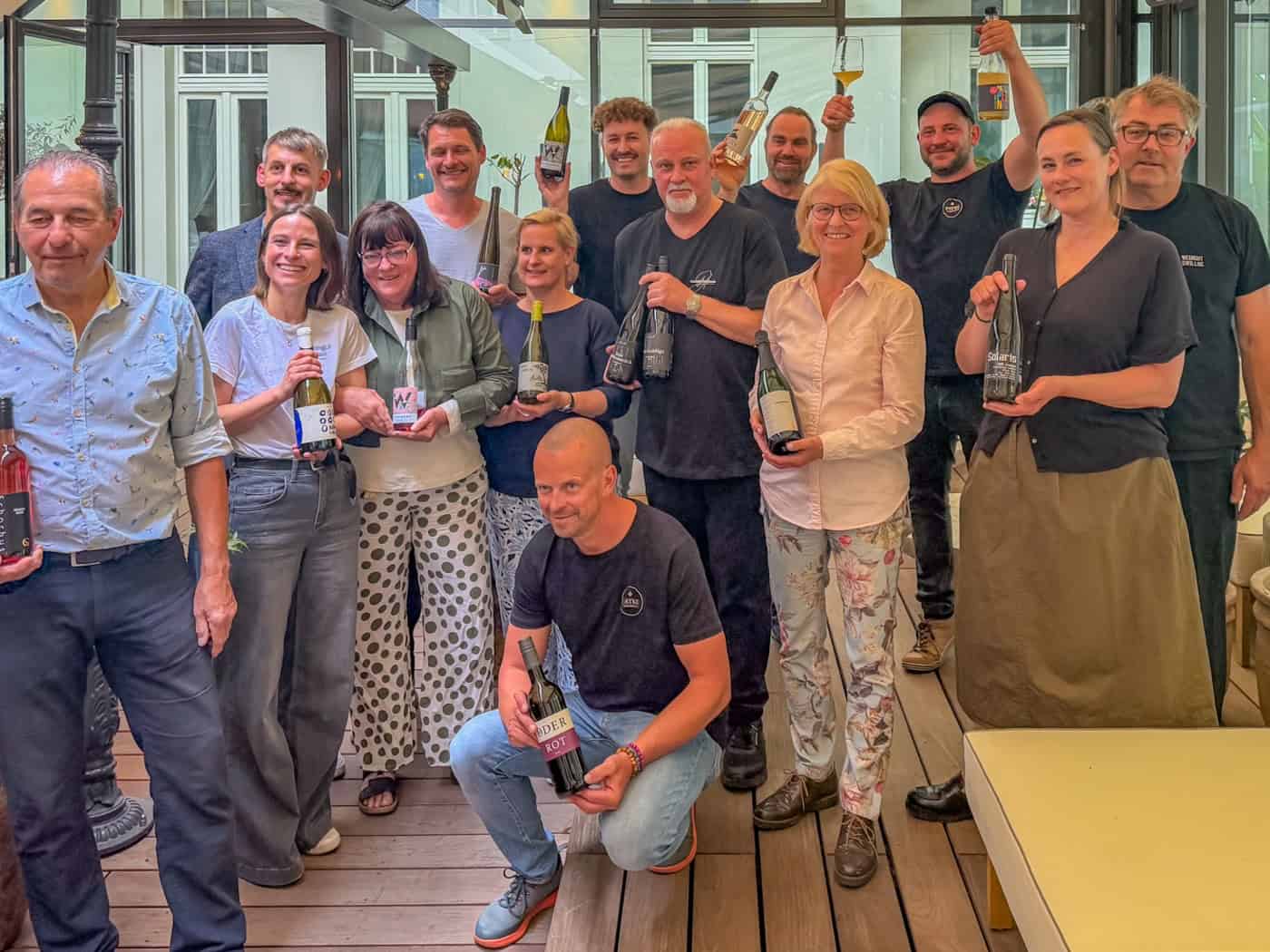
Group picture with winemakers: all from the North and East, all with amazing wines... (Picture: Ulrich van Stipriaan)
From: Ulrich van Stipriaan
Podcast about wine from Brandenburg and Mecklenburg-Vorpommern with Somm Matthias Dathan and four winemakers


Wine from Brandenburg and Mecklenburg-Vorpommern? "But yes!" says sommelier Matthias Dathan, who came up with the idea of organizing a platform for winegrowers from the regions north-east of the established quality winegrowing regions of Saale-Unstrut and Saxony. The young wine scene is currently in an exciting phase: founded mostly 20 to 30 years ago by enthusiasts who wanted to revive a tradition that also existed here (and had been buried), the second generation is now arriving - and these are usually the well-trained winegrowers who have already made good wine elsewhere.

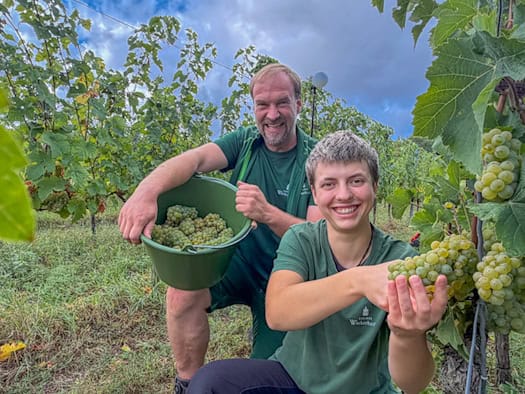
In tranquil Jerischke, the Marbach winery is even going one step further and training its own apprentices: "For the first time in the Cottbus Chamber of Crafts district and in the state of Brandenburg, we are training a wine technologist," said winery founder Hubert Marbach in a press release from September 2024. Together with her trainer Stefan Bönsch, Axinja Laubmann was able to experience first-hand what it's like to work with discerning restaurateurs and specialist retailers at the small north-east presentation.
More from this category

"Surprising perspectives on German viticulture beyond the classic regions" was Matthias Dathan's promise. And there were indeed exciting regional wines to taste - including two island talents. In this podcast, I got the initiator, two female winegrowers and two male winegrowers in front of the microphone to briefly introduce the wineries and the philosophy behind them.

Five perspectives in the podcast

Matthias Dathan - the Somm

The idea for this event came from Matthias Dathan. During his many years of involvement with viticulture in Saxony as part of his work for the Vinum wine guide, he repeatedly came across wine projects north of the classic German wine-growing regions. His research eventually led him to the history of viticulture in north-eastern Germany, which several centuries ago extended as far as the Uckermark. However, wars, climatic changes and economic developments caused viticulture there to largely disappear.

Since German reunification, the region has been experiencing a cautious renaissance. New vineyards have been planted in historic locations, while winemakers from other parts of Germany have ventured into previously undeveloped winegrowing areas. Today, the spectrum ranges from Brandenburg to the islands of Rügen and Usedom.

Dathan sees his event as a platform for these often small businesses, most of which work on a part-time basis and rarely have the opportunity to present their wines to a larger professional audience. Many of the estates cultivate less than five hectares of vines and do not have the financial means for their own presentation trips or extensive marketing measures.

In addition to classic grape varieties such as Riesling and Burgundy, fungus-resistant grape varieties (PIWIs) play an important role for winegrowers in the north-east of the republic. Some wineries focus on natural wine, others on traditional cultivation methods: as hardly any historical structures had to be adopted, many wineries were able to develop their own style.

Dathan deliberately chose Berlin as the venue for the event. The capital has a lively gastronomy scene with a strong focus on regional products and therefore offers ideal conditions for promoting wines from Brandenburg and Mecklenburg-Vorpommern. His aim is to give the up-and-coming wine regions of north-eastern Germany greater visibility and open up new sales opportunities for them in the long term.

Katharina Lindecke - Weinbau Lindecke

Katharina Lindicke is the second generation to run the Lindecke family winery in Werder an der Havel. Today, the business cultivates 7.6 hectares of vineyards on the Werderaner Wachtelberg and Werderaner Galgenberg sites. Although the winery is located in Brandenburg, the vineyards belong to the Saale-Unstrut growing region, meaning that the wines can be marketed as quality wines from this growing region.

The winery was founded in 1996 by Katharina's parents. She has been working in the business herself for more than 20 years and is now responsible for the further development of the company together with a small team. The winery has had its own winery since 2012, meaning that all winemaking takes place on site in Werder.

The range is broad and includes classic grape varieties such as Müller-Thurgau, Sauvignon Blanc and Dornfelder as well as numerous fungus-resistant grape varieties such as Cabernet Blanc, Muscaris, Sauvignac, Regent and Pinotin. The variety is deliberately chosen in order to be able to offer different flavors and styles.

Müller-Thurgau is of particular importance to the winery. The grape variety has been grown in Werder since 1985 and is considered the starting point of modern viticulture in Brandenburg. With its fine fruit and moderate structure, the wine is particularly appreciated as an accompaniment to regional asparagus. The vines grow on pure sandy soils, which require the plants to be very dry, but at the same time promote deep rooting. (I have written about Lindeckes' Müller in more detail in my wine column...)

With an annual production of around 50,000 to 60,000 bottles, the winery markets its wines predominantly regionally. In addition to direct sales via the estate's own wine tavern, retailers and restaurants are among the most important target groups. Katharina Lindecke sees potential for additional partnerships in Berlin and Brandenburg in particular.

In terms of quality, the winery is based on a four-tier pyramid of estate, local, site and premium wines. The latter are produced as elaborately matured cuvées, some with barrique ageing. Another special feature are two grape variety trails, each with more than 50 white and red wine varieties. They serve both as a test facility for new grape varieties and as a basis for experimental cuvées.

Romano Voß - Weingut Patke

The Patke winery in Pillgram, Brandenburg, just a few kilometers from the Polish border, is one of the most dynamic young wineries in north-eastern Germany. It was founded around ten years ago by Matthias and Marcel Jahnke as well as Steffen and Holger Lehmann, who turned Grandma Patke's former farm into the center of a new wine-growing project. The now 97-year-old namesake is still the identifying figure of the winery.

Romano Voß has been responsible for winemaking since the 2023 vintage. After training at renowned wineries such as Weingut Robert Weil in the Rheingau, Landesweingut Kloster Pforta and other stations in the Palatinate, he brought extensive experience to Brandenburg. His aim is to produce fruity, precise wines that reflect the character of the region.

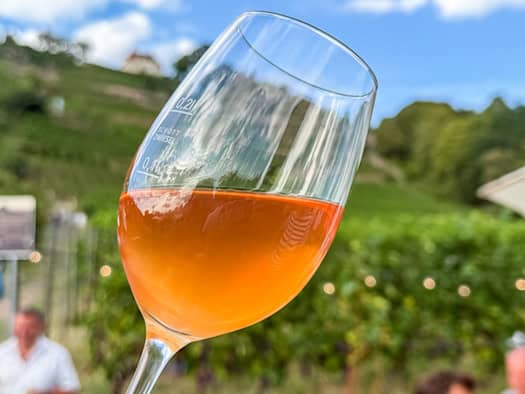
Voss sees Brandenburg as a classic cool-climate region. The comparatively cool conditions enable wines with moderate alcohol levels, lively acidity and pronounced fruit. At the same time, the winery offers room for experimentation. One special project is a Souvignier Gris from the amphora. The wine is produced after a long maceration period, spontaneous fermentation and ageing in a handmade clay amphora from South Tyrol. The result is an orange wine with pronounced fruit and structure, which deliberately sets itself apart from the often rustic representatives of this style.

The winery now cultivates around 20 hectares of vines, of which twelve hectares are in production. A further eight hectares are young vineyards. The soils range from sand to clay marl to calcareous sites. The company places particular emphasis on fungus-resistant grape varieties. Souvignier Gris plays a key role here, as the variety is considered robust and at the same time produces high-quality, versatile wines. With an annual production of around 54,000 bottles, the winery pursues a clear quality approach. Most of the wines are marketed directly. In addition to wine tastings and events, visitors can also enjoy the estate's own restaurant. The business is complemented by fruit growing, strawberry cultivation, distillates and a small herd of Dexter cattle. The aim is to achieve a closed-loop economy in which by-products are consistently reused.

Sabrina Steeb - Weingut Welzin

Sabrina SteebThe Welzin winery on the island of Usedom is one of the most unusual wine-growing projects in Germany. In the small village of Welzin with only around 50 inhabitants, a family business has emerged in recent years that deliberately focuses on an independent path. Sabrina Steeb represented the winery in Berlin on behalf of the family. The driving force behind the project is her father-in-law Christoph, a farmer who has been farming organically for decades. However, his enthusiasm for wine did not originate in Mecklenburg-Vorpommern, but in Sicily. He bought a small vineyard on Mount Etna and taught himself viticulture. There he also learned the principle of the Gemischter Satz, which would later become the core of the wine project on Usedom.

Today, the family cultivates one hectare of vines, on which only fungus-resistant grape varieties grow. Muscaris, Solaris, Rinot, Sauvignac, Ravel Blanc, Soreli and Fleurtai are cultivated together, harvested and processed into a mixed set. The decision to use PIWI vines is based on a clear concept of sustainability: little plant protection is required and the vines cope well with the conditions of the region. The vineyards stand on very different soils, ranging from sandy loam to heavier clay soils. At the same time, Usedom benefits from a special climate. With many hours of sunshine, the island is one of the sunniest regions in Germany. Although the surrounding waters delay the start of vegetation in spring, they ensure a long ripening phase in the fall.

The main wine of the estate is the Gemischter Satz "Witt", supplemented by a very small-edition PetNat. Production ranges between 3,500 and 5,500 bottles per year. The family consistently follows the principle of "quality before quantity". By greatly reducing yields and working intensively by hand, wines full of character are created that reflect the special characteristics of their origin. The wines are mainly matured in stainless steel tanks, sometimes supplemented by ageing in wooden barrels. The wines are not filtered, but are given sufficient time for natural clarification. The result is fresh, independent wines with a clear vintage character. While the 2023 vintage was rather light and delicate, the sunnier 2024 produced significantly more mature and powerful wines. (We also featured the 23 Witt in episode 175 of "Auf ein Glas".)

Stefan Bönsch - Weingut Marbach

The Marbach winery in the south-easternmost part of Brandenburg is one of the young wineries that are actively developing viticulture in eastern Germany. Cellar master Stefan Bönsch combines a love of experimentation with a clear view of the practical requirements of the market. While the winery is already established, an important development step is imminent: the planting of a further vineyard with around two hectares of vines.

The main grape varieties to be planted are fungus-resistant varieties such as Souvignier Gris and Sauvitage as well as Roter Riesling. The latter is considered a historical variant of Riesling and is set to play an important role in the range in future. However, the experience of recent years shows how strongly viticulture in Brandenburg is affected by extreme weather conditions. Drought, heavy rain and frost events influence planning as much as yields.

Bönsch's approach is particularly evident in a new project: a Blanc de Noir made from Cabernet Cortis. The idea arose from a discussion with winegrower friends from Brandenburg. The background to this was the idea of using part of the red wine production in a different way. While red wines often need several years to mature and are more difficult to market, there is a much greater demand for fresh summer wines. An experimental wine was initially produced from just a few rows of vines and proved to be a complete success. The grapes were harvested early, pressed as whole bunches and then fermented under cool conditions. The aim was to produce a fresh, fruity wine with moderate residual sweetness. At the same time, the paprika note typical of Cabernet Cortis was to remain as restrained as possible. The result impressed both the company and the first restaurateurs, who see the wine as a versatile accompaniment to food.

The Blanc de Noir is a good example of how Bönsch works: New ideas are first tested on a small scale before larger quantities are produced. Exchanges with other winegrowers in the region play an important role in this. The young winegrowing scene in Brandenburg benefits from short distances and close cooperation. At the same time, Bönsch advocates making fungus-resistant grape varieties more visible. Many of these varieties disappear behind fantasy names or cuvées, although they are increasingly producing high-quality wines. He is convinced that grape varieties such as Souvignier Gris or Cabernet Cortis in particular could become more prominent and contribute to the sustainable and future-proof development of viticulture in Brandenburg.

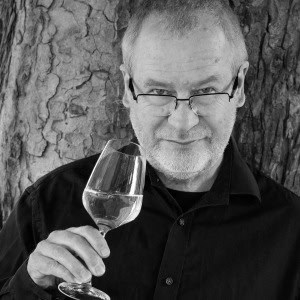
Ulrich van Stipriaan
Article from

Ulrich van Stipriaan

Ulrich van Stipriaan is responsible for the content itself. The platform's code of conduct applies. The platform checks and treats content in accordance with the legal requirements, in particular the NetzDG.

Social Media