


Restaurant Alte Meister: Modern Bohemian cuisine with wine from Moravia by Marek Špalek
Mira Matus is head chef at the Alte Meister restaurant - and he is Czech. A good reason to offer something a little different from the usual menu as part of the Cooking Star Hours: Czech, of course, accompanied by Czech wines. The Moravian organic winegrower Marek Špalek contributed two of them - and he had now come to Dresden for an evening from the village of Nový Šaldorf just before the Austrian border. He had seven wines and a sparkling wine in his luggage, a little more than the normal ration for the menu, which was therefore extended by one course before and one after.
Czech cuisine and the finer cuisine usually practiced by the Old Masters do not necessarily go together in the mind, as one does not necessarily think of prawns or pink saddle of lamb, but of hearty dishes. So there was a lot of excitement beforehand about how the food would turn out - after all, the idea of paying culinary tribute to our neighbors is great! And then the matching wines to go with it, that sounded exciting.
Marek Špalek speaks excellent German (it's his mother's line, he told me before the evening appointment when recording the upcoming episode of the podcast "Auf ein Glas") and is a very entertaining wine explainer. As befits a winemaker, he had brought a sparkling wine to start with. Homemade, of course, from a not exactly ordinary base wine cuvée of Sauvignon Blanc, Grüner Veltliner and Riesling. 18 months of maturation on the yeast during the second fermentation ensured a fine perlage of the fresh and fruity aperitif. The kitchen also served Chléb a sul - caraway bread, salt and crackling lard - as an additional faint snack. Did this set the course for the end of the hikers' rest stop? Or should we get to know the "modern Bohemian cuisine" variant after all (as announced on the blackboard in front of the Old Masters, but slate is patient)?
Basic Czech course in six courses
In the basic Czech course for beginners, we learned at the start of the official KSS menu: Králik means rabbit. It came to us in the form of three crispy croquettes on spinach and herbs, three dollops of baked garlic mayonnaise garnished the plate both visually and (as expected, of course) in terms of taste. It still wasn't chiselled fine cuisine, but it didn't have to be - because it tasted good! Without the salad, by the way, it would have been perfect finger food and, because it was "something different", would have been at the top of the popularity scale. The winemaker poured a Grüner Veltliner to go with it - the most important grape variety on the 12-hectare vineyard (you can tell it's close to Austria). With 0.9 grams of residual sweetness, it is a very dry, but also a very fruity wine. "There are many sweet wines in the Czech Republic. But the best winemakers mainly make dry wines," noted the winemaker, who also produces semi-dry and residual sweet wines, but mostly with a residual sweetness of less than one gram.
The mushroom foam soup with quail egg cooked according to all the rules of Loriot's wax-soft method proved to be soul food of the cheerful, light kind. The taste was beautifully mushroomy without being dull and heavy - also because it was wonderfully foamy. Modern Bohemian cuisine? It could be like this! It was wonderful to eat, and the Pinot Gris chosen for the course had already impressed me during the podcast. Rulandské Šedé is what the Czechs call this grape variety and is therefore close to the German Ruländer: this is how Pinot Gris is classified here. However, if you order Ruländer, you get a rather heavy, sweet variety, at least in the southwest of the republic. The Špalek version, however, is again bone dry, but still has a melting texture to match the soup.
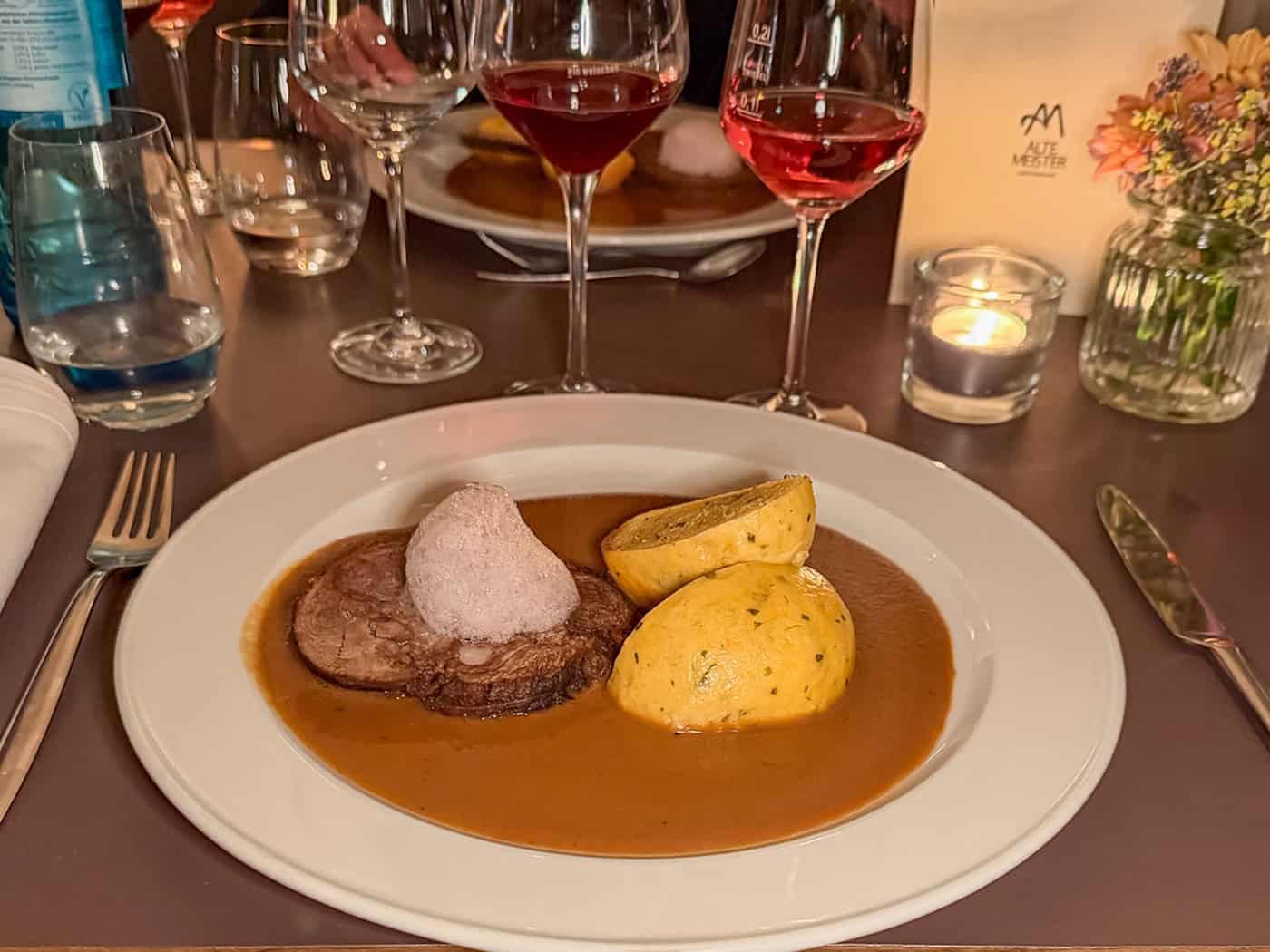
For the main course, Svíčková was the order of the day. If you google it, you end up with beef fillet in cream sauce and quickly learn: it doesn't have to be fillet, but there should be plenty of sauce (made from root vegetables and cream) for the dumplings. Mira Matus opted for a more delicate version with braised venison and sweet potato and yeast dumplings with herbs, naturally with plenty of sauce. In terms of appearance (apart from the foam on the slice of meat), it was close to what we are used to, so my head was satisfied. Making the dumplings from sweet potatoes turned out to be a good idea, and bathing them in an excellent sauce (sorry: dipping them in a sauce, of course) led to great pleasure on the palate. Using venison instead of beef gave the dish the final kick - even if the meat turned out too dry for my taste when braised that evening. The wines (yes: they, because there were two with the main course) provided quick consolation: a dry Pinot Noir and a semi-dry Zweigelt rosé. The rosé was very young, but is probably meant to be drunk like this - fruity and light and not at all as sweet as I had feared - just the right amount for good drinking flow, so to speak. Nevertheless, my favorite was the 21er Spätburgunder, which is cultivated on only half a hectare in the winery. This was a harmonious, well-rounded wine with low alcohol (12% is a challenge when making wine in the current summer), a long finish and a Špalek-like dryness - a great Pinot Noir.
As a pre-dessert without food accompaniment, we were introduced to a Zweigelt Auslese. Harvested late, lots of sunshine, but only 0.4 g residual sugar: no wonder it has 14% alcohol. "A very strong, good red wine from the year 2023!" commented the winemaker, and he was right. But this late in the evening, you're happy to put up with things - especially if you're going home by streetcar... But: "We can also do sweet!" said Marek Špalek before the last two wines from his workshop: Number one was a Riesling Beerenauslese, vintage 19, for dessert. Lots of honey, a beautiful golden color and over 70 grams of residual sugar. But a Beerenauslese can do that, especially when it has over 7 grams of acidity. A good pairing with the Žemlovka pyre, which the kitchen had prepared from baked brioche, quark, apple and cinnamon parfait. And all in all, something that (on a normal menu) is a good way to finish, also in terms of satiety.
But the winemaker still wanted to show off his semi-dry Gewürztraminer! Whereby semi-dry here too is more due to the complicated arithmetic - from four grams it is no longer dry throughout Europe if not enough acidity is analyzed. This wine has 7.8 g of residual sugar - that will usually be a dry wine here (with a little more acidity). But no matter: it has to taste good, and with Bohemian cheese (we learn: sýr), the rather fine, only slightly sweet Traminer proved to be an elegant companion.
Menu
- Králik
Rabbit croquette | spinach | baked garlic mayonnaise - Kulajda
Mushroom foam soup | quail egg | dill - Svíčková
Braised venison | sweet potato-yeast dumplings with herbs | cranberries - Žemlovka
baked brioche | curd cheese | apples | cinnamon parfait
Wine pairing
This will be accompanied by a white wine from Moravia and a red wine from Moravia. We will also serve a sweet wine from the small wine-growing region near Litomerice for dessert.
Info
- 3-course menu 46 € | incl. wine accompaniment 68 €
- 4-course menu 55 € | incl. wine accompaniment 83 €
- . Wine accompaniment 83 €
Alte Meister
Theaterplatz 1a
01067 Dresden
Tel. +49 351.4810426
altemeister.net
The winemaker in the podcast (from 13.3.26) and on the net.
[Visited on March 6, 2026]

