


Fine dining at Kaagman & Kortekaas in Amsterdam: a tasty break with convention
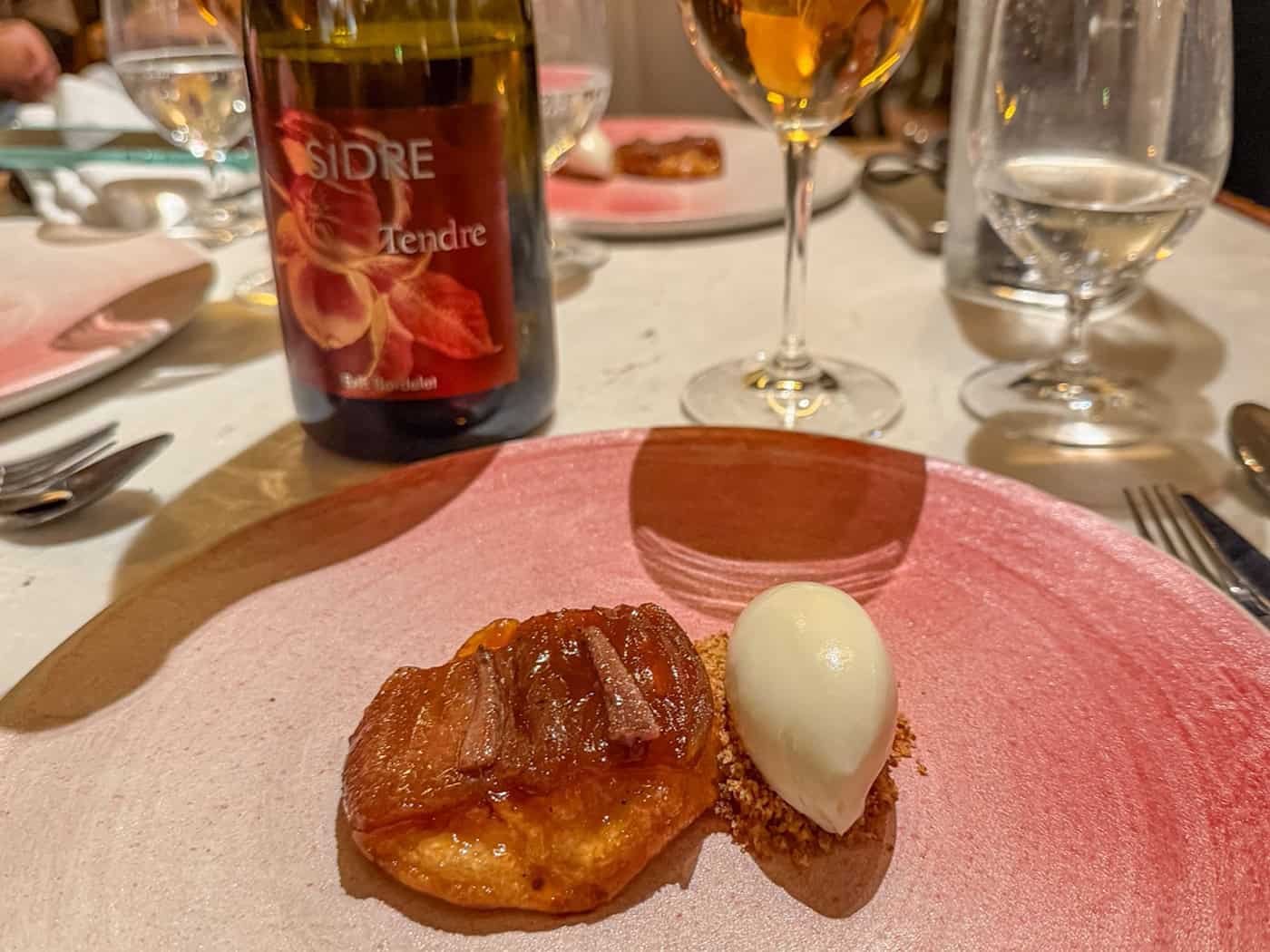
The dessert divided opinion along gender lines: while the women thought that anchovies had no place in a dessert, the man accompanying them praised the saltiness - that salty kick of fermented fish as the icing on the cake to complement the sour rhubarb and sweet brioche. A classic case of head cinema, by the way, because if it hadn't been a dessert but an intermediate course, it would have been perfectly fine - the women said. Now, the word dessert wasn't mentioned anywhere, but at the end of a multi-course meal, that's the expectation, including a touch of Udo Jürgens (but with cream, please!), and chocolate if necessary. But at Restaurant Kaagman & Kortekaas, breaking with convention is of course intentional.
Giel Kaagman and Bram Kortekaas opened their restaurant together in September 2015 on Sint Nicolaasstraat in the heart of Amsterdam. As chef (Kaagman) and sommelier (Kortekaas), the two were already known to the Amsterdam gourmet community - both separately and together (in the then trendy restaurant Bordewijk in the Jordaan). Since they opened, their restaurant has always been full - and with plenty of space. The open kitchen is the focal point, with an area to the left and right of the kitchen - as well as seating at the bar and in the cellar. The service has a lot to do! But, spoiler: everything works perfectly - in English by default, and once even ("I hear you're German?") in the local idiom. What they all have in common, once again, is the warmth, the friendliness, the hospitality.
"Chef Kaagman, known as Giel to his friends, felt the freedom of his own kitchen for the first time during the renovation of the industrial building in the Sint Nicolaasstraat. Slowly but surely, he shook off classic rules and modern trends and followed his gut instinct. Since the opening of Kaagman & Kortekaas, he has been working uninhibitedly and full of zest for action with the ingredients that nature offers him: Wild harvested herbs from the island of Texel, venison from the Oostvaardersplassen game reserve or a proud fishmonger with a crate of freshly caught mackerel: At Kaagman & Kortekaas, nature is the source of everything", I gather from the website. Sounds promising!
In principle, there is only one menu, with a choice of four, five or six courses. The very small à la carte menu includes oysters (€4.50), cheese and charcuterie, a terrine of foie gras (€39.95) and a decent piece of côte de boeuf for two people (€55.50 per person). The wine list is what you would expect from a reputable somm - and you can also ask the staff to choose an accompaniment by the glass (with or without alcohol, both are possible).
We opted for five courses and then topped up with oysters - so we missed out on the combination of quail, duck liver, wild garlic and prawns - but if something is missing, that's a reason to come back! The oysters beforehand were definitely worth it, they were fresh (anyway, right?) and wonderfully nutty. In the run-up to the real menu, we took some bread with us - home-baked sourdough bread, which was unfortunately so good that one slice wasn't enough. There was also butter decorated with the KK restaurant logo - a terrible duo. You don't want to stop, even though you know there are several more courses to come! Together with the amuse-bouche (a very spicy slice of poultry pâté plus a cup of veal bouillon), this was actually a perfect evening meal! But - and this was probably the intention - it was also an inspiration for what was still to come. However, the surprises were not yet anticipated...
For example, the crispy pig's ear (from the butcher, not the bakery) that had joined the lettuce. It came à part with the mackerel, which was basically raw and merely flamed. The bite-sized morsels were separated by slices of strawberry - whoever comes up with something like that would also come up with the idea of serving magnolia sorbet as the ideal combination with mackerel. The service staff seem to be no strangers to guests' astonishment: yes, that's how they all look, said the service staff member presenting the dish and smiled back at the pass. There was really only one or two bites between looking surprised or disconcerted and praising the chef for his idea and the team for implementing it. In principle, we were ready for more afterwards!
If it hadn't been for the purely vegetarian course of all kinds of greenery, which the women (of course) were perfectly happy with and even praised - but I struggled. The wild mix of bimi - broccoli - kombu - miso - amaranth looked good, but for me (who really like vegetarian food and am used to it) it didn't come together to form a tingling taste. Seeking consolation, I reached for a glass, in which a Verdicchio dei Castelli di Jesi from the organic Sabbionare winery casually proved how different flavors can come into their own in one sip.
Disagreement at the table is good for conversations - but with the best pea soup in the "beyond the rustic" category, the quickly reached consensus was twice as enjoyable. It's a well-known fact that soups are not served directly on the plate these days. This prevents hot fingers for the service staff and spillage in the event of accidental spills - and because these are both only theoretical considerations, the only valid argument is that the soup stays warm better in the pot. For good measure, you can take a photo of the plate with the solid ingredients. Wasabi, truffle, morel (we had previously seen how the morels were filled with ricotta for the evening with stoic composure): promising. The soup came out of the pot thick and viscous - but it didn't look coarse at all, but very fine. And that's exactly how it was!
Veal played the leading role in the main course - as the bouillon for the kitchen greeting had already indicated. Here, they take this from tail to nose seriously, because in addition to a piece of fillet (which is familiar, even if it's usually beef...), there was a colorful offal mix: calf's head (anyone who has ever eaten Töttchen in Münsterland knows this too), brains (emerged from the list of forgotten gourmet delights) and tongue (marinated a little too much with garum for me - not everything the old Romans liked has to taste good to me!) The only greenery on the plate: monk's beard - originally (speaking of Romans...) from the Mediterranean, but nowadays the salty, earthy herb with its mineral aroma is considered a regional product in the Netherlands.
...and that brings us to the desserts. Yes, in the plural, because it came in two courses. In both cases, the rhubarb was accompanied not only by the expected side dishes, but also by maritime contrasts - we are in a restaurant that likes to work with local fishermen. We didn't even notice this with the granité with sea urchin - the refreshing course with its subtle interplay of acidity and rhubarb and sea urchin would have been perfect as a palate neutralizer and short break before the main course. So now, as a prelude to the grande finale: a tarte tatin as a sweet delicacy with a hint of acidity and a slushy yoghurt ice cream. And the aforementioned anchovies...
Info
Chef's menu
- Amuse-Bouche (poultry pâté / bouillon)
- Mackerel - strawberry - basil - lettuce - pig's ear
- Bimi - broccoli - kombu - miso - amaranth
- Peas - wasabi - morel - ricotta - Truffle
- Quail - Duck liver - Wild garlic - Caponata - Dutch shrimp
- Calf - Bergamot - North Sea crab - Monk's beard - Sage
- Rhubarb - Sea urchin - Cassis-Houl
- Rhubarb - anchovy - yogurt - brioche
4 courses 69,50 - 5 courses 79,50 - 6 courses 89,50
Kaagman & Kortekaas
Sint Nicolaasstraat 43
1012 NJ Amsterdam
Tel. 020-2336544
kaagmanenkortekaas.nl
[Visited on April 22, 2026]

