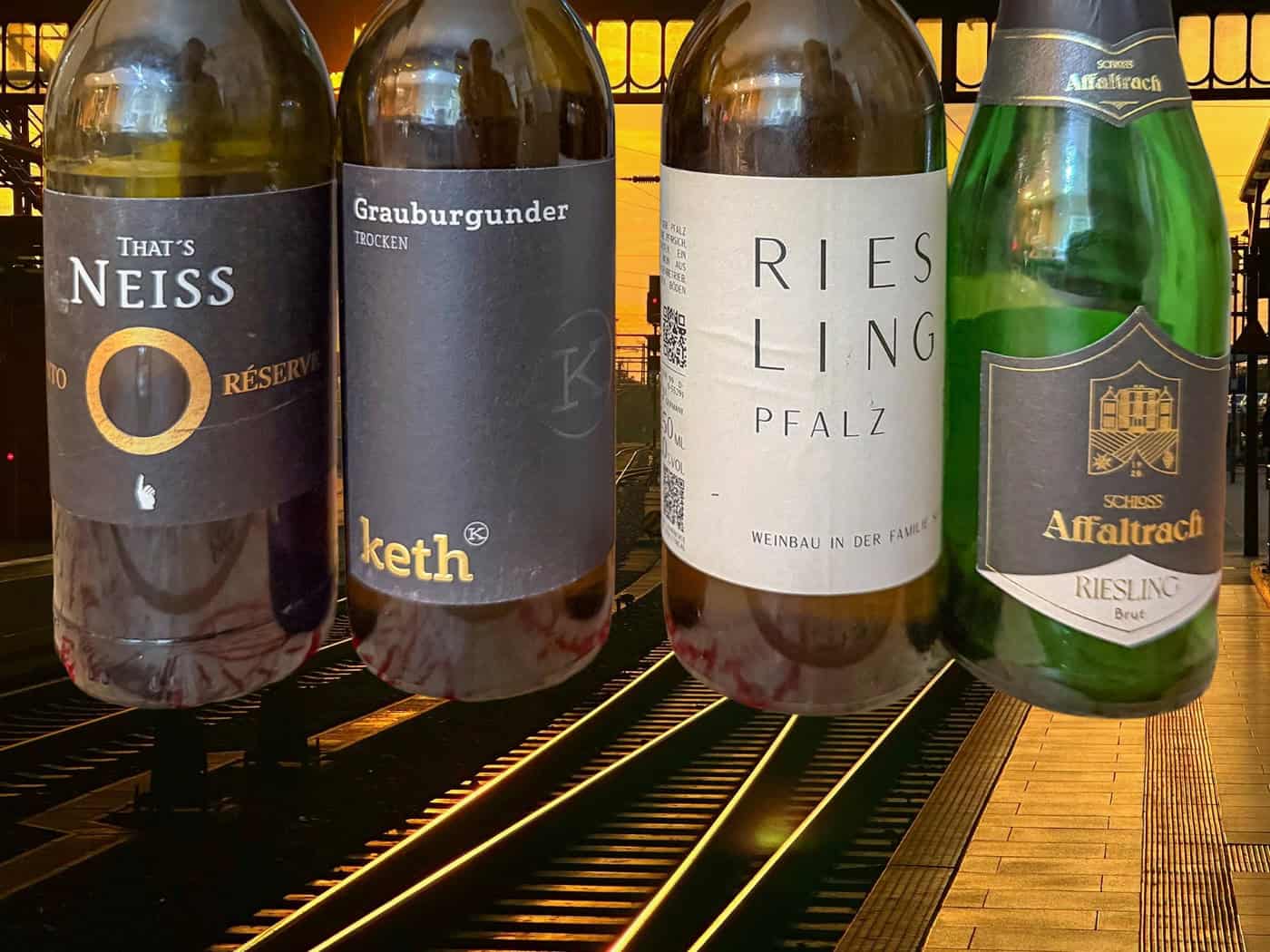


The other day, I was able to enjoy life to the fullest once again. That’s just how it goes when the railway company lets the ICE sit idle for an hour at the beautiful Fulda station and makes passengers from the rear cars switch to the front ones—because, oh right: no explanation was given, and the public address system wasn’t working (either). Maybe I should have used the time to sample the railway’s new offerings in the onboard bistro: a glass of sparkling wine and three wines (two white, one red). Maybe even record a podcast right there on the spot with the previously unknown passenger across from me—live and emotional, given the situation. But, grateful for the blessing of having my own seat, I stayed put and postponed the tasting until later—after all, the German Wine Institute (DWI), which had advised Deutsche Bahn on the selection of wines, had sent me the four small bottles to my home. So they were definitely at the right temperature and, in the cool Rdbl. podcast studio (no scheduled ICE stop), formed the basis for the first part of episode 178 of “Auf ein Glas.” In the second part, there was a double dose of “Routine Recalculated” —more on that below.
We’re tasting from small bottles
We kick off our tasting with the Riesling sparkling wine brut from Schloss Affaltrach in Württemberg. Matthias wonders if it can be sabered—but there’s a screw cap in the way! The sensory evaluation, however, is positive: cleanly made, creamy, uncomplicated, and perfectly suited for its intended use. We find that the sparkling wine really comes into its own when well-chilled and represents a solid value for the in-flight bistro price of around nine euros. Perhaps this is no surprise, as Württemberg can look back on a long tradition of sparkling wine production—a facet of the region that is often underestimated outside the Southwest.
Next up is the dry Riesling from the Peter Stolleis Winery in the Palatinate. It’s quite deliberately made to appeal to the masses—but of course, an in-flight wine must meet different requirements than a top-tier wine for the discerning wine enthusiast. If a wine is to appeal to several hundred thousand travelers, it simply has to be reliable. From that perspective, the selection is spot-on: full of character, but without being off-putting. A wine like a full-bodied Riesling from van Volxem would likely be less successful in the onboard bistro.
With its onboard catering offerings, Deutsche Bahn potentially reaches around 134 million passengers a year; about one million bottles of wine and sparkling wine are sold. For the participating wineries, this isn’t exactly a gold mine, but it does mean enormous visibility. Their own name literally travels all across Germany. Matthias did a rough calculation based on the on-board bistro price (we rounded it to nine euros) and laconically noted that, after deducting VAT, logistics costs, and the prices for small bottles, labels, and packaging, there’s less profit left over than many might assume, but the exposure for the wineries is, of course, extremely attractive.
The Pinot Gris from Keth in Rheinhessen clearly demonstrates just how varied tastes are. While we would tend to reach for a Riesling, the Pinot Gris is the top seller in the Bordbistro, with around 400,000 bottles sold. This doesn’t surprise us, as Pinot Gris has been one of Germany’s most popular grape varieties for years and is therefore the more obvious choice in the onboard bistro as well. We found the wine light, approachable, and unpretentious—exactly the way travelers like it.