


What Makes Infineon's New Factory in Dresden the Largest of Its Kind
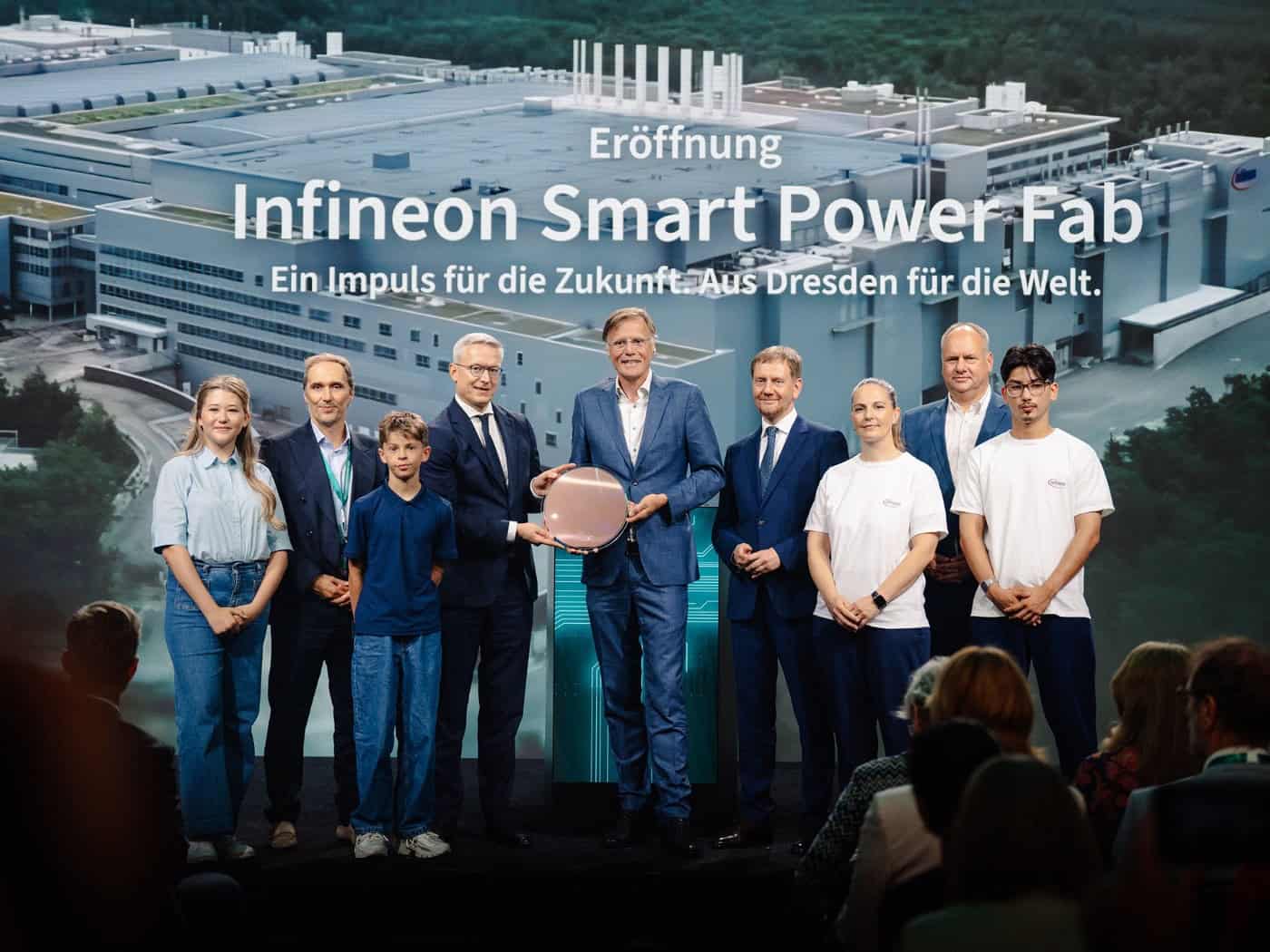
Dresden. Major German projects and meeting deadlines - that’s rarely a love story. This makes what Infineon celebrated on Thursday (July 2) in Dresden all the more remarkable: The semiconductor company opened its new Smart Power Fab - several months ahead of schedule. The plant cost five billion euros - the largest single investment in the company’s history -and it creates around 1,000 new jobs.
With the new facility, Infineon is doubling its production capacity in Dresden and, according to the company, now operates the world’s largest factory for so-called power semiconductors and analog/mixed-signal chips here. “We’re opening our new plant at exactly the right time,” said CEO Jochen Hanebeck.
What’s Being Produced at the Smart Power Fab
Behind the technical jargon lie tangible applications. Power semiconductors control and monitor current flows - they are the silent regulators in almost everything that needs to use energy efficiently. In the future, chips from Dresden will power AI data centers, operate in wind and solar plants, and be used in software-controlled cars. One example cited in the press release is smart switches that not only control loads but also monitor the flow of electricity. The interplay of these components gave the facility its name: Smart Power Fab.
Demand for these components is growing rapidly, primarily due to the insatiable appetite of AI data centers for electricity. Infineon is targeting precisely this gap- and aims to be fast enough with the new fab to actually meet the demand.
Planned Using a Digital Twin . and in Collaboration with Villach
The planning process itself was also unusual. A digital twin helped simulate the building and machine layout entirely on a computer before the first cleanroom was even built. AI algorithms support the approval of equipment and processes. And through the connection to the sister plant in Villach, Austria, production can be qualified as a “One Virtual Fab” more quickly than was previously possible.
The result: Infineon can ramp up production at twice the speed and respond flexibly to market opportunities. The fact that the factory went online ahead of schedule is seen by those involved as proof of Dresden’s reliability in high-tech projects -a reputation that gives the location a competitive edge.
A Political Showcase of Superlatives
Accordingly, the opening became a major public event. Chancellor Friedrich Merz, Saxony’s Minister-President Michael Kretschmer, and Digital Minister Karsten Wildberger were quoted offering praise and celebrated the fab as a signal for Germany as an industrial hub and for Europe’s technological sovereignty. Such superlatives are par for the course with a project of this size - and should be taken with a grain of salt.
More substantial than the political rhetoric is the impact on the region. More than 80,000 people already work in the “Silicon Saxony” semiconductor cluster around Dresden. According to studies, every single job in the cleanroom creates six more in the surrounding area - among suppliers, service providers, and skilled trades. The 1,000 new jobs are therefore only the visible tip of a significantly larger employment effect.
Sustainability as a Promise -Proof Is Still Pending
The company also emphasizes its frugal use of resources. The new production facility operates without natural gas, uses closed-loop systems, and is expected to 90 percent of its water; Infineon aims to recover up to 45 percent of the energy it uses. These are ambitious figures - whether the factory will actually achieve them in continuous operation remains to be seen in the coming years.
For now, the outcome is one that’s rare enough in Germany: a billion-euro project has not only been completed, but finished ahead of schedule. What this will mean—for the city, the region, and Europe’s chip ambitions - will be determined not by the opening day, but by the long-term operation that follows.

