


New methods to break down PFAS, the "forever chemicals"
Whether in a small village stream, a large river, or a lake – so-called “forever chemicals,” or PFAS for short, can now be detected almost everywhere in the environment. They hardly break down on their own and have already been detected in high concentrations in the Elbe River, for example. Some PFAS are suspected of promoting cancer or damaging genetic material. For many others, their effects on humans remain unclear. Researchers at the Helmholtz-Zentrum Dresden-Rossendorf (HZDR) have now developed two methods for selectively breaking down PFAS in the laboratory.
PFAS are among the most persistent chemicals in existence. More than 10,000 substances belong to this group. They owe their stability to the strong bonds between carbon and fluorine. As part of the National Water Strategy, the HZDR is searching for ways to remove them from water.
Breaking the stable bonds
A team led by postdoctoral researcher Ysabel Huaccallo-Aguilar is utilizing a physical effect in which tiny vapor bubbles form in water and collapse immediately. Experts call this hydrodynamic cavitation. The PFAS attach themselves to the bubbles. When these collapse in fractions of a second, extreme temperatures are briefly generated. This causes the stable PFAS molecules to begin breaking down.
In tests, the researchers degraded about 37 percent of the PFAS compound under investigation. This is not yet sufficient for practical application. “Our goal is to degrade more than 80 percent of the PFAS,” says Dr. Sebastian Reinecke, head of the Water and Environmental Technologies Department at HZDR.
Plasma breaks down PFAS almost completely
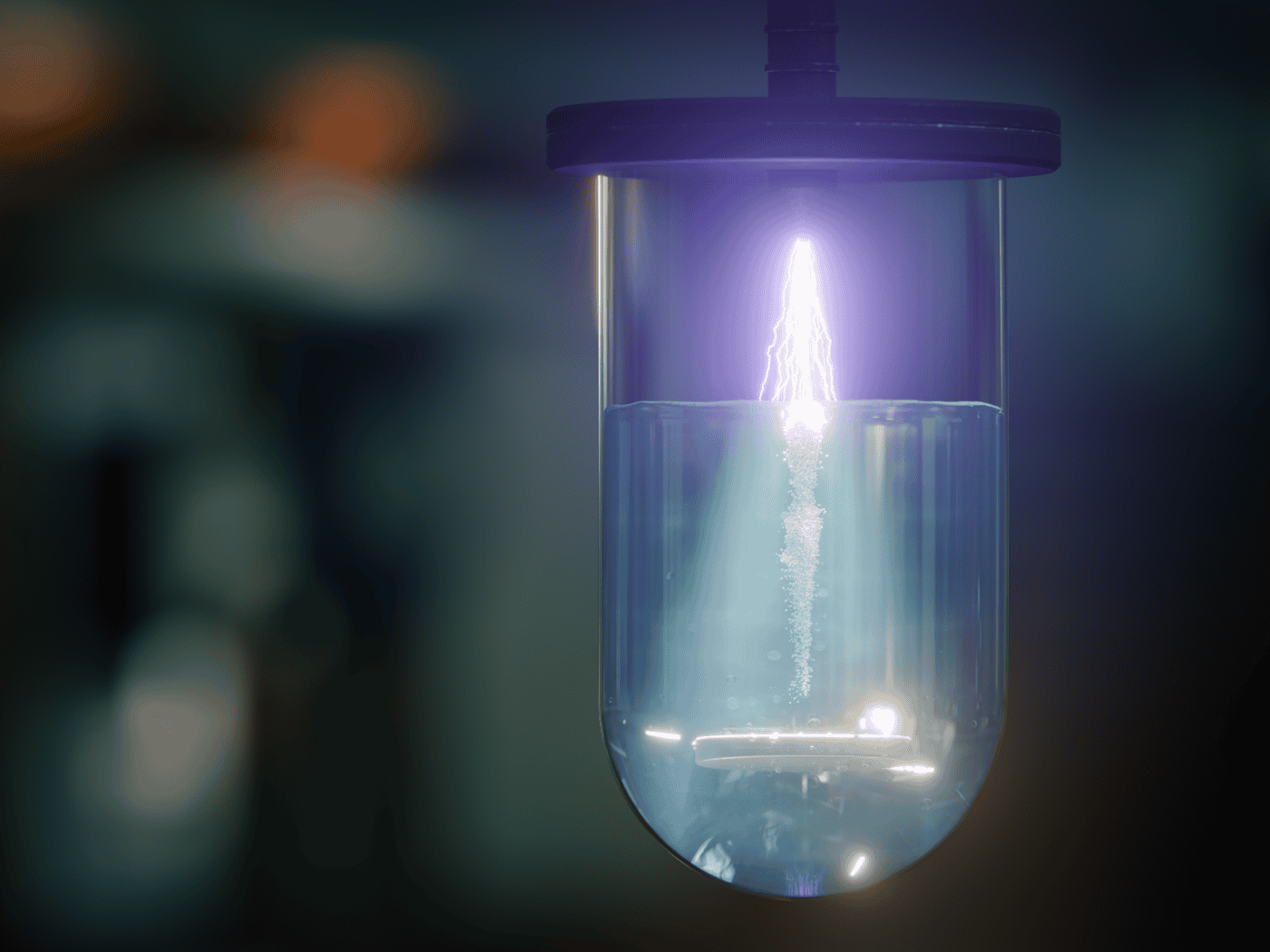
Postdoctoral researcher Dr. Amit Kumar is pursuing a different approach. He generates a cold plasma at the water’s surface. This is a type of high-energy gas containing highly reactive particles. At the same time, small gas bubbles rise through the contaminated water and carry the PFAS to the surface. There, the plasma attacks the chemicals and breaks them down.
In the experiment, the short- and long-chain PFAS under investigation were degraded almost completely. However, the process requires significantly more energy than cavitation. In addition, new substances are produced in the process, and it is not yet clear whether they are safe for human health.
Next, the team plans to combine both methods. “I think we’ll achieve high degradation rates if we combine the effects of plasma and cavitation,” says Reinecke. The Helmholtz Centre for Environmental Research (UFZ) confirmed the success of both methods. If the processes are further developed to market readiness, they could be used in industry in the future, thereby preventing PFAS from entering rivers and lakes in the first place.

