


Big Bang in the lab: Measuring the universe's first minutes
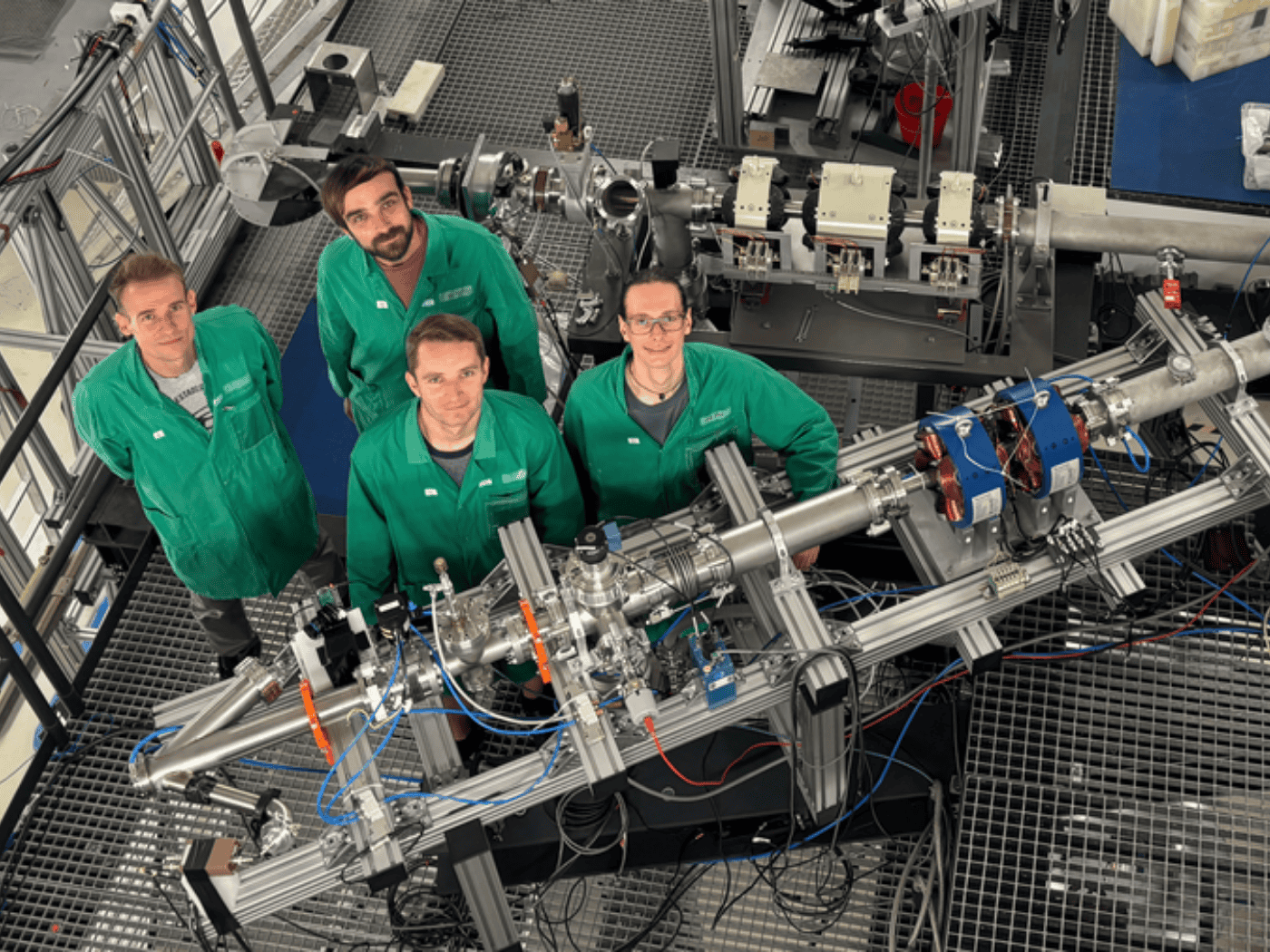
The universe came into being 13.8 billion years ago. Just a few minutes later, the first chemical elements formed. Researchers are still trying to figure out exactly how that happened. At the Technical University of Dresden (TUD), a new experimental facility is now set to help us better understand this earliest phase of the universe’s history.
Two nuclear reactions take center stage
Shortly after the Big Bang, hydrogen and helium were the primary elements formed. To this day, these two elements make up the majority of visible matter in the universe. Theoretical models already describe these first few minutes in great detail. However, sufficiently precise measurement data are still lacking for some crucial nuclear reactions. This is precisely what the Dresden research team hopes to provide.
Their work focuses on two reactions involving the hydrogen isotope deuterium. These reactions influenced the quantities of certain light atomic nuclei that formed shortly after the Big Bang. A better understanding of these reactions allows for a more accurate reconstruction of the early universe’s evolution. The measurements also help to better determine the amount of ordinary matter in the universe – the matter that makes up stars, planets, and even us humans.
New measurement line for a glimpse into the past
For their experiments, the researchers at the TUD’s neutron generator have set up a new measurement line, known as a beamline. It enables measurements in precisely the energy range relevant to the processes shortly after the Big Bang. The facility went into operation in June 2026. Shortly thereafter, the first successful measurements were made on specially developed samples.
This lays the foundation for further precision measurements. These measurements are intended to help us understand the formation of the first chemical elements even more precisely. At the same time, the results provide important data for improving models of the universe’s evolution.
The project is led by Steffen Turkat at the Chair of Nuclear Physics at the Institute for Nuclear and Particle Physics. The team also includes doctoral student Max Osswald and master’s student Frederik Uhlemann. Toralf Döring from the Helmholtz-Zentrum Dresden-Rossendorf (HZDR) assisted with the construction of the new measurement setup.

