


Armin Imgraben, Winzergenossenschaft Britzingen: Our "in" drink is sparkling wine!
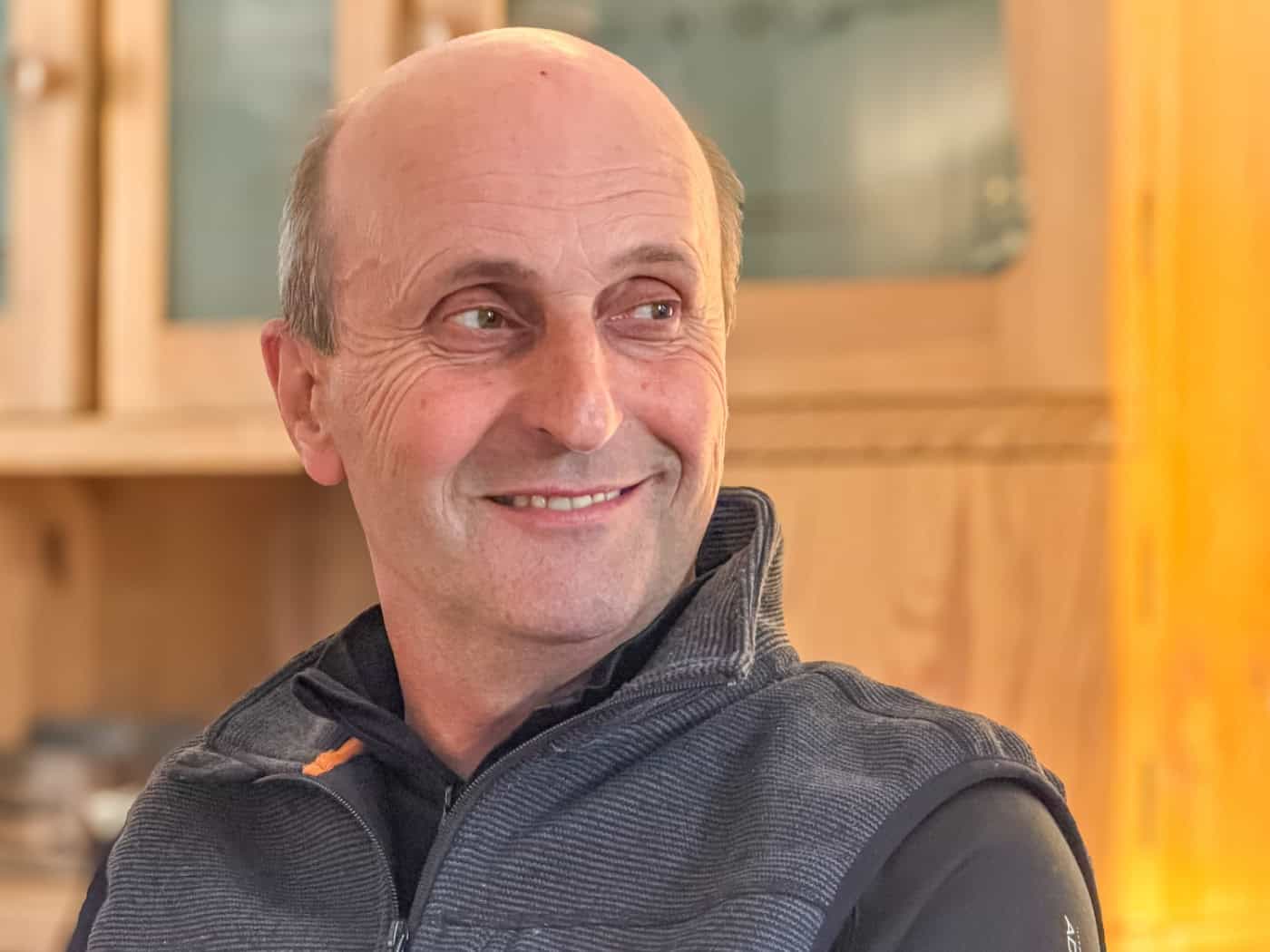


Others like mixed drinks with wine, but in the Markgräflerland the rule is: it should be a sparkling wine. There are several culprits (which is too harsh a word in this context, as you will see) - one of them is the winegrowers of the cooperative in Britzingen. Their sparkling wines have been around forever (since 1979, to be precise), but for the past three years they have been accepted into the Olympus of German traditional sparkling wine making - as the only winegrowers' cooperative among many individual sparkling wine makers. But in Britzingen, they don't just make sparkling wine (which now accounts for a 20% share, and rising), they also make normal wines. Chasselas, the bread-and-butter wine of Markgräflerland, of course, but also Burgundy - both white and red. Matthias Gräfe (Wein & fein) and Ulrich van Stipriaan (STIPvisiten) talk about all this (and much more...) with Armin Imgraben, winegrower and chairman of the board of the Britzingen winegrowers' cooperative.
Armin Imgraben is one of around 45 winegrowers in the cooperative, which is one of the smaller ones in Baden. Together with his family, he cultivates around six hectares of vines, including in Muggardt - the best site, which lay fallow for a long time and now provides the basis for the finest Pinot Noir through the joint efforts of four winegrowers. But as being a winegrower and chairman of the board does not keep Armin Imgraben busy, he is also active in other areas - for example in local politics or at the village shop cooperative. Imgraben describes himself as a "freelance artist" and says in conversation that he likes to enjoy a wine or two on the terrace in the evening...
The high proportion of main businesses in the winegrowers' cooperative is remarkable: around a dozen members work entirely in viticulture and are responsible for around 80 percent of the total area of 200 hectares. This structure enables a close link between viticulture and cellar management. They know each other, and the cellar master knows specifically which vineyards are suitable for certain qualities or selections. The payment of grape money consistently follows the quality - a mechanism that is understood within the cooperative as a central incentive for differentiated work in the vineyard.
Britzingen is located in the foothills of the Black Forest - the vineyards benefit from this with a transition from lighter loess soils to heavier loam structures, which enables a certain stylistic range. The characteristic single vineyards are Britzinger Sonnhole, Rosenberg and Badenweiler Römerberg. The climate poses similar challenges for the vineyards as in other parts of Baden: an increasing frequency of hot years, but also risks due to late frost, hail or dry periods. Accordingly, differentiated harvest management is becoming increasingly important, including targeted incentives for early harvesting in order to optimally control ripening processes.
Traditionally, Chasselas plays a central role in the Markgräflerland region. However, the variety is also considered to be comparatively susceptible to disease and has a relatively limited lifespan. Burgundy varieties last longer and are gaining in importance, while Imgraben considers Pinot Blanc to be the region's most important future variety. The cooperative also works with fungus-resistant varieties (PIWIs), although their market penetration is still limited and requires communicative mediation.
The cooperative is not a certified organic business, but is guided by the criteria of environmentally friendly viticulture. In the cellar and in sales, the focus is on a classic, more traditional style. Marketing takes place predominantly in southern Germany, with individual sales markets beyond, for example in northern Germany and Switzerland.
An important part of the product range is sparkling wine. Around 20 percent of production is accounted for by a total of around 15 different cuvées. The sparkling wine tradition dates back to 1979 and is closely linked to the long-standing cellar master Hermann Zenzen, who played a key role in its development. Today, the cooperative is a proud member of the Association of Traditional Sparkling Wine Makers.
In addition to classic bottle formats, the cooperative is also trying out alternative packaging. For example, Pinot Blanc is offered in a bag-in-box, which has met with a positive response both from a sustainability perspective and in terms of consumption situations - for example at leisure and outdoor events. In the podcast, we tasted the rosé and the Pinot Blanc from the Bag-in-Box. In the evening, we had more, which you can read about (including what you could eat with each)!
Some key points of the conversation
- [00:32] Our guest from Markgräflerland: Armin Imgraben from the Britzingen winegrowers' cooperative
- [14:59] Baden is the third largest winegrowing region (15.500 ha of vineyards)
- [21:51] Further development of the Piwis
- [31:54] Label: who is that on horseback?
- [36:10] New wine and new packaging (on request!): Pinot Blanc in a bag-in-box
- [45:06] how did the sparkling wine come about
Infos
[Recorded on April 1, 2026 before the press conference for BW Classics, which this year on April 18 and 19. April brings 40 winegrowers from the two growing regions of Baden and Württemberg to the Dresden Congress Center]
Winzergenossenschaft Britzingen Markgräflerland e.G.
Markgräfler Straße 25-29
D-79379 Müllheim-Britzingen
Tel. +49 7631-17 710
britzinger-wein.de

