

From Tradition to Experiment: How to Become a Stollen Sommelier
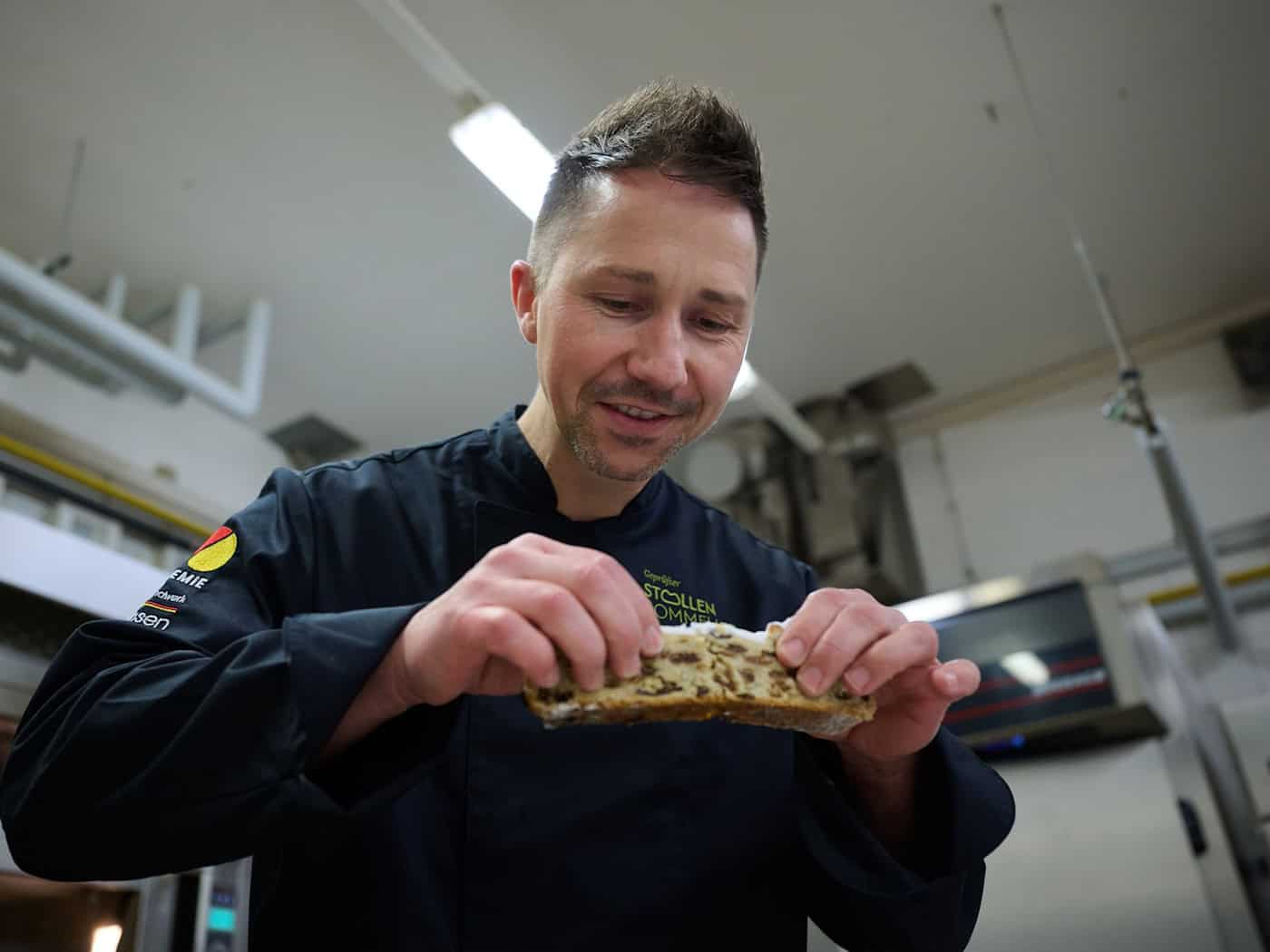
What does a good Stollen smell like? What flavors can you taste, and which drink pairs best with it? Master baker Alexander Schellenberger from the Ore Mountains has been deeply engaged with questions like these over the past few months. He is one of 17 participants in a Stollen sommelier training program at the Saxon Academy of German Baking in Dresden. According to the academy, this certification program is unique worldwide. Schellenbergers’ goal: to gain an even deeper understanding of this traditional Christmas pastry and to pass on his enthusiasm for it to future generations. “You never stop learning,” he says immediately after his oral exam. The training isn’t a requirement for his job, but rather a way to consistently improve his skills. “Tastes change, people change, and so do their habits.” Especially with a product that has a long history, he says, it’s important to preserve its significance and artisanal quality. He also wants to pass on his knowledge to the next generation and his customers. Schellenberger is the fourth generation to run a family business in the Ore Mountains. The bakery was founded in 1927. In addition to the traditional bakery, the family operates a stollen factory whose products are shipped throughout Germany and abroad. Since May, master bakers and pastry chefs from Saxony, Thuringia, Brandenburg, North Rhine-Westphalia, and Hamburg have been participating in five three-day training modules, reported school director André Bernatzky. The curriculum covered the history of the stollen, regional specialties, ingredients, and storage conditions, as well as artisanal production methods. A key focus was sensory analysis. Participants learned to systematically evaluate the pastry. “How does the Stollen look to me, what do I taste, what do I smell?” Schellenberger describes the process. First, the surface is examined; then, upon cutting into it, the distribution of fruit and almonds as well as the texture of the crumb are assessed. Next, the aromas are sniffed and tasted. Consistency is also crucial: as you chew, additional flavor notes can unfold. Finally, the focus is on pairing the stollen with beverages that complement or highlight its flavors. The Stollen sommelier training program concluded with the final module in Dresden. Three exam components awaited the participants: a theoretical exam, a practical exam, and the presentation of their final projects. During the practical exam, they had to identify flavor notes, among other tasks. The official certificates have not yet been issued. Schellenberger dedicated his final project to the influence of salt content on the flavor of a Saxon Bodenstollen. Salt influences how flavors are perceived. “My father always said that baking is a matter of luck, and my mentor always said that baking is a science.” For Schellenberger, it’s both: “Science and passion.” The Stollen sommeliers are intended to breathe new life into this traditional Christmas pastry, as school director Bernatzky reports. Hamburg participant Björn Demski demonstrates what that might look like. He developed a Franzbrötchen-Stollen that combines the North German baking tradition with the Saxon Christmas pastry. “I’m not trying to challenge the traditional Stollen with this,” says Demski. Rather, he sees his creation as a complement to a small market niche. Traditionalist Schellenberger isn’t averse to the experimental stollen: “It’s a good variation, but you can tell just from the basic texture—the dough is different from ours.” Copyright 2026, dpa (www.dpa.de). All rights reservedFrom Appearance to Aroma
New Ideas for the Stollen