


Hot, dense matter: Electrons behave differently than expected
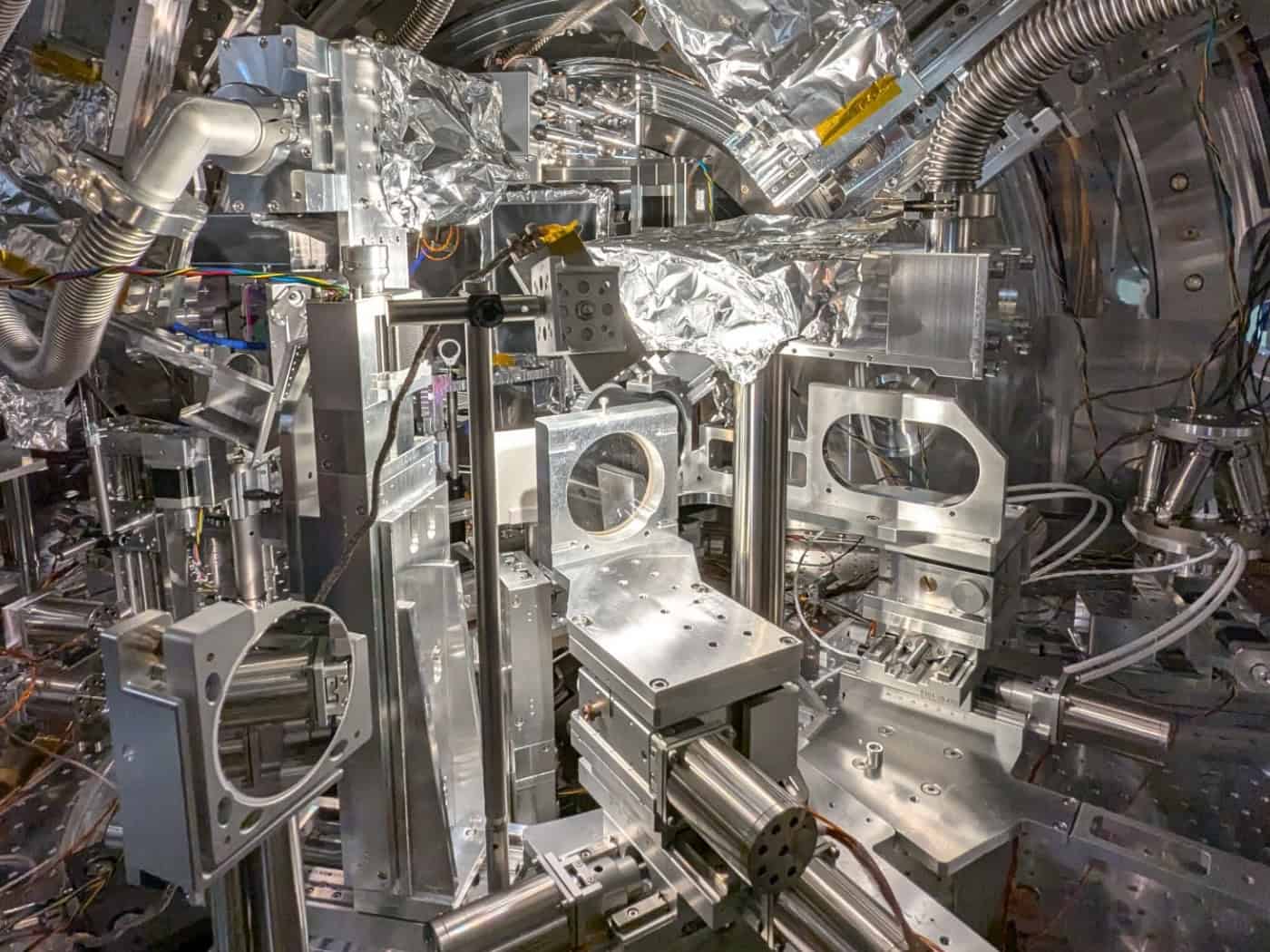
Electrons behave differently in extreme states of matter than previously assumed. This is shown by a new study conducted by researchers at the Helmholtz-Zentrum Dresden-Rossendorf (HZDR), the European XFEL, and other partners. The findings could help us better understand the interiors of planets and advance research on nuclear fusion.
Aluminum Under Extreme Conditions
At the European XFEL near Hamburg, the world’s largest X-ray laser research facility, the researchers compressed a thin aluminum foil to 500,000 times normal atmospheric pressure and heated it to nearly 7,000 degrees Celsius. This created what is known as “hot dense matter,” a state of matter found inside large planets or in nuclear fusion experiments.
Hot dense matter is difficult to study. Researchers therefore use X-ray experiments and computational models to describe the behavior of electrons. Among other things, these determine how a material conducts heat and electricity or reacts to radiation.
However, the newly published study shows that many models used to date do not accurately capture important properties of the electrons. The measured values deviated from the predictions by up to 25 percent.
Implications for Planets and Nuclear Fusion
“Even in the case of aluminum, which is often regarded as a simple metal, the electron response cannot be adequately described by overly uniform models once the material is placed in this extreme state,” says lead author Dmitrii Bespalov. “Only when we take the actual disordered structure into account do theory and experiment agree.”
The solution came from significantly more detailed computer simulations. They account for the actual arrangement of the atoms and their interactions with the electrons much more accurately than previous approaches. These findings help describe the conditions inside planets more precisely. They are also relevant to fusion research.
In nuclear fusion, atomic nuclei fuse together, releasing large amounts of energy – similar to what happens in the Sun. Researchers hope to one day harness this energy for climate-friendly electricity generation. More accurate models could help evaluate such experiments more reliably in the future.
Original publication:
D. S. Bespalov et al.: Momentum-Resolved X-Ray Thomson Scattering Benchmark of Electronic-Response Models in Warm Dense Aluminum, in Physical Review Letters, 2026

