


Schmiedelandhaus Greifendorf: When sparks fly between country bumpkins and men's chocolate
So they can do ambience in Greifendorf! And just from reading the menu for the cooking star menu, you could tell that (sorry, Greifendorfers) here in the middle of nowhere, they've been thinking outside the box in culinary terms - and have been doing so since 2011. What makes the menu special even before you start enjoying it is the openness communicated: every course (apart from dessert - which is never served with fish or meat 😉 ) is provided with a well thought-out vegetarian option, and every wine with alcohol is accompanied by one without as an alternative (another exception here: everyone is offered Jörg Geiger's organic red Prisecco 0/0 with apple, chokeberry and meadowsweet as an aperitif). That's how it should be!
Aronia is not one of my favorite flavors, but obviously it's like the toddler-spinach pairing: you should try it every now and then. However, the chokeberry component in the complex Prisecco is so skillfully married with other fruits and herbs that the cuvée tastes extraordinarily good to me - and I had a similar experience with the bread that the service brings to the table first: a chokeberry farmer's bread, slightly warm with a fluffy crumb and grateful for the salty butter and a strong herb, pepper and salt mixture.
The first course was tarragon foam soup plus sour cream - and depending on the choice of "with" or "without", the flavorful garnish consisted of trout or eggplant caviar. As an eggplant has no eggs, but the appearance was much closer to trout caviar than to the popular oriental-spiced spread, we puzzled for a moment: how did he do it (alternatively: where did he buy it)? But we quickly gave up the search for an answer, because when this eggplant caviar also had a slightly crunchy bite, we summed it up simply and unprofessionally: crazy! The soup, from which we were distracted by the caviar arrangement on the edge of the plate (there was more of it on the sour cream with the soup), was then just right.
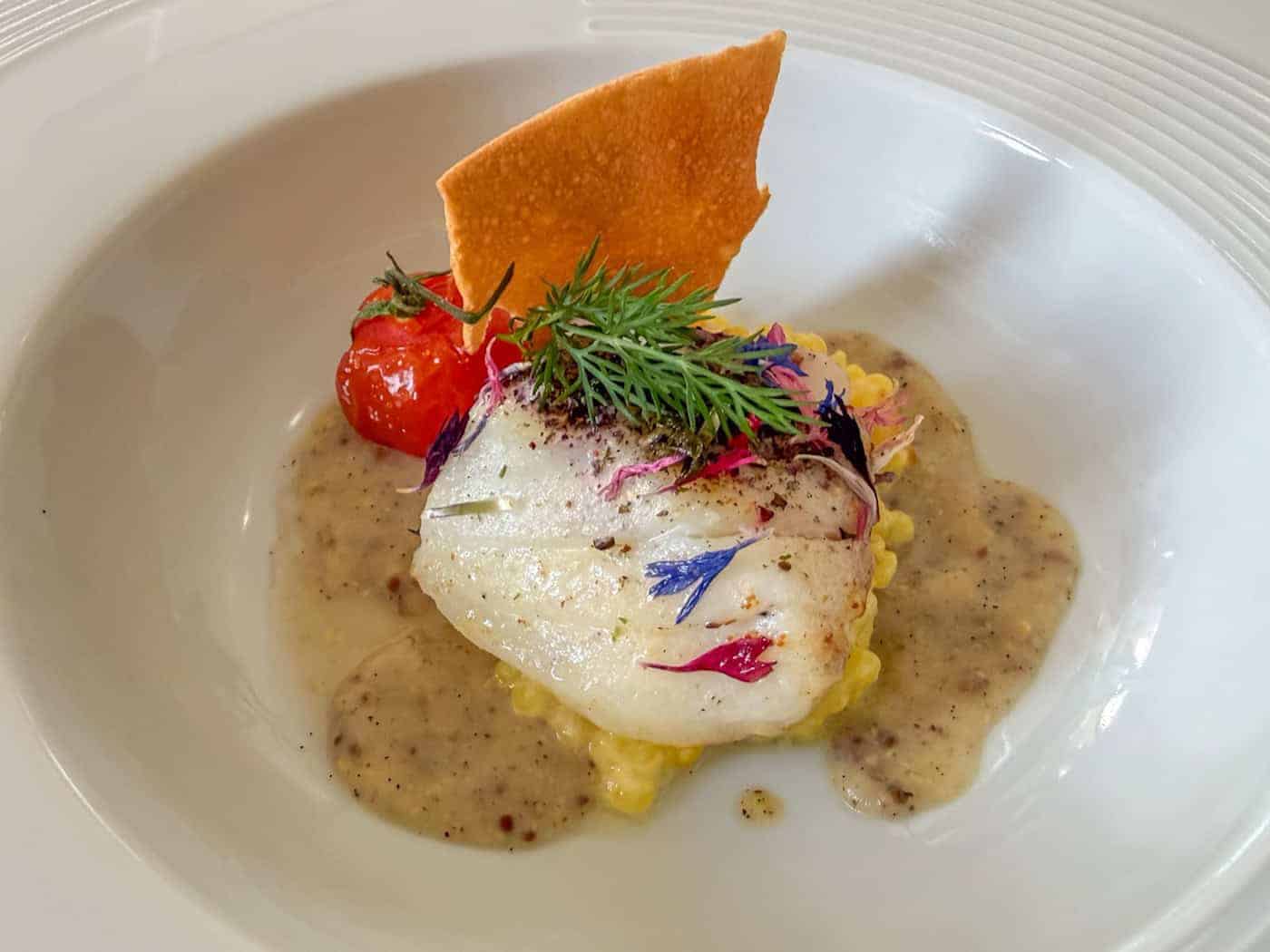
When it came to the intermediate course, was it cod or poached country egg? How good that there were two of us and we could compare, how stupid that even after the comparison, no variant could be chosen as the winner because both were good. So: the fish was juicy and served as a lump that resembled an egg in shape. Topped with small, colorful flowers and - if I'm not completely mistaken - the pepper and salt mix from the bread selection. Well, you don't really do such repetitions, but the taste was just right. The egg also turned out to be perfectly cooked to perfection, the yolk flowed out after opening and enriched the sauce. Barley risotto as a side dish was not new to us, but is always surprisingly good (if cooked as correctly as we had received it).
Our best alcohol-free wine to date
The wine accompaniment to the two courses (with refills on request...) not only provided us with "the gentleman of the range" from the Styrian winery Muster.Gamlitz, as Markus Zurk had put it in our podcast "Auf ein Glas" for the Pinot Blanc with its subtle balance, but also the best non-alcoholic wine tasted this year: the Komma nix Cuvée weiß from the Franconian winemaker friends of "Frank&Frei" (explained here). Müller Thurgau, Bacchus, Gewürztraminer, Muskateller and Riesling are in it - and finally, finally, a dealcoholized wine doesn't taste like jam, but like wine! Perhaps it's due to the typical Franconian residual sugar: it's always as low as possible - and here it's 28 g/l (where others can easily offer twice as much - of course always legally correct on the label in the indication per 100 g, where the figure here is now Franconian dry under three: 2.8 g).
The main course came with braised roots, caramelized pearl onions and marsala sauce, accompanied by stuffed squab or a stuffed cabbage, depending on how you feel and taste. Visually, both dishes resembled each other again - but (unfortunately) there were also many similarities to the previous pattern. We knew the large blue flower on top from the soup, the many colorful small flowers from the intermediate course - as well as the cocktail tomato and the hippe from the preparation arsenal were familiar. Odds and ends? Perhaps. But barley risotto again (as a filling for the cabbage) was a little unimaginative, as there are more options for such an experienced chef. The disappointment eased a little when we tried it, because the sauce was particularly great and the squab - if you like that sort of thing - had a variety of flavors, because it wasn't just the breast that was served. This time, the choice of wine was clearly in favor of the "mit": Pia Strehn from Deutschkreutz in Burgenland (not Styria, as printed in the menu...) is actually the rosé queen of Austria, but she can also do red: her Blaufränkisch is a simple wine, but nevertheless one with a beautiful fullness and texture that accompanies the food with a velvety smoothness. Just right for a Sunday (afternoon) lunch. The Sangre de Toro from Torres is produced on one of the best (and most expensive) dealcoholization plants in Europe - but overall, in terms of mouthfeel and depth, the red wines are even less close to the pleasure of wine than the whites. So in such cases, proxy solutions with a real zero point (because it's never been wine) are usually the more attractive ones...
Men's chocolate on Women's Day?
For dessert, the groundhog greeted us again in the form of small flowers on the edge of the plate and large flowers on top of thousand-leaf cake and men's chocolate along with the odd chokeberry. Because we didn't want to make a fuss about the blossoms (can blossoms be peanuts? Exactly!), the beautiful term 'men's chocolate' gave us something to talk about on this International Women's Day. Because the answer to the question of how sexist chocolate can be is far too little known. Because her dissertation, which has become a book, costs almost €70, I didn't want to look to Monika Setzwein for the answer ("Ernährung - Körper - Geschlecht: Zur sozialen Konstruktion von Geschlecht im kulinarischen Kontext"), but decided to consult my own experience. After all, isn't it the case that only marketing brains believe that men (or even "gentlemen") would rather eat dark chocolate than women? In reality, we all experience in everyday life that women are the more sensible ones and find this whole milk nut rather unhealthy, which is why they reach for the bar with the high cocoa content.
Reconciliation - even with the dessert details strawberry and fig, which are not obvious for February/March - and a return to the region brought the herbal liqueur to a close. It's called Striegi, which is very cute for the Striegi Valley, where the 18 different herbs, roots and spices in the liqueur come from - "mostly from our own herb garden", as I read from the producer. Just like the aronia berries, I thought to myself: that's what the service had told us, and we thought: yay, that's how slow food works: as close as possible!
Menu
- Aronia farmhouse bread | salted butter
- Foam of tarragon soup | sour cream | trout caviar
OR
Foam of tarragon soup | sour cream | eggplant caviar - Codfish | barley risotto | vanilla & Mustard
OR
Poached country egg | barley risotto | vanilla & Mustard - Stuffed squab | braised roots | caramelized pearl onion | marsala sauce
OR
Stuffed cabbage | braised roots | caramelized pearl onion | marsala sauce pearl onion | marsala sauce - Thousand leaf cake | men's chocolate | aronia berries
Wine accompaniment
- Aperitif Jörg Geiger Prisecco 0/0 organic red: Apple - Aronia - Meadowsweet
- 2022 Pinot Blanc, Weingut Reinhard Muster, Illyr, Southern Styria (Austria)
OR
Komma nix Cuvée white "Frank&Frei", Baldauf, Franconia - 2021 Blaufränkisch, Pia Strehn, Burgenland, Austria
ODER
Sangre de Toro Red 0/0, Miguel Torres, Catalonia, Spain - Spirit from Rose Valley (2cl) or an Espresso Greifenberry
OR
Espresso Greifenberry or a coffee specialty of your choice
Info
- Menu 75 € | incl. beverage accompaniment drinks included 101 €
Schmiedelandhaus Greifendorf
Doebelner Str. 19
09661 Rossau / OT Greifendorf
Tel. +49 37207 99288
schmiedelandhaus.de
[Visited on March 8, 2026]

